
Geospatial Support for Atrocity Accountability Act
Last updated 05:24 PM EDT • Read time: 4m
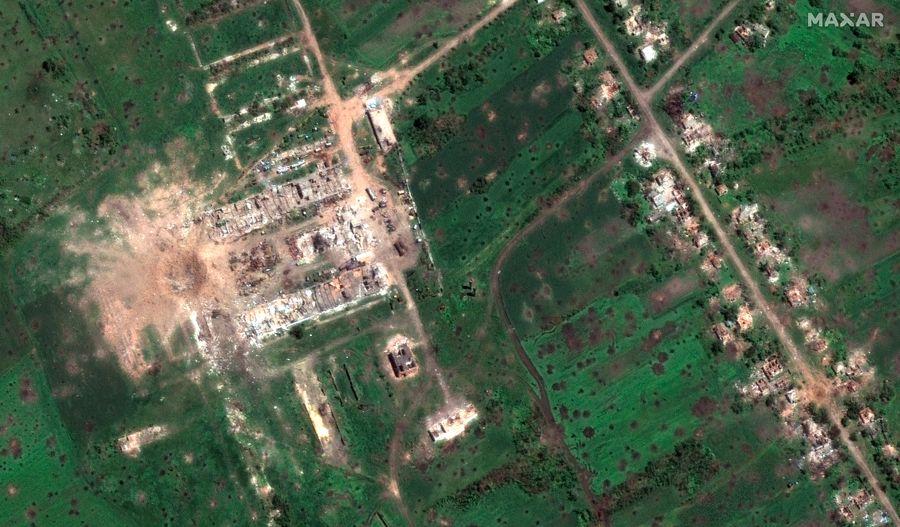
The world has witnessed the horrifying civilian atrocities Russia has committed against Ukraine, and leaders across the West have rightfully called for Putin and his military leaders to be held accountable for their heinous war crimes. Ukrainian civilians’ tragic suffering reminds us of the horrors of war and the catastrophic consequences of Russia’s blatant disregard for civilian life, and the laws of armed conflict under the 1949 Geneva Convention. The United States has the capability and capacity to bring these heinous, ongoing acts in Ukraine—and other atrocities—to the center of the world’s attention.
My current Congressional Defense Fellow, Sergeant Major Andrew Brown, previously served with the Defense Attaché Service in Sarajevo, Bosnia and Herzegovina (BiH). During that time, he worked with members of a missing persons working group that included representatives from the International Commission on Missing Persons (ICMP), Bosnian missing persons agencies, various Bosnian police agencies, and prosecutor’s offices to locate clandestine mass grave locations. With approximately 8,000 persons still missing from the 1992 – 1995 Bosnian War, the group identified the need for greater sharing of intelligence and mass grave location data. Sergeant Major Brown’s task was to corroborate location data with archived geospatial imagery analysis and uncover additional gravesites.
However, challenges of distrust between organizations and the lack of central authority or leadership from the BiH government had to be overcome to secure accurate mass grave data. Determined to bring closure to the many Bosnian families, Sergeant Major Brown and a group of dedicated geospatial analysts worked tirelessly to attain the imagery needed to unearth the missing and provide evidence of war crimes. Eventually, there were breakthroughs.
Thanks to successive hits from archive imagery, the team utilized unclassified commercial imagery with the outline of potential mass graves and confirmed the size and dimensions of the largest post-World War II mass grave in Europe. The joint effort was a resounding success and demonstrated that archived, classified imagery and recent commercial geospatial imagery could successfully assist in decades-old human rights and war crimes investigations.
There were numerous other examples where geospatial imagery led to excavations of. Forensic evidence, which was included at the trial and conviction of Radko Mladić at ICTY in 2015 on multiple charges, including genocide. Also, in 2016, imagery located another grave in Kozluk, from which forensic evidence assisted in the successful genocide conviction of Srećko Aćimović in 2020.
Protecting human rights and preventing war crimes has been foundational to the United States’ foreign policy, and our government agencies already maintain offices to prevent mass atrocities and genocide. However, there is more to do to strengthen these offices’ ability to execute their missions. The State Department’s Atrocity Warning Task Force (AW-TF), in particular, can benefit from the fusion and analysis of geospatial intelligence from the Department of Defense and Intelligence Community. This should not be difficult to deliver. We must build upon the efforts provided by the Elie Wiesel Genocide and Atrocities Prevention Act of 2018, break down the silos of intelligence across the government, and enable the Secretary of State to receive and provide the AW-TF with the latest geospatial intelligence that may provide evidence of war crimes and mass graves.
I recently introduced the Geospatial Support for Atrocity Accountability Act to enable the State Department to obtain geospatial imagery and share it with international partners like the ICMP, international courts and tribunals, and local civil society to locate the missing and, similar to Bosnia, provide the evidence to tribunals and bring perpetrators to justice.
As the world searches for the tools to help the people of Ukraine, the United States has an opportunity to act. We can leverage U.S. technological advantages and near-global coverage of satellites and aerial platforms to document crimes and send a message to perpetrators that we are watching and will hold them accountable. War criminals like Vladimir Putin should look to those who came before them, like Ratko Mladić and Radovan Karadžić, to understand their crimes will not be forgotten and that justice will prevail.
Rep. Elise Stefanik represents New York's 21st District in the House of Representatives. She is a member of the House Armed Services Committee, the Committee on Education and Labor, and the House Permanent Select Committee on Intelligence.
Don’t Be Swayed by Tactical Nukes
By Benjamin Giltner • RealClearDefense
How Seoul’s Break With Kyiv Serves Trump’s Russia Turn
By Sang Won Pyo • RealClearDefense
When the Grid Goes Down, the Mission Must Go On. Solar and Storage Can Help.
By John Szoka • RealClearDefense
Data and Communications Technology are the Hidden Keys to Success for Golden Dome
By Eric Velte • RealClearDefense
The Dual Threat: Why Beijing’s Collapse Is Just As Dangerous as Its Rise
By Efraín Vázquez-Vera • RealClearDefense

USS Stout Loses Power During Port Visit Due to ‘Engineering Casualty’
By USNI News
Air Force Lessons Learned From Operation Epic Fury
By Tabitha Reeves, National Defense
Marines Need Nine More Amphibious Warships To Carry Out Its Missions
By TWZ
AFRL, ACC Fly XQ-67A Drone To Test Autonomous Teaming
By Airforce Technology
F-35B Releases Meteor BVRAAM for the First Time
By Parth Satam, The Aviationist