
The Influence of Elite Support on Insurgency
Last updated 06:51 AM EDT • Read time: 11m
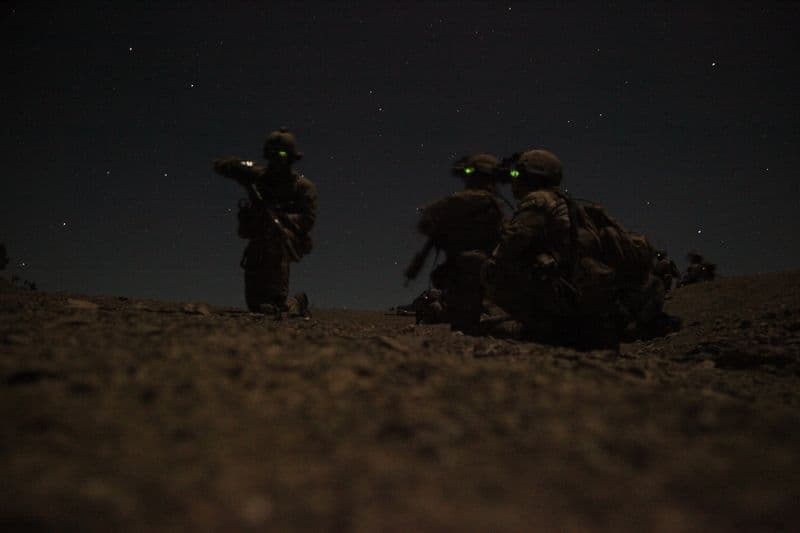
Photo: Members of a combined Afghan and coalition security force maintain security during an operation in search of a Haqqani network facilitator in Sarobi district, Paktiya province. The facilitator provided safe havens, money and supplies to network leaders throughout the region. (Department of Defense photo by U.S. Army/Released)
“Insurgency cannot succeed without outside assistance.”
Learning to Eat Soup with a Knife, John Nagl
Martha Crenshaw speculated that “Perhaps terrorism occurs precisely where mass passivity and elite dissatisfaction coincide.” (Crenshaw, 2011) The ‘Elites’ in Crenshaw's statement refer to the support of powerful outside actors, typically tribal, state, or individual, while the mass passivity is the lack of action by potentially opposing elite actors. I hypothesize that, while the groups discussed in this paper operated prior to receiving elite support, their ultimate success was dependent on that support.
The three example groups examined are complex and often blur the lines between categories but largely fit into either religious, nationalist, or ideological motivations. In this paper I contrast operations before and after ‘Elite’ support, detail ‘Elite’ actors, and examine the phenomena where the ideology of the insurgent group may differ greatly from those of the supporting ‘Elites.’ I also examine the insurgent group’s status today and the environment of mass passivity in which each group operated.
Group 1: Fundamentalist Islamic Party (HIK)/The Haqqani Network
The Haqqani Network is a mostly Zadran Sunni extremist group (Coll, 2019) based in eastern Afghanistan and western Pakistan. Founder Jalalludin Haqqani, rose to prominence in Hezb-e Islami (HIK) under commander Younis Khalis, later becoming one of Usama bin Laden’s formative mentors (DNI, 2024). The Network has risen to power in Afghanistan twice, in the 1990s (Coll, 2019) and in 2021 after ISAF withdrawal. Today, while aligned with the Afghan Taliban, the Network remains a distinct organization.
The Network’s roots date to the 1978 Saur Revolution and Islamic Traditionalist resistance to the Marxist/Atheist Democratic Republic of Afghanistan (DRA) (Barfield, 2010). Initially local and self-supported and lacking unified command. Their equipment was crude, often 1930s-era rifles like the SMLE, and even, in one documented ambush of a DRA convoy, the Afghan Jezail black powder rifle. (Jalali, Grau, 2010) Despite these limitations HIK and the greater Mujahedeen were successful enough to provoke a Soviet invasion 1979 (Barfield, 2010), displacing over 4 million people.
Post invasion, expansion of DRA/Soviet counter insurgency operations forced Mujahideen to seek support. This ‘Elite’ support would come from substantial (~1 billion annually) Saudi/American funding and a joint CIA/Inter-Services Intelligence effort (Coll, 2004) (Vickers, 2023). The impact is best exemplified by the Zhawar One base in Afghanistan’s Paktika Province, a mountain complex 4 miles from the Pakistani border connected by road to the Pakistani resupply base in Miran Shah. (Jalali, Grau, 2010) Located safely in Haqqani/Zadran tribal lands, the base became a destination for ‘war tourists’ like US Congressmen. While Zhawar One was ultimately destroyed in a Soviet attack (Vickers, 2023) these visits increased aid and helped Haqqani build influence, with the Network eventually superseding HIK. Leveraging ‘Elite’ support meant that the large-scale displacements that occurred elsewhere during the Soviet-Afghan war and Afghan-American war largely did not occur in the Zadran tribal areas (Jalali, Grau, 2010). Ultimately, The Network would successfully repel not only the Soviets from Afghanistan but also ISAF 30 years later earning a terror designation (DNI, 2024).
Without the influence of ‘Elites’ Haqqani would never have been able to leverage his role in the Soviet-Afghan war into The Network. Notably, while the Americans and the HIK/Haqqani Network held starkly differing ideologies, these differences caused very few problems, with HIK and later The Network received direct support into the 1990s, CIA even providing captured Iraqi weapons and equipment for use in 1991-2 (Coll, 2019.) Relations remained cordial enough that a series of interviews were conducted by an American military officer with leaders of The Network in 1995 (Grau, 1996).
Throughout its existence The Network has benefited from mass passivity in the form of both the internal Afghan population’s tolerance of Haqqani domination of the Zadran region, and the international community’s disinterest in anything beyond superficial engagement. It is important to note, however, that the progression of the Network to a position of power was not entirely linear. Experiencing significant losses and hardship during the first two decades of the 21st century, the Haqqani Network was able to survive and become a major force in the Taliban-led de facto Afghan government.
Group 2: Kosovo Liberation Army (KLA)
The KLA was the armed wing of the International People’s Movement of Kosovo (LPK), a Marxist-Leninist organization founded in 1982 among Kosovo Albanians in support of a unified Kosovo-Albania, after the death of Josip Brotz Tito. Early incarnations of the KLA were loosely affiliated local militias nominally aligned with the LPK. Initially during the conflict, the KLA procured arms either through local police forces or – in the case of the precision rifles that made the movement infamous – private collections (West, 2008). As the Albanians in Kosovo became more active against Serbian rule, the KLA became more organized and effective (Sullivan, 2004). Despite initially limited resources, the impact of KLA operations was profound – to the point that modern insurgent sniper tactics are largely credited to KLA operations (West, 2008).
As the war progressed the KLA drew the support of Albanians in diaspora, notably Florin Krasniqi, a Kosovo-Albanian who had immigrated illegally to the United States in 1988 to avoid ethnic persecution. Krasniqi owned a successful roofing business in Brooklyn, New York, and was cousin and close confidant of Xhevdet Krasniqi, a founding commander of the KLA. Through his domestic fundraising efforts, Krasniqi raised more than 30 million dollars for the KLA between 1998-99, at one point arriving at a fund-raising event with empty duffel bags that were then filled with cash over the course of the evening (Sullivan, 2004). Krasniqi was also skilled at logistics management. Reportedly arranging the purchase of surplus NYPD body armor and transferring more than 100 M82a1 rifles through Swiss airports by claiming they were for elephant hunting, going so far as to obtain actual permits from Zimbabwe (West, 2008). While operational prior to Krasniqi’s support, the network of ‘Elite’ donors in the Albanian-American community was crucial to KLA effectiveness.
While Florin Krasniqi and the American Albanians were largely capitalists, the majority having fled the Communist Hoxha government to the US, the KLA remained Communist. This ideological difference would cause Krasniqi to break with the KLA in favor of leveraging NATO intervention in Kosovo (Sullivan, 2004).
In this case the ‘Elite’ actors came in two forms: first, Florin Krasniqi’s Albanian-American charity networks and second direct intervention by the US and NATO. The mass passivity is more complex. UN complicity during the siege of Sarajevo stands as possibly the worst example of the danger of mass passivity in recent history. With the UN enforced cordon at the international airport becoming a de facto part of Serbian lines, denying civilians escape from the large-scale artillery and sniper campaigns being waged in the city.
In the aftermath of the war the KLA lost its ‘Elite’ support and has since largely faded away, ceasing combat operations in the late 1990s and disbanding in 2013 after merging with the Center Left LVV. The catalyst for this outcome was, ironically, the same NATO intervention Krasniqi caused.
Group 3: Zimbabwe People’s Revolutionary Army (ZIPRA)
ZIPRA was a Communist revolutionary organization operational during the Rhodesian Bush War/Zimbabwe War of Liberation in the 1960-70s. The result of an ideological split within the Zimbabwe African People’s Union (ZAPU) in 1963, (Bhebe, Ranger, 1995) ZIPRA was formed as a militant wing across multiple ethnicities and tribes. With the goal of majority rule through guerrilla insurgency. Intentionally targeting civilian infrastructure “…targets such as post offices, communications nodes, electricity supplies…” (Bhebe, Ranger, 1995).
ZIPRA started as a small-scale operation with limited success and even less notoriety. Although it would, officially, be the first direct action African Nationalist group, 1965 cross boarder attacks beating the Zimbabwe African National Union’s militant ZANLA by over a year (Bhebe, Ranger, 1995). The use of primitive equipment and lack of tactical training made the attacks ineffective (Bax, 2013).
By the 1970s things had changed, ZIPRA’s parent organization ZAPU gaining support from three different sources: First, joint operational support from South Africa’s African National Congress (ANC) in response to South African government presence in Rhodesia (Bhebe, Ranger, 1995). Second, through association with FRELIMO in Mozambique. Finally, material support was gained from the USSR (Bax, 2013) and advisory support from Vietnam was gained through nominal acceptance of Communist ideology (Bhebe, Ranger, 1995). ‘Elite’ support would bolster the operational capability allowing ZIPRA to recruit military-aged males (19-24) from refugee camps in neighboring nations (Bhebe, Ranger, 1995), and turn international opinion against minority-rule in Rhodesian. This international opinion proved essential to nationalist success. With British spies inside Rhodesian intelligence supporting insurgent operations, even informing a rebel leader of a bomb planted inside a microphone, preventing assassination (Balaam, 2014).
African Nationalist forces including ZIPRA are unique in their ‘Elite’ support. Few Cold War-era groups would receive assistance from such diverse benefactors. With British, Soviets, Vietnamese, and tribal groups, all working in support despite conflicting ideologies. The mass passivity in this case occurred primarily in the population of Rhodesia itself. The country saw a mass exodus of its minority population, disproportionately educated white dual citizens, because of Nationalist successes. This mass migration caused a feedback loop of economic decline and worsening security (Bax, 2013).
While the minority-ruled Rhodesian government would fall, it was Robert Mugabe’s Zimbabwe African National Liberation Army that took power in 1980, not ZIPRA (Bax, 2013) dismantling both organizations.
Conclusion
The examples here fit neatly into the model established by the speculation “Perhaps terrorism occurs precisely where mass passivity and Elite dissatisfaction coincide,” (Crenshaw, 2011). This paper’s core assumption, that “insurgency cannot succeed without outside assistance” (Nagl, 2005) also fits the examples, providing an effective framework for assessing each organization’s operations and the benefits they received from ‘Elite’ support. In each case ‘Elite’ support increased operations capability and recruitment, most dramatically in the case of the Haqqani Network which, in less than 15 years, moved from black powder rifles to tanks. But no less crucially for the KLA, where US intervention and elites in diaspora halted Serbian ethnic cleansing of Kosovo Albanians. ZIPRA, despite losing to ZANLA, achieved the objective of majority rule. In these cases, an interesting pattern emerges with support depending on commonality of opponent rather than ideological values. Supporting ‘the enemy of my enemy’ regardless of long-term partnership viability.
Though this framework is useful, and the chosen examples fit, it cannot be applied universally, insurgencies often succeed without exterior ‘Elite’ support. Additionally, ‘Elite’ support can be a double-edged sword – Taliban patronage resulted in significant losses for The Network and forced its leadership from national power into exile for nearly 20 years. In identifying potential sources of support, it is important to consider the opportunity cost an organization incurs when accepting the support of specific ‘Elites.’
Adam Reilly is an Air Traffic Manager and Controller with experience in everything from day-to-day aviation to emergency airlift, disaster response, UAS, and combat operations support. His career spans multiple countries, continents, and conflicts in austere conditions. In his spare time, he reads books and likes to wax philosophical about low intensity conflict and practical logistics.
References
Balaam, Andrew (2014) Bush War Operator: Memoirs of the Rhodesian Light Infantry, Selous Scouts and beyond
Bax, Timothy (2013) Three Sips of Gin: Dominating the Battlespace with Rhodesia's Elite Selous Scouts
Barfield, Thomas J. (2010) Afghanistan: a cultural and political history
Bax, Timothy (2013) Who Will Teach the Wisdom: Lining with the Tribes
Bhebe, N. & Ranger, T. (1995). Soldiers in Zimbabwe’s liberation war.
Coll, Steve (2004) Ghost Wars: The Secret History of the CIA, Afghanistan, and Bin Laden, from the Soviet Invasion to September 10, 2001
Coll, Steve (2019) Directorate S: The CIA and America’s secret wars in Afghanistan and Pakistan
Council on Foreign Relations (2024) www.cfr.org/article/pakistans-support-taliban-what-know
Director of National Intelligence (2024) www.dni.gov/nctc/groups/haqqani_network.html
Hovey, Graham (1979) www.nytimes.com/1979/10/16/archives/us-hopeful-on-rhodesian-talks.html
International Crisis Group: Kosovo's long hot summer (1998) www.refworld.org/docid/3ae6a6d41c.html
JSTOR (Byrd Amendment) www.jstor.org/stable/20671758
Jalali, Ali Ahmad and Lt. Col. Grau, Lester W. (2010) The Other Side of the Mountain: Mujahideen Tactics in the Soviet-Afghan War
Lt. Col. Grau, Lester W. (1996) The Bear Went over the Mountain: Soviet combat tactics in Afghanistan
Nagl, John A. (2005) Learning to Eat Soup with a Knife (updated)
Ramzy, Austin (2017) www.nytimes.com/2017/11/15/world/africa/zimbabwe-mugabe-coup.html
Rich, Spencer and Frevendel, Jane (1977) www.washingtonpost.com/archive/politics/1977/03/16/rhodesian-chrome-embargo-restored-in-senate-massive/
Smith, Jeff M. (2021) warontherocks.com/2021/11/the-haqqani-network-afghanistans-new-power-players/
Sullivan, Stacy (2004) Be Not Afraid, for You Have Sons in America: How a Brooklyn Roofer Helped Lure the U.S. into the Kosovo War
Vickers, M. G. (2023) By all means available: memoirs of a life in intelligence, special operations, and strategy
West, John (2008) Fry the Brain: The Art of Urban Sniping and its Role in Modern Guerrilla Warfare
The Services Do Not Need a Four-Star Autonomous Warfare Command
By Steven Wills • RealClearDefense
Honor Them While There Is Still Time
By Jeffrey Rosales • RealClearDefense
From Siberia to Fairford: How Operation Spider’s Web Has Changed the Rules of Airpower
By Frank A. Rose • RealClearDefense
Faster Simulations, Better Defense Decisions
By Rut Lineswala • RealClearDefense
Will HASC Have an Oversight Subcommittee in the Next Congress?
By Christopher J. Bright • RealClearDefense
Hegseth Barred Trans Troops. Military Boards Are Rejecting Those Orders.
By NYT
Closing the Sea: Lessons from Ancient Mediterranean Blockades
By DeCasien, CIMSECFrom Siberia to Fairford: How Operation Spider’s Web Has Changed the Rules of Airpower
By Frank A. Rose • RealClearDefenseFaster Simulations, Better Defense Decisions
By Rut Lineswala • RealClearDefense
Bombers Could Have a Major Air-to-Air Combat Role
By Joseph Trevithick, The WarZone