
The ISIS Caliphate Is Destroyed, but Washington Won't Accept Victory
Last updated 05:01 PM EDT • Read time: 6m
When President Trump tweeted in December 2018 that all 2,000 U.S. troops in Syria would come home shortly, the foreign policy establishment went into overdrive to stop a full withdrawal from taking place. Defense Secretary Jim Mattis and envoy to the anti-Islamic State coalition Brett McGurk resigned in protest, and prestigious editorial pages opined as if the entire universe would fall apart should a single U.S. soldier leave Syria.
Now, the Trump administration is changing tack. The New York Times reports that once half those 2,000 U.S. forces are withdrawn, the White House will pause the drawdown and reassess the situation every six months. Even if additional withdrawal rounds proceed, 400 Americans will remain on Syrian soil indefinitely, performing operations as varied as nation-building in areas cleared from ISIS occupation to managing a purported safe-zone in the northeast—both of which are detached from the original counterterrorism mission.
Trump has a fundamental choice to make. He can go along with this plan, which will further entangle the United States in a complicated regional dispute with no America national security interest at stake. Or he can do the sensible, prudent thing, which is also his original gut instinct: a full, unconditional, military withdrawal.
There is an excellent case to be made for precisely that sort of strategic U.S. troop departure from Syria's war—and it is a plan the American people, disillusioned by the endless wars of the 21st century, would support.
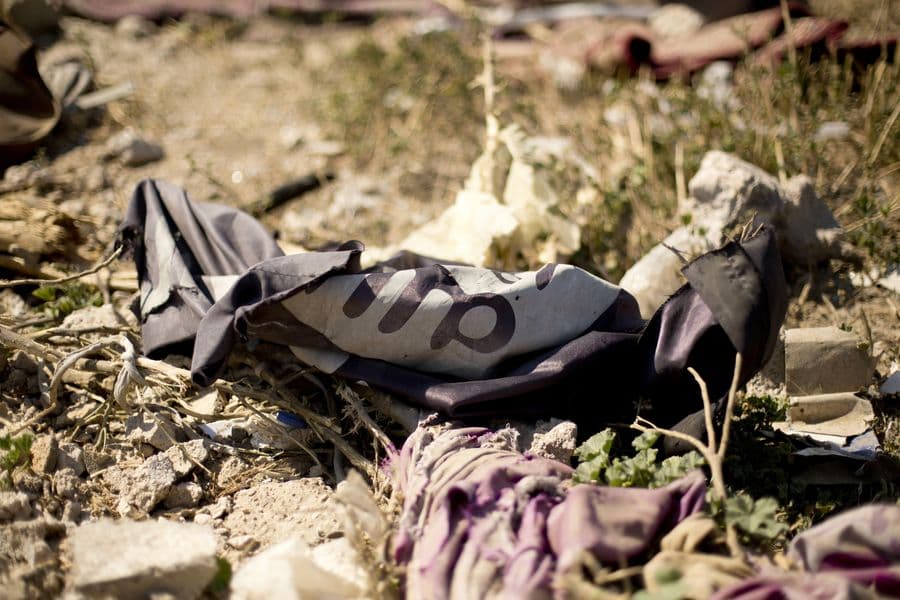
First, the Islamic State as a territorial entity is defeated. The organization’s last stretch of terrain in the Syrian hamlet of Baghouz was retaken by Arab and Kurdish fighters over a week ago. Eliminating ISIS's so-called caliphate was the U.S. objective in Syria given to justify military intervention, and it was completed the moment the last batch of desperate, weak, and hungry terrorists were killed or taken into custody. It makes zero sense for U.S. troops who were deployed to eastern Syria to remain in a dangerous environment when the primary job they were sent to do is finished. This is like a student doing his classmate’s homework after she finishes her own rather than putting down the pencil and relaxing for the rest of the night. In this case, the United States is the overachieving classmate doing the homework of post-conflict state building that Arab political leaders should do themselves.
Indeed, keeping the U.S. military in Syria even a day longer than necessary to accomplish the mission is one extra day when our troops are stuck in harm’s way for no strategic purpose. For policymakers to artificially expand the counter-ISIS mission into a counter-Iran mission—particularly in a country like Syria, which is far more important to Tehran than it is to Washington—is mission-creep on steroids. It is a dereliction of duty by U.S. policymakers.
A resurgence of ISIS post-U.S. withdrawal is frequently cited as a reason for U.S. troops to stay in Syria, but this concern is overblown and overhyped. As Cambridge University professor Andrew Preston wrote in a March 26 article in USA Today, “neither Russia nor Iran, and certainly not Syria, want ISIS to return, so America’s dirty work can be outsourced to others.” No country in the region—not Syria, Iran, Jordan, Turkey, or Russia—has an interest in permitting ISIS to reestablish the second coming of the caliphate. The Islamic State’s brutality and terrorist attacks in multiple countries have made the group many enemies in the region over the last five years.
These regional powers in the Middle East strongly disagree on many foreign policy issues, but strangling ISIS in its crib is not one of them. Counter-ISIS operations will continue even after U.S. troops come home; intelligence and military arrangements between the region’s governments have already been made, a development ensuring the ISIS problem will continue to be managed.
Third, for Washington to remain focused on a weak, dysfunctional, and disorderly Syria limits the opportunity for the strategic transformation of U.S. foreign policy that is critical in an era where great power competition is increasingly the name of the game. America's focus at home and arguably in the Asia-Pacific region—a part of the world far more valuable in terms of international commerce, defending the American people's economic prosperity, and minimizing potential miscalculations with an assertive China—will be hindered if we remain entangled in Syria and nearby nations. The Middle East, simply put, is not as crucial to U.S. national security than it was a decade ago when the American economy was more dependent on foreign oil supplies to sustain productivity.
The Syrian proxy is a humanitarian and economic tragedy for the Syrian people. It also negatively impacted Syria's neighbors, who opened their arms to millions of Syrian refugees fleeing the conflict. But for the United States, Syria was at the bottom about annihilating the ISIS caliphate and minimizing the threat transnational terrorist groups posed to the American people. The U.S. military's work here is done.
No terrorist group can be defeated through the use of military force alone. Bombs, missiles, and endless troop deployments are like pain relievers—they may provide short-term relief, but the causes of the illness will linger on, ready to inflame again at any moment. Washington should demilitarize counterterrorism policy and use every tool available to fight ISIS and ensure the security of the American people is protected. Countries with lax banking systems that terrorists can exploit should be put on notice. Governments who exploit sectarianism for geopolitical gain or lavishly spend money on exporting extremism should be read the riot act. But ultimately, it the responsibility of governments in the Middle East to remedy the political, economic, and social problems that provide terrorist groups like ISIS with the oxygen to continue living.
It is now up to the region's governments to take charge of their own security and work collaboratively to address the grievances that power Islamic extremism. U.S. troops can't do it for them, nor should Arab leaders and elites in Washington expect American soldiers to risk their lives for an impossible job they need not conduct.
Daniel DePetris is a fellow at Defense Priorities.

The Services Do Not Need a Four-Star Autonomous Warfare Command
By Steven Wills • RealClearDefense
Honor Them While There Is Still Time
By Jeffrey Rosales • RealClearDefense
From Siberia to Fairford: How Operation Spider’s Web Has Changed the Rules of Airpower
By Frank A. Rose • RealClearDefense
Faster Simulations, Better Defense Decisions
By Rut Lineswala • RealClearDefense
Will HASC Have an Oversight Subcommittee in the Next Congress?
By Christopher J. Bright • RealClearDefense
Hegseth Barred Trans Troops. Military Boards Are Rejecting Those Orders.
By NYT
Closing the Sea: Lessons from Ancient Mediterranean Blockades
By DeCasien, CIMSECFrom Siberia to Fairford: How Operation Spider’s Web Has Changed the Rules of Airpower
By Frank A. Rose • RealClearDefenseFaster Simulations, Better Defense Decisions
By Rut Lineswala • RealClearDefense
Bombers Could Have a Major Air-to-Air Combat Role
By Joseph Trevithick, The WarZone