
U.S. Military Must Be Employed for America's Vital Interests
Last updated 05:29 PM EDT • Read time: 6m
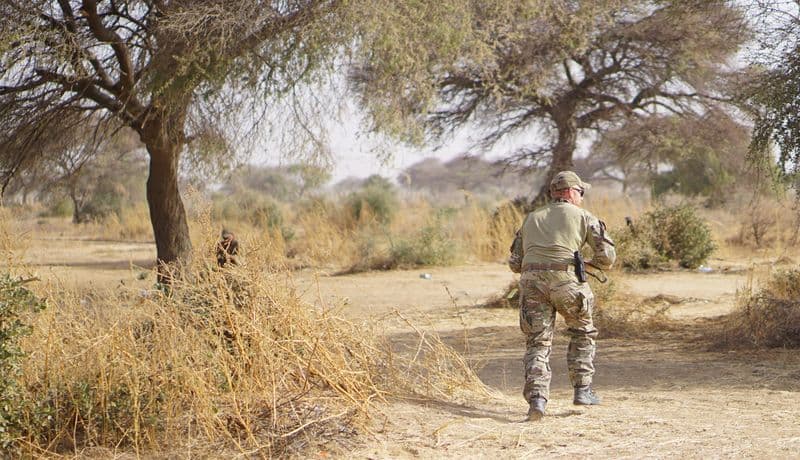
Last week, the House Armed Services Committee held a hearing on U.S. military operations in Africa, approximately five months after four U.S. special operators were killed in western Niger in an ambush by a large group of militants affiliated with the Islamic State. Preliminary findings from military investigators suggest that poor intelligence and excessive operational discretion for field commanders will be cited as the primary reasons for the incident.
The three questions administration officials and U.S. lawmakers should examine, however, are far more elemental to how much heavy equipment the soldiers had or whether their vehicles were hardened enough. First, should the U.S. military have been put into the position of accompanying Niger’s troops in hostile, desert-terrain in search of a local terrorist leader in the first place. Second, is the threat posed by terrorist groups on the African continent commensurate with the manpower the U.S. has deployed? And third, should Washington treat all terrorist organizations, regardless of capability or risk to U.S. security, equally?
The answer to all three questions is “no.” While the African continent is certainly a troubled, violent territory with porous borders and corrupt governments, the terrorists in Africa have largely local aims and should therefore largely be left for local African armies and intelligence services to handle.
Gen. Thomas D. Waldhauser, the Commander of U.S. Africa Command, described Africa-based terrorist groups as an increasingly perilous security issue for ever greater sections of the continent. “Violent extremist organizations are a huge challenge to African nations,” Waldhauser told the Armed Services Committee. In the very next breath, the General assessed that “[A]t the present time, [the terror networks] really do not have the capability to conduct operations, for example, in the United States.”
This last point cannot be overstated enough, for it exposes the widening imbalance between the actual terrorist threat in Africa to the United States and the significant amount of resources the U.S. has spent on security in Africa over the last two presidential administrations.
Instead of concentrating counterterrorism resources on groups with transnational ambitions, Washington has taken a wholly indiscriminate approach, lumping all extremist organizations in Africa—and globally—as if each one poses an equal threat to the U.S. homeland even though they admit that is not at all the case.
With perhaps the exception of al Qaeda in the Islamic Maghreb, best known for capturing western tourists to generate revenue, Africa’s terrorist groups have shown themselves to be concerned mainly with local goals in the specific countries they operate in. Despite the wanton violence al Shabaab has perpetrated against thousands of Somalis in over a decade of existence, the group’s objectives center on expelling the U.N. and Western-supported Somali government in Mogadishu and replacing it with an Islamic emirate. While the Shabaab has conducted terrorist attacks in Kenya and Uganda before, these operations were mainly revenge-oriented, designed to punish two countries who have deployed troops to Somalia to shore up the legitimate government.
Boko Haram is a vicious group—in 2015 and 2016, over 6,700 Nigerians were killed in terrorist attacks—but it has exhibited no such intention towards the United States or Americans in general. Boko Haram’s presence in other Western African nations is based more on the reality of its fighters being pummeled by the Nigerian military rather than an unstoppable terrorist menace swallowing the region in a terrorist blitzkrieg. At present, the only way Boko Haram could kill a U.S. soldier is if the Trump administration deployed American servicemembers into the conflict zone, something that no serious counterterrorism official in Washington is advocating.
The point here is not to excuse the depravity and evil these groups represent or hint in any way that they do not contribute to the violence, poverty, and human rights abuses in Africa as a whole. Nor does that mean the U.S. should do nothing to change the situation. We have important economic and diplomatic means at our disposal. However, the U.S. military should be reserved for direct threats to U.S. security and prosperity.
Not all terrorist organizations in Africa or indeed around the world are fed by a thirst to attack the United States or kill untold Americans on American soil. A predominant number of them are motivated by local grievances and have local objectives in mind.
Africa, it should be noted, is not the backwater it used to be. The continent has immense economic potential. The World Bank reported that Africa’s GDP nearly doubled from 2016 to 2017 after several years of anemic growth, even as the number of Africans living in poverty has increased. If current trends continue, Africa’s booming population growth over the next three decades will translate into more young men entering the workforce without a stable job, a prime recruiting target for jihadist groups seeking manpower.
Not every group of extremists, in other words, has the same transnational ambitions as Osama bin Laden did before the 9/11 attacks. And not all bad guys who call themselves al Qaeda or ISIS—often despite zero operational connection with either—merit the sacrificing of U.S. blood and treasure.
If any nation needs to become more involved in Africa’s counterterrorism efforts, it is the likes of Italy, Spain, France, Germany, and the U.K. - all of which will continue to be seen by Africans as seeking greater economic opportunity as the ultimate destination. The European Union can, and indeed, should follow France’s footsteps and invest more in and partner with African security institutions to ensure the terrorism problem does not spread and become more of a security crisis for Europe. Such an effort would be good for the Africans who need assistance, good for the Europeans who have a national security interest in containing terrorism across the Mediterranean, and good for Washington’s correct policy of promoting fairer burden sharing within the U.S.-European alliance.
Like all agencies of the federal government, the U.S. counterterrorism community does not have a money-tree planted in the premises. It is far more appropriate to use the taxpayer-provided resources America’s counterterrorism agencies do have on targeting terrorists who demonstrate a clear and present danger to the U.S. homeland, American interests, and the American people. Right now, as evidenced by the terrorists’ own actions, the troubled continent of Africa is not one of those places.
Daniel DePetris is a fellow at Defense Priorities.

The Services Do Not Need a Four-Star Autonomous Warfare Command
By Steven Wills • RealClearDefense
Honor Them While There Is Still Time
By Jeffrey Rosales • RealClearDefense
From Siberia to Fairford: How Operation Spider’s Web Has Changed the Rules of Airpower
By Frank A. Rose • RealClearDefense
Faster Simulations, Better Defense Decisions
By Rut Lineswala • RealClearDefense
Will HASC Have an Oversight Subcommittee in the Next Congress?
By Christopher J. Bright • RealClearDefense
Hegseth Barred Trans Troops. Military Boards Are Rejecting Those Orders.
By NYT
Closing the Sea: Lessons from Ancient Mediterranean Blockades
By DeCasien, CIMSECFrom Siberia to Fairford: How Operation Spider’s Web Has Changed the Rules of Airpower
By Frank A. Rose • RealClearDefenseFaster Simulations, Better Defense Decisions
By Rut Lineswala • RealClearDefense
Bombers Could Have a Major Air-to-Air Combat Role
By Joseph Trevithick, The WarZone