
A Nuclear World in Disarray
Last updated 04:59 PM EDT • Read time: 6m
We are in a uniquely dangerous period in the atomic age. Geopolitical tensions have spiked in Europe, in the Middle East, on the subcontinent and in East Asia. The nuclear arms control architecture is fraying and crumbling, but no negotiations are underway to reduce global nuclear stockpiles.
A hostile international security environment, the proliferation of nuclear weapons and the emergence of new space, cyber and AI technologies have increased the risk of accidental or deliberate use of nuclear weapons. The growing strategic risks and uncertainty in turn fuel the vicious cycle of renewed interest among U.S. allies in a nuclear deterrent as a hedge against receding U.S. primacy and reliability.
At the conclusion of a United Nations conference on 7 July 2017, 122 states parties of the Nuclear Nonproliferation Treaty adopted a new Treaty on the Prohibition of Nuclear Weapons. All nine countries that possess the bomb (China, France, India, Israel, North Korea, Pakistan, Russia, the UK and the U.S.) boycotted the conference and rejected the treaty. They have done their very best since then to validate the concerns behind the drive to adopt it.
The 2018 U.S. nuclear posture review will guide the Trump administration’s nuclear decision-making, modernisation, targeting and signalling. With an expansive vision of the role of nuclear weapons, its threefold effect is to enlarge the U.S. nuclear arsenal, lower the threshold for the use of nuclear weapons, and broaden the contingencies in which the threat of nuclear weapons can be wielded as a tool of diplomatic coercion.
The 2015 Iran nuclear deal established a robust dismantlement, transparency, inspections and consequences regime. Last year, President Donald Trump pulled the U.S. out of the agreement and reimposed sanctions on Iran, despite its still being in compliance with its obligations. That put Washington in breach of the multilaterally negotiated and UN-endorsed Joint Comprehensive Plan of Action. Trump’s decision will have reconfirmed North Korea’s belief that the one thing standing between its security and a U.S. attack is the bomb. It has also caused the recent surge in tensions in the Persian Gulf.
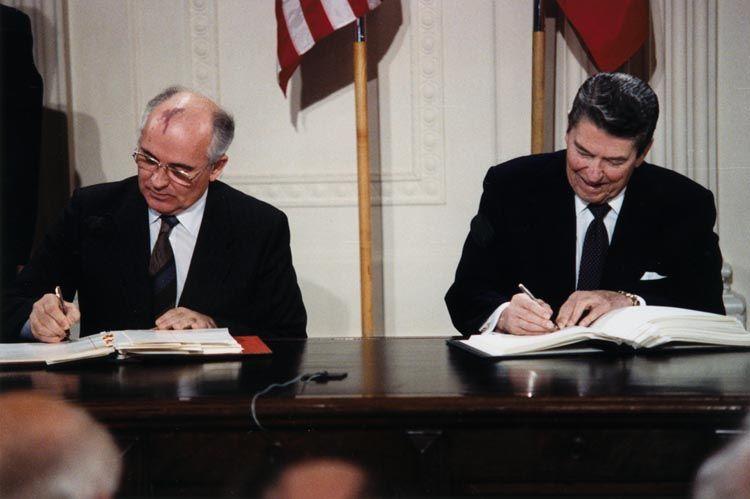
On 1 February, Trump decided to suspend U.S. participation in the Intermediate-Range Nuclear Forces Treaty—an arms control agreement with Russia that contributed to the end of the Cold War and underpinned European strategic stability for three decades. It lapsed on 2 August. Trump has also rebuffed Russian overtures to discuss a five-year extension of New START beyond 2021. His second summit with North Korea’s leader Kim Jong-un in Hanoi in February collapsed without agreement and Pyongyang now seems to be expanding its nuclear arsenal. Still, at least the U.S. and North Korea are engaged in high-level and working-level discussions and the fear of an imminent war has faded.
The altered U.S. nuclear posture will have cascading effects on the arsenals, doctrines and deployments of other nuclear-armed states. On 1 March 2018, Russian President Vladimir Putin boasted of a new array of invincible nuclear weapons that can penetrate any defences anywhere in the world. He noted the U.S. had not heeded Russian warnings when it pulled out of the 1972 anti-ballistic missile treaty in 2002. ‘You didn’t listen to our country then. Listen to us now’, he said. Putin’s language was reminiscent of the Cold War.
After the U.S.–Russian suspensions of the INF Treaty, Putin warned that Russia could place hypersonic nuclear weapons on submarines deployed near U.S. waters to match the time in which U.S. missiles based in Europe could strike Russia. He also warned of a radioactive tsunami that could be triggered in densely populated coastal areas by a new nuclear-powered underwater drone dubbed ‘Poseidon’.
The more that Putin and Trump revalidate the role of nuclear weapons in strengthening national security, the more they normalise the discourse of nuclear weapons use and embolden calls for nuclear weapon acquisition in other countries. In Australia, this debate has been restarted most recently by Hugh White.
Meanwhile, the official newspaper of the People’s Liberation Army has called for China to strengthen its nuclear deterrence and counterstrike capabilities to match the U.S.’s and Russia’s developing nuclear strategies. China is upgrading its relatively small nuclear arsenal. It rejected Germany’s request to save the INF Treaty by agreeing to trilateralise it, emphasising that its warheads in the low hundreds cannot be compared with U.S. and Russian arsenals in the several thousands.
India and Pakistan are enlarging, modernising and upgrading stockpiles, while investing in battlefield tactical nuclear weapons and systems to counter them. The INF Treaty was the first disarmament agreement of the nuclear age. In an unwelcome symmetry, on 26 February we witnessed the first airstrikes by one nuclear-armed state against another, and the two engaged in a deadly dogfight above the skies of Kashmir the next day. Another India–Pakistan war is a question of when, not if.
The U.S., described by former Canadian disarmament ambassador Paul Meyer as ‘the high priest of nuclear orthodoxy’, has left its allies looking rather foolish. Washington had led them in dismissing the nuclear weapon ban treaty as impracticable virtue-signalling, instead extolling the decades-long efforts at step-by-step measures to advance the cause of nuclear disarmament that had seen global stockpiles plummet by over two-thirds from their Cold War peak.
When unkind critics noted that the only steps that were visible were leading backwards, Washington responded by launching a new initiative on ‘creating the conditions for nuclear disarmament’. Lest some conditions be specified and met, however, Washington suddenly embraced the more nebulous and inherently subjective language of ‘creating an environment for nuclear disarmament’.
During the Cold War, Soviet citizens who kept to the straight path as the communist party veered sharply to the left or right were denounced as ‘deviationists’. For decades, U.S. allies have been singing from the same hymn book, joining it in the insistence that the step-by-step, progressive approach was the only realistic path to nuclear disarmament. Instead of embracing the new orthodoxy from their fallible high priest, they should do a hard-nosed analysis of the merits of the changing risk–reward calculus of integrating more deeply with the nuclear alliance structure or
Ramesh Thakur, a former UN assistant secretary-general, is emeritus professor at the Australian National University and director of its Centre for Nuclear Non-Proliferation and Disarmament.
This article appeared originally at The Strategist (ASPI).

A Defense Win for Americans and Israelis in Arkansas
By Bradley Bowman • RealClearDefense
A Path to Success Against Iran
By Michael Schwartz • RealClearDefense
The World Cup Is Over. The Drone Threat Isn’t.
By Mitzi Perdue • RealClearDefense
AI Should Speed Veterans’ Benefits, Not Decide Them
By Rob Schroder • RealClearDefense
Don’t Be Swayed by Tactical Nukes
By Benjamin Giltner • RealClearDefense

Big Surface Combatants are so Hot Right Now
By CDR Salamander
USS Stout Loses Power During Port Visit Due to ‘Engineering Casualty’
By USNI News
Air Force Lessons Learned From Operation Epic Fury
By Tabitha Reeves, National Defense
Marines Need Nine More Amphibious Warships To Carry Out Its Missions
By TWZ
AFRL, ACC Fly XQ-67A Drone To Test Autonomous Teaming
By Airforce Technology