
As Allies' Capabilities Grow, They Need To Work With U.S. on Nuclear Signalling
Last updated 01:01 PM EDT • Read time: 6m
The Indo-Pacific’s next deterrence problem may be a shortage not of military capability but of coordination. As Australia, Japan and South Korea acquire long-range strike, missile defence and other strategic conventional capabilities, they are increasingly becoming mixed up in U.S. nuclear signalling. Yet the U.S. alliance network lacks mechanisms for coordinating how use of allies’ capabilities is interpreted and communicated during a crisis.
This gap should be addressed before it becomes a wartime liability. U.S. allies should strengthen peacetime and pre-crisis signalling, including through wargames that focus on escalation management and consider how that signalling might be interpreted. Partners should also develop a common deterrence vocabulary and understanding. This would help ensure consistency in messaging to adversaries and avoid miscommunications that could undermine joint efforts.
The central challenge is what strategists call nuclear–conventional entanglement. Increasingly, the most advanced conventional weapons can affect the survivability of an adversary’s nuclear forces. Precision-strike missiles, cyber operations, space systems and anti-submarine warfare capabilities can all hold nuclear forces at risk. Missile defences can threaten to blunt the use of nuclear weapons.
Actions undertaken for conventional purposes can therefore be interpreted as attempts to undermine nuclear retaliation capabilities, generating escalation pressures neither side intended.
This is especially important in the Indo-Pacific. Chinese nuclear and conventional forces are increasingly interconnected through shared infrastructure, command systems and dual-use equipment, such as the DF-26 intermediate-range ballistic missile, which can carry both conventional and nuclear warheads. At the same time, U.S. allies are acquiring conventional capabilities that could threaten China’s nuclear forces during a crisis. What might appear in Canberra, Tokyo or Seoul as a limited action against conventional forces could look very different from Beijing.
Non-nuclear U.S. allies have therefore become strategically relevant to future nuclear crises, but policy debates have not kept pace. Discussions of Australia’s missile acquisitions, Japan’s counter-strike capabilities or South Korea’s Three-Axis System (integrating early warning, missile defence and retaliatory strike capabilities) have focused largely on deterrence and warfighting, with less attention given to how these capabilities function as signals in a nuclear context. Deployments, readiness changes, exercises and strikes all convey information about intentions and resolve.
The risk is not simply escalation but misinterpretation, including among allies themselves. Even close partners often use different concepts of deterrence, escalation and strategic stability. A recent dialogue that Monash University ran with official and non-government participants from Australia, Japan, South Korea and the United States showed that people can use the same terminology in this field while attaching different meanings to it. This can include specific definitional issues such as what counts as ‘advanced conventional’ capabilities, what should be thought of as a de-escalatory signal, and even fundamental conceptual confusion over distinctions between deterrence and compellence. Such differences may appear academic in peacetime, but in a crisis they can shape decisions about signalling, risk-taking and military employment. Developing a common understanding of these capabilities and their signalling potential is therefore a strategic necessity.
Consider a Taiwan crisis. A limited Japanese strike against military infrastructure, a South Korean mobilisation of strategic conventional forces, or an Australian operation tracking Chinese submarines could carry different meanings for their governments than for Chinese decision-makers. The intent may be to achieve advantage in conventional warfare, but China’s interpretation may be that its nuclear forces are threatened and may need to be used while they’re still viable.
The danger is heightened because allies may not share the same views on escalation, acceptable risk or war termination. The increased number of signals circulating within a crisis complicates efforts to distinguish coordinated alliance behaviour from independent national actions. Crisis signalling between two actors is a delicate art. Adding extra actors with military capabilities capable of sending escalatory and de-escalatory signals increases the need for allied coordination.
The uncomfortable reality is that Washington’s allies are becoming strategically consequential faster than they are becoming coordinated. Current arrangements remain largely bilateral. The U.S.-ROK Nuclear Consultative Group and U.S.-Japan Extended Deterrence Dialogue have improved consultation, while Australia maintains its own strategic dialogue with Washington. But there is no mature framework through which the United States, Japan, South Korea and Australia can collectively discuss how strategic non-nuclear capabilities should be employed for signalling, or to avoid signalling, during a major regional crisis.
The solution is not to create an Asian NATO or elaborate new bureaucracies. Even the terminology of ‘interoperability’ can be too closely associated with warfighting rather than crisis management. A more practical objective is enhanced crisis-management coordination: developing shared understandings, communication mechanisms and signalling practices while preserving national autonomy. Allies need greater capacity to coordinate how they communicate military intent during acute tension.
Three priorities stand out.
First, allies should expand regular tabletop exercises focused on escalation management rather than warfighting. Most alliance exercises examine how to win conflicts; far fewer explore how military actions might be interpreted by adversaries or how signalling should be coordinated under uncertainty. Signalling also begins long before a crisis. Decisions about whether to proceed with exercises, adjust deployments or publicise military activities can send powerful messages of resolve or restraint. Allies therefore need to consider signalling during peacetime and the pre-crisis period, not simply when hostilities appear imminent.
Second, existing extended deterrence mechanisms should broaden their remits. Future crises may hinge less on nuclear weapons themselves than on conventional capabilities that affect nuclear calculations. Consultative bodies designed for nuclear coordination should therefore incorporate strategic non-nuclear systems into their work.
Third, allies need to develop something approaching a common vocabulary and understanding on strategic conventional capabilities and signalling. If they interpret ‘escalation’, ‘strategic stability’ and ‘signalling’ differently, consistent messaging toward adversaries becomes difficult. Japan and South Korea face similar strategic environments in Northeast Asia, while Australia and the U.S. face different pressures and bring different forces to bear. Shared definitions will not eliminate disagreement but could reduce the risk that allies work at cross-purposes when coherence matters most.
For years, deterrence debates in the Indo-Pacific have centred on weapons and force postures. These matter. But as the region enters an era of increasing nuclear-conventional entanglement, the ability to manage escalation may prove as important as the ability to project force.
The real capability gap facing the U.S. alliance network is organisational. The most consequential investment the allies can make now is not in another missile battery or submarine but in mechanisms that ensure that, when a crisis comes, they send the same signal rather than four different ones.
This article is based on research from the project Nuclear-Conventional Entanglement Risks: Australia and Allied Crisis Management Interoperability, which is supported through the Strategic Policy Grants Program of the Australian Department of Defence. The views expressed here are personal.
Benjamin Zala is a senior lecturer at Monash University, where his work focuses on great power relations and the management of nuclear weapons.
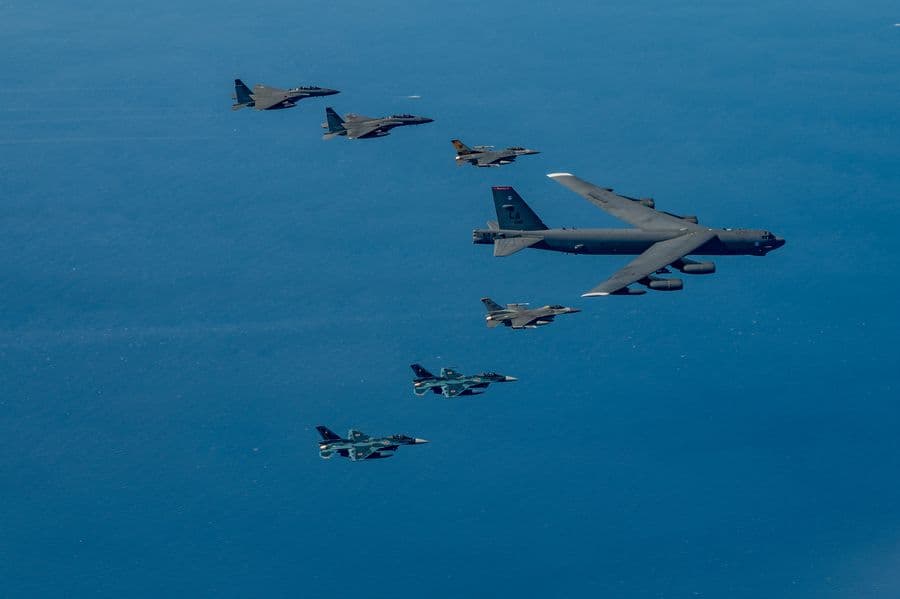
Image of fighter aircraft from the U.S., Japan and South Korea conducting a trilateral escort flight of a U.S. B-52H Stratofortress Bomber in the Indo-Pacific, 22 Oct, 2023: U.S. Air Force/Senior Airman Karla Parra.
AI contributed no ideas to this article – Benjamin Zala.
This article appeared originally at The Strategist (ASPI).

In Pursuit of Nuclear Abolition
By Peter Huessy • RealClearDefense
Innovation Alone Won’t Prepare the U.S. for the Future Battlefield
By Joshua Segal • RealClearDefense
The sUAS Tactical Trifecta
By Bryan T. Woody • RealClearDefense
The Revolutionary War: When Strategic Options Share the Same Weakness
By Henry Yep • RealClearDefense
The Houthis Are Testing the Limits of Collective Defense
By Saima Afzal • RealClearDefense

Who Shoots Down the Drone Over the Shipyard?
By John Ferrari & Dillon Prochnicki • RealClearDefense
Northrop Grumman Breaks Out the Big Guns at AUSA
By Daniel Terrill, Defense News
Army Pursuing Diverse Array of New Anti-Air Interceptors
By Trevithick, The WarZoneWho Shoots Down the Drone Over the Shipyard?
By John Ferrari & Dillon Prochnicki, RCD
F-35C Lands for the First Time on a Ford-Class Aircraft Carrier
By The Aviationist