
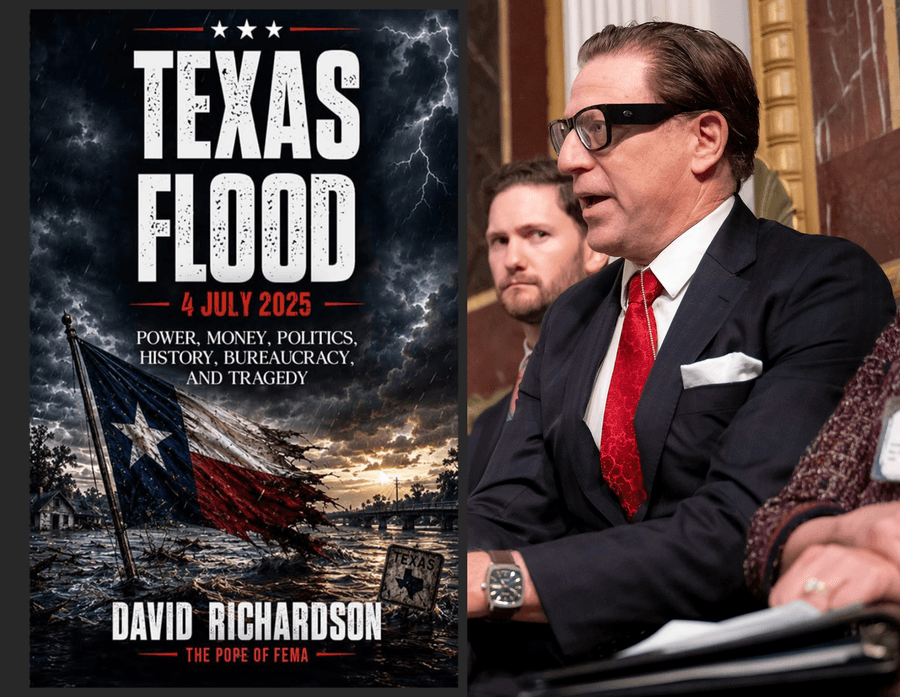
The Pope of FEMA
Last updated 06:00 AM EDT • Read time: 7m
The Pope of FEMA (Federal Emergency Management Agency) was the moniker ascribed to David Richardson, by a colleague, after enduring the hurricane season in 2025 and successfully coordinating state, intra-state and federal assets to recovery efforts for the catastrophic floods in the Central Texas Hill Country region.
Richardson’s new book “Texas Flood – 4 July 2025 - Power, Money, Politics, History, Bureaucracy, and Tragedy,” is a tribute the families that suffered unimaginable grief through the tragic loss of life that day, leaving 136 deceased and more missing.
The Texas flood in July of 2025 was an immensely tragic event, less than a year from the Hurricane Helene tragedy at the end of the Biden administration. The response to Helene led to renewed scrutiny of FEMA and its response to catastrophic natural disasters.
With refreshing brevity and clarity, Richardson’s book takes us behind the scenes as he takes the helm of the reviled agency that had been in turmoil since the fateful events of Hurricane Katrina in the summer of 2005.
Richardson’s book begins with him executing the plan to dismantle the DHS office for Countering Weapons of Mass Destruction (CWMD) as directed by the Trump Administration. While seemingly superfluous to the response to his becoming FEMA administrator, Richardson talks about his personal goal of having Fentanyl declared a weapon of mass destruction (WMD).
In March of 2025, Richardson signed a memo requesting that Fentanyl be officially declared a WMD to the Secretary of DHS, but was never acted upon until December of that year, when Tom Homan, impressed with Richardson’s analysis and advocacy successfully convinced the President to add Fentanyl to the list of WMDs.
This was just the first of many instances where Secretary Noem and her “special advisor” either intentionally or inadvertently placed bureaucratic roadblocks in the path of Richardson’s methodical revamping of FEMA.
In May of 2025, just four weeks away from the official start of hurricane season, Richardson found himself in a job that nobody wanted and an agency with a legacy of failures.
Instead of cowering under the weight of bureaucracy and failure, Richardson rose to the occasion by implementing what worked for him throughout his military career and his time as the head of CWMD.
Richardson was well versed in the infamous five paragraph order that is instilled in every Marine, Soldier and others that had a career in the military, especially in combat, and that was the five paragraph order.
Situation, Mission, Execution, Administration/Logistics, and Communications (SMEAC) was the framework of the five paragraph order, and became second nature to Richardson in his posts at CWMD and later as FEMA administrator.
The situation was dire, but Richardson quickly identified the lack of a clear mission, so he directed his staff to identify the actual mission of FEMA as dictated by federal statute.
Drawing on a small team with a proven record of getting things done from people he had at CWMD and FEMA, David devised a completely new organization chart, mission statement and a plan to significantly reduce the size of FEMA to better apply assistance to states and localities in the event of a disaster that exceeded the ability of local and state authorities.
The revised organization of FEMA and clear mission, morale began to improve. And Richardson’s team developed a comprehensive plan, in coordination with regional offices and state and local emergency response teams.
However, Richardson’s plan for hurricane disaster response met with opposition, as DHS Secretary Noem and her staff refused to sign off on the plan, likely fearing that having her name attached to it might be held against her.
This led to the media, falsely, reporting that Richardson was unaware of when hurricane season actually began and a lacking a plan. A glaring shortfall in the wake of Hurricane Helene, less than a year ago.
In addition to the Secretary Noem not signing off on Richardson’s plan for hurricane season, the Noem along with her pseudo chief of staff that Richardson refers to as Colonel Sanders (likely Corey Lewandowski) were focused on contracts and constraining the colossal FEMA budget by sending out what David refers to as the 100K memo, meaning that any contract awarded by FEMA that exceeded $100,000 must be approved by the Secretary Noem’s office. A serious impediment to awarding contracts to fulfil a state’s need in the midst of a disaster.
Despite these impediments to deliver the statutory support to State and local disaster relief efforts, Richardson’s team pushed forward. Conducting exercises on how to coordinate and respond to not only hurricanes, but any disaster that would require a response from FEMA.
What nobody expected was that it wouldn’t be a hurricane that would test Richardson’s plan for disaster relief and support, it would be a catastrophic flash flood.
Fortunately, Richardson’s plan was not dependent on a specific disaster, but rather executing the mission in the most efficient manner at the state and local levels with FEMA ready to coordinate support that exceed the capability of state and local response teams.
Richardson was ready for the Texas flood, because he had already had his team researching the potential for future flash floods and ordered a review of flood maps and quickly found that the data for determining the flood plains were based on actuary tables rather than how vulnerable areas were to potential flash floods. This led to building in areas that should have never been approved for residential housing or even businesses in many cases.
It soon became apparent to Richardson that the data used for the National Flood Insurance Program (NFIP), funded by taxpayers, was manipulated by corporations and the wealthy to build in areas susceptible to hurricanes and flash floods with low risk and low insurance premiums.
This data manipulation created the perfect storm for what beset Texas Hill Country on July 4, 2025, and the tragedy at Camp Mystic. The storm in hill country was caused by a mesoscale convective vortex initiated by a tropical storm from the Gulf.
On that day, on what had become an annual trip with his boys to Gettysburg, Richardson began receiving calls from Nim Kidd, Chief of Texas Emergency Management, regarding the storm. Richardson knew Kidd from exercises that Richardson ordered for hurricane season to ensure the most prone areas were ready, and Richardson knew that Kidd’s team was ready.
Initially, Kidd didn’t need any support from FEMA, but Richardson coordinated support with his newly battle tested team to be on standby and ready support from nearby states and FEMA field representatives.
Over the next hours and days, Richardson and his team successfully provided support and award contracts for search and rescue teams from outside Texas to rescue as many as possible in short order, bypassing the infamous 100k memo that would have stalled support efforts indefinitely.
But somehow, many in the media were reporting that Richardson had turned down phone calls during this time of crisis. After speaking to Richardson and some of his key staff, I found that Richardson only responded to calls from those directly involved in relief efforts or had the ability to provide direct support.
Perhaps the most glaring example of this was a Washington Post reporter complaining that Richardson hadn’t responded to her emails in the midst of coordinating the response to the Texas Floods. Richardson was simply being a leader and did not have time to also be his own public affairs officer in a time of crisis.
Perhaps even more disappointing as I finished Richardson’s book, is that he wasn’t able to break through the bureaucracy and implement his plan to reform FEMA, which, in the end, was why Richardson resigned his position in early December 2025, but came away as the Pope of FEMA.
David Craig is the editor of RealClearDefense and retried Marine Corps combat veteran.

In Pursuit of Nuclear Abolition
By Peter Huessy • RealClearDefense
Innovation Alone Won’t Prepare the U.S. for the Future Battlefield
By Joshua Segal • RealClearDefense
The sUAS Tactical Trifecta
By Bryan T. Woody • RealClearDefense
The Revolutionary War: When Strategic Options Share the Same Weakness
By Henry Yep • RealClearDefense
The Houthis Are Testing the Limits of Collective Defense
By Saima Afzal • RealClearDefense

Who Shoots Down the Drone Over the Shipyard?
By John Ferrari & Dillon Prochnicki • RealClearDefense
Northrop Grumman Breaks Out the Big Guns at AUSA
By Daniel Terrill, Defense News
Army Pursuing Diverse Array of New Anti-Air Interceptors
By Trevithick, The WarZoneWho Shoots Down the Drone Over the Shipyard?
By John Ferrari & Dillon Prochnicki, RCD
F-35C Lands for the First Time on a Ford-Class Aircraft Carrier
By The Aviationist