
What Franklin Roosevelt Understood About Military Leadership
Last updated 02:57 AM EDT • Read time: 5m
The United States is at war, and the Army is losing its senior leadership.
Army Secretary Dan Driscoll resigned last month after months of reported conflict with Defense Secretary Pete Hegseth. Earlier this year, Hegseth forced out Gen. Randy George, the Army chief of staff, along with other senior Army generals. Driscoll reportedly opposed some of those removals and later raised concerns that Hegseth’s personnel decisions were undermining Army modernization and readiness. His departure is part of a much broader turnover in the Pentagon’s senior ranks.
There are legitimate reasons to replace military leaders, of course, and it is the right of civilian leaders to do so in the United States. Civilian control of the military is foundational to our republic. But exercising that authority effectively requires those same leaders to be willing to hear disagreement from their military advisers—particularly during war.
Franklin D. Roosevelt understood this exceptionally well.
I spent years studying Roosevelt’s relationship with the two men who principally built and led the United States Army during World War II: Secretary of War Henry L. Stimson and Army Chief of Staff George C. Marshall. Their relationship with Roosevelt offers a useful lesson today about the value of candid advice and the kind of leadership that encourages it.
Roosevelt did not choose either man for the job because of personal loyalty. Stimson was a Republican who had served in the cabinets of William Howard Taft and Herbert Hoover and had been a vocal critic of Roosevelt and the New Deal. Yet in the summer of 1940, with France defeated and Britain standing alone, Roosevelt asked the 72-year-old Stimson to become his secretary of war.
The appointment was deliberately bipartisan. Roosevelt was preparing a divided, isolationist country for the possibility of war. He wanted a man of unquestioned stature and experience at the helm of the War Department, even if that man belonged to the opposition party.
Roosevelt’s choice of Marshall was even more telling. In 1938, a year before Roosevelt selected him as Army chief of staff, Marshall attended a White House meeting with a dozen high-ranking military and civilian officials. Roosevelt argued for dramatically expanding aircraft production. Nearly everyone in the room enthusiastically agreed. Then Roosevelt turned to Marshall.
“I am sorry, Mr. President, but I don’t agree with you at all,” Marshall told him.
When the meeting ended, the other officials joked that Marshall’s career in Washington was finished. It wasn’t. A year later, when Roosevelt told Marshall that he intended to make him Army chief of staff, Marshall reminded the president that he had a habit of saying exactly what he thought and that Roosevelt might sometimes find that unpleasant. Roosevelt accepted the bargain.
Over the next six years, Roosevelt, Stimson, and Marshall disagreed repeatedly, often heatedly. They argued over strategy, weapons, personnel, and the allocation of military resources. Marshall often pushed back against Roosevelt’s recommendations. Stimson could be equally stubborn, and once became so exasperated with Roosevelt that he hung up the telephone on him.
Yet Marshall’s willingness to challenge the president came with an almost reverential view of civilian control of the military. He believed his responsibility was to give Roosevelt and Stimson his unvarnished military judgment before a decision was made—and to carry out their decision once it was.
That distinction—candor before a decision, obedience afterward—is crucial to understanding the current moment. It’s possible that every one of Hegseth’s personnel decisions can be individually defended. But taken together, the departures raise a different question: What kind of advice reaches a president when senior officials begin to believe that disagreement may end their careers?
That danger is hardly unique to President Trump, Hegseth, or any political party. Power naturally encourages deference, and over time there is a risk that a president hears less of what his advisers believe and more of what they believe he wants to hear. War makes that danger more consequential.
Roosevelt himself was hardly immune from vanity or political calculation. He could be manipulative, secretive, and ruthless, and he frequently maneuvered around his own advisers. But when it came to the greatest military challenge the country had ever faced, he had the confidence to surround himself with extraordinarily strong subordinates and understood that their willingness to challenge him made their advice more valuable, not less.
It was a remarkable combination: a self-assured president, a formidable civilian secretary, and an independent-minded general, each understanding the boundaries of his office.
It also worked. Marshall and Stimson inherited an Army that was small and poorly prepared for a global war. Six years later, the United States had mobilized millions of soldiers, fought enormous campaigns on opposite sides of the world, and emerged victorious—in large part due to the extraordinary partnership between Roosevelt, Stimson, and Marshall.
Roosevelt’s example is worth remembering now. Presidents and defense secretaries must be free to choose—and remove—the military leaders who serve them. But they also need those leaders to believe that giving unwelcome advice will not, by itself, end their careers.
George Marshall once risked his career by telling Franklin Roosevelt that the president was wrong. Roosevelt could have punished him for it. Instead, he made him Army chief of staff.
Every president, in war or in peace, should understand why.
Edward Farley Aldrich is the author of "The Partnership: George Marshall, Henry Stimson, and the Extraordinary Collaboration That Won World War II"
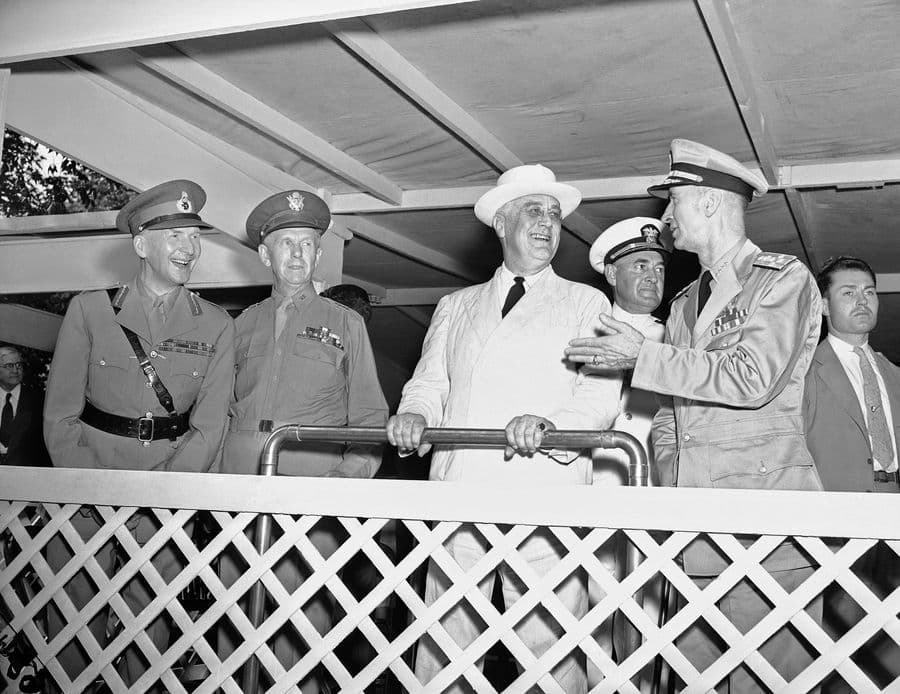
image: Flanked by army and navy chiefs, U.S. President Franklin D. Roosevelt reviews a Memorial Day parade in Washington on May 30, 1942. From left to right are: Sir John Dill, head of the British military mission in the U.S.; Gen. George C. Marshall, chief of staff of the U.S. Army; President Roosevelt, Capt. John L. McCrea, the President’s naval aide, and Admiral Ernest J. King, chief of naval operations and commander in chief of the U.S. fleet. (AP Photo)

In Pursuit of Nuclear Abolition
By Peter Huessy • RealClearDefense
Innovation Alone Won’t Prepare the U.S. for the Future Battlefield
By Joshua Segal • RealClearDefense
The sUAS Tactical Trifecta
By Bryan T. Woody • RealClearDefense
The Revolutionary War: When Strategic Options Share the Same Weakness
By Henry Yep • RealClearDefense
The Houthis Are Testing the Limits of Collective Defense
By Saima Afzal • RealClearDefense

Who Shoots Down the Drone Over the Shipyard?
By John Ferrari & Dillon Prochnicki • RealClearDefense
Northrop Grumman Breaks Out the Big Guns at AUSA
By Daniel Terrill, Defense News
Army Pursuing Diverse Array of New Anti-Air Interceptors
By Trevithick, The WarZoneWho Shoots Down the Drone Over the Shipyard?
By John Ferrari & Dillon Prochnicki, RCD
F-35C Lands for the First Time on a Ford-Class Aircraft Carrier
By The Aviationist