
Nuclear Deterrence Gap in Europe
Last updated 06:01 AM EDT • Read time: 4m
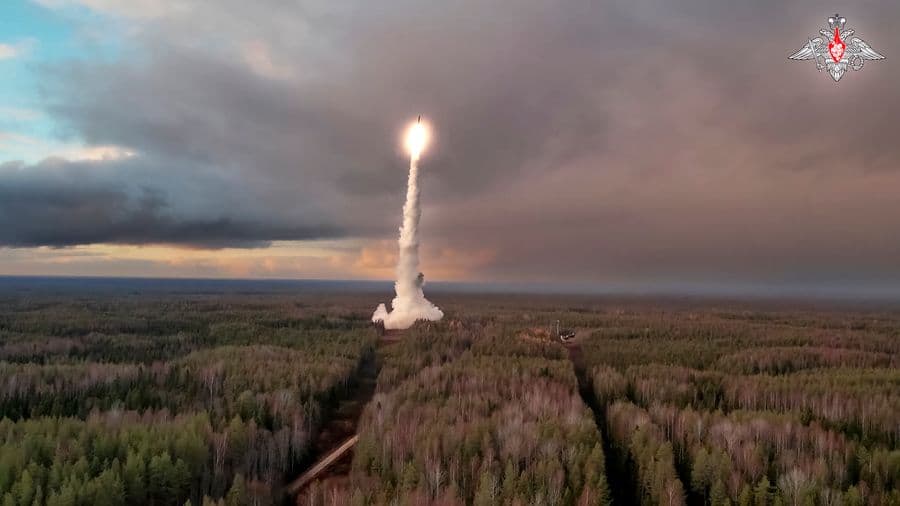
Russia has a huge advantage in nuclear arms for use in Europe. In a crisis, Moscow might perceive nuclear superiority and try to exploit it. Lessening the imbalance may also reassure allies and be essential for any negotiated arms control efforts.
Moscow combines its nuclear edge with irresponsible bluster. In 2018 President Vladimir Putin displayed an animated missile strike on Florida. Early in the full-scale war on Ukraine, he raised Russia’s nuclear alert status. Former President Dmitry Medvedev recently warned of a nuclear strike on France and the UK. All this might not be idle rhetoric. In 2022, Russian leaders might have “credibly discussed” using low-yield nuclear arms to avert defeat in Ukraine.
The Kremlin may think swagger is justified. Russia could have nearly 1,500 tactical and theater nuclear arms, most oriented to the European theater. The U.S. has only about 100 tactical nuclear bombs there, and France about 50 nuclear-armed missiles. All would be delivered by tactical fighter-bombers. The U.S. bombs are part a NATO program that shares nuclear responsibilities among allies.
The theater imbalance emerged in part from post-Cold War U.S. unilateral withdrawals and Russia’s nuclear modernization. By comparison, in long-range, or strategic, nuclear forces, the two countries have rough parity.
This is not the first theater imbalance. In the 1970s, the Soviets unsettled NATO by fielding new, more potent nuclear-armed ballistic missiles, the SS-20. West German Chancellor Helmut Schmidt warned that this gap could "decouple" European security from U.S. nuclear protection. In the mid-1980s, NATO countered by deploying its own new missiles.
The strident hostility of Putin’s Russia heightens nuclear risks. So, too, does a possible decline in allied confidence in U.S. extended deterrence, the “nuclear umbrella.” In 2023, the U.S. Strategic Posture Commission said many allies “perceived no need” to acquire their own nuclear capabilities. This may be changing. Recently, the European Nuclear Study Group warned of the risk of Russian “nuclear coercion” and the “fragility” of U.S. extended deterrence.
Europeans are speaking out. Chancellor Friedrich Merz says Germany is discussing nuclear cooperation with France and the UK. So is Sweden. Poland is talking with France, and President Karol Nawrocki says his country should develop a security strategy based on “nuclear potential.” Nuclear issues were front and center at the recent Munich Security Conference. There a Pentagon leader reiterated that the U.S. would ”continue to provide” extended deterrence.
NATO members are taking some steps to bolster theater nuclear forces. The U.S. has modernized its nuclear bombs in Europe. The UK plans to deploy a small, land-based nuclear force using F-35s to deliver them. On March 2, President Emmanuel Macron said France may allow “temporary deployment” of nuclear-armed aircraft in allied states as part of a strategy of “forward deterrence.” France and the UK have submarine-based strategic forces, but they are less suited to theater needs.
The U.S. has deployed low-yield nuclear warheads on long-range Trident ballistic missiles on submarines and might field a nuclear-armed sea-launched cruise missile. They will help but have downsides. Being less visible, sea-based missiles may have less deterrent value. Russian radars may be unable to tell if a Trident in flight has only a low-yield warhead.
More remedies to the theater gap may be considered. Poland, Sweden, Finland, and other allies might play greater roles in NATO’s nuclear sharing program. If Poland were to host U.S. nuclear bombs, deliverable by its F-35s, this could help counter Russia’s nuclear buildup in Belarus and western Russia. Nuclear missions could be added to a U.S. Army land-based theater missile.
If confidence in U.S. extended deterrence were to decline further, some allies might seek to develop their own nuclear arms. But this could be expensive, take up to a decade, and draw criticism for undermining the 191-nation Nuclear Nonproliferation Treaty (NPT).
Multiple allies could develop nuclear weapons. Prior to joining the NPT in 1968, Sweden had a program capable of producing nuclear weapons within a few years. Italy halted nuclear weapons R&D when it joined the NPT in 1975.
Interest in arms control could resurface. NATO’s missiles in the 1980s gave the U.S. leverage to conclude the path-breaking 1988 Intermediate-range Nuclear Forces Treaty with the USSR. Deployment of a new U.S. land-based theater nuclear missile could be essential for negotiating any arms control accord.
NATO has a vital interest in reducing the risk that Kremlin leaders might misperceive its nuclear deficiency as weakening extended deterrence. A new Helmut Schmidt-like call for the alliance to do more may be merited.
William Courtney was deputy negotiator in U.S.-Soviet Defense and Space Talks (missile defense), ambassador to the U.S.-Soviet Commission to implement the Threshold Test Ban, co-chair in early talks with Russia on the safety, security, and dismantlement of nuclear weapons, and ambassador to Kazakhstan, where he helped negotiate the withdrawal of remaining Soviet nuclear forces.

In Pursuit of Nuclear Abolition
By Peter Huessy • RealClearDefense
Innovation Alone Won’t Prepare the U.S. for the Future Battlefield
By Joshua Segal • RealClearDefense
The sUAS Tactical Trifecta
By Bryan T. Woody • RealClearDefense
The Revolutionary War: When Strategic Options Share the Same Weakness
By Henry Yep • RealClearDefense
The Houthis Are Testing the Limits of Collective Defense
By Saima Afzal • RealClearDefense

Who Shoots Down the Drone Over the Shipyard?
By John Ferrari & Dillon Prochnicki • RealClearDefense
Northrop Grumman Breaks Out the Big Guns at AUSA
By Daniel Terrill, Defense News
Army Pursuing Diverse Array of New Anti-Air Interceptors
By Trevithick, The WarZoneWho Shoots Down the Drone Over the Shipyard?
By John Ferrari & Dillon Prochnicki, RCD
F-35C Lands for the First Time on a Ford-Class Aircraft Carrier
By The Aviationist