
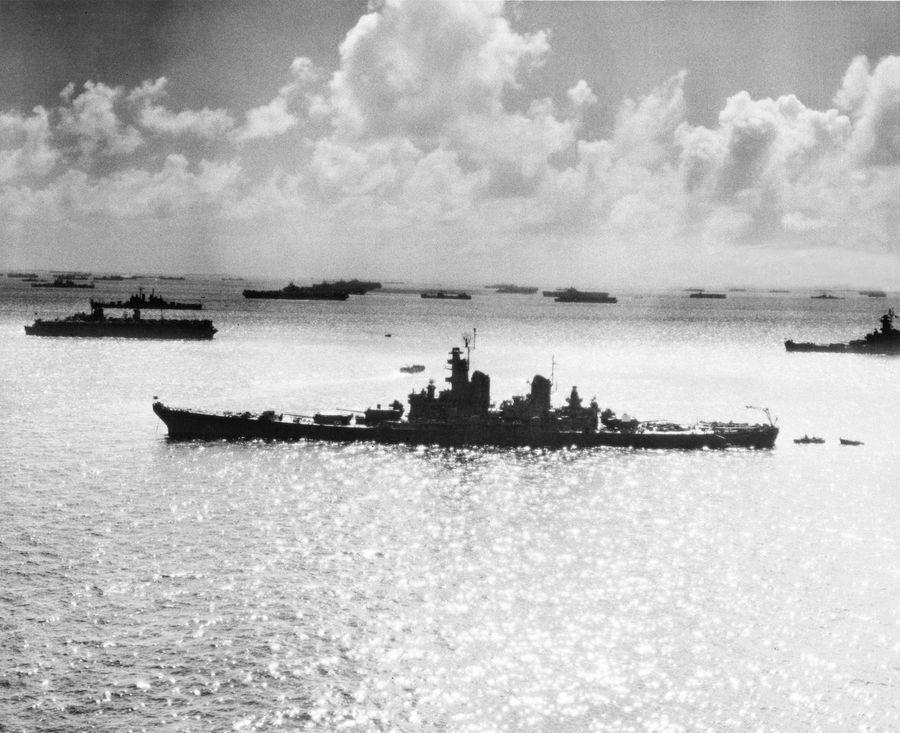
Nuclear Proliferation in the Western Pacific?
Last updated 10:29 AM EDT • Read time: 6m
A recent Gallup Korea poll reveals that 65 percent of adult South Koreans support an independent nuclear deterrent for the country, according to a report from the Yonhap News Agency. Writing in The Diplomat, international relations professor Christoph Bluth reports that there is currently an intense debate in South Korea over the issue of a potential South Korean nuclear deterrent, and that 80 percent of South Koreans support acquiring nuclear weapons. Last month, retired South Korean Gen. Chun In-bum proposed the development of a “sovereign nuclear deterrent” by South Korea “as an integral component of an allied deterrence network led by the United States and supported by other democratic partners.” Meanwhile, Japan is revisiting the question of whether it should acquire nuclear weapons, and a former Singaporean diplomat writes that Japan and South Korea will at some future time acquire nuclear weapons. And earlier this year, Kenji Yoshida, writing in Japan Forward, notes that some security experts think that Japan’s acquiring nuclear weapons would enhance deterrence in East Asia and the western Pacific.
There are currently five Asian powers that possess nuclear weapons—China, Russia, India, Pakistan, and North Korea (for this analysis, I place Israel as a Middle Eastern country, though it is technically on the Asian continent). Japan and South Korea are currently “covered” by the U.S. nuclear umbrella, but the fact that the nuclear issue is being seriously debated in both countries and has support among some of the population in these democratic nations (more in South Korea than in Japan) indicates that for some in those countries the U.S. nuclear umbrella is not enough. China and North Korea have growing nuclear arsenals which can pose existential threats to Japan and North Korea. It is only reasonable for the leaders and people of Japan and South Korea to question whether U.S. presidents would risk Washington or New York to defend Tokyo or Seoul.
And then there is Taiwan. Back in the 1960s, Taiwan’s leader Chiang Kai-shek had the Chung Shan Institute of Science and Technology begin the task of secretly developing a nuclear weapon for the island nation. That program was only halted when a CIA informant within the Institute informed Washington of the Institute’s work and Washington pressured Chiang to end it. Two national security experts have noted that “vulnerable middle states” (i.e, Japan, South Korea, Taiwan) might determine that acquiring nuclear weapons would bolster rather than undermine the deterrent value of the U.S. nuclear umbrella. Indeed, that is the essence of Chun-In-bum’s proposal for South Korea to develop sovereign nuclear forces which, he says, should be integrated with the U.S. nuclear deterrent.
Nobumasa Akiyama, an international security expert at the Japan Institute of International Affairs, claims that “the political foundations of the regional nuclear order are eroding” in East Asia. The erosion of this order, he writes, is due to the “relentless expansion” of the nuclear arsenals of China and North Korea, as well as a “renewed sense of nuclear coercion from Russia.” Debates in Japan about acquiring a nuclear deterrent, he continues, “are becoming part of mainstream strategic discourse.” America’s East Asian allies, he explains, worry whether the U.S. “can manage simultaneous crises across regions, operate under cyber and space disruption, and maintain escalation control against multiple nuclear-armed adversaries at once.” America’s East Asian allies fear that “the old model of extended deterrence—strategic ambiguity backed by overwhelming U.S. superiority—may no longer be sufficient.” The mere possession of nuclear weapons, he notes, “can shape a conflict even when nuclear weapons are not used.”
In 1985, former President Richard Nixon wrote a lengthy piece in National Review about the political uses of nuclear weapons. What Nixon called “nuclear diplomacy” helped achieve positive diplomatic results to end the Korean War in 1953, during the Suez Crisis in 1956, in Berlin in 1959, and in Cuba in 1962. That was an era, however, when the United States enjoyed strategic superiority in nuclear weapons and delivery systems. Nuclear diplomacy also worked to our favor, Nixon wrote, during the Yom Kippur War in 1973, even though we had lost nuclear superiority by then.
Nixon’s point, which Nobumasa Akiyama agrees with, is that a nuclear balance or imbalance matters during crises among nuclear-armed powers and their allies, and that as nuclear credibility wanes, the possibilities of nuclear coercion increase. Chinese leaders understand this. Back in 1996 during the Third Taiwan Strait Crisis, Chinese General Xiong Guangkai, Deputy Chief of the PLA’s General Staff, remarked that the United States would not risk Los Angeles for Taipei. That was still in the era when we had overwhelming nuclear superiority over China. Today, that superiority is waning. A Hudson Institute report notes that “China’s nuclear build-up is transforming global politics,” as the PLA swiftly pursues a nuclear triad of land-based, air-based, and sea based nuclear weapons. It is closing the nuclear gap with the United States, and once it achieves parity the deterrence capability of America’s nuclear umbrella will lessen.
The United States cannot allow China to achieve nuclear parity, let alone superiority, at either the regional or strategic level. During the 1960s under the flawed leadership of Defense Secretary Robert McNamara, we voluntarily surrendered our strategic nuclear advantage vis-à-vis the Soviet Union by clinging to McNamara’s concept of Mutual Assured Destruction (MAD). Strategic superiority, McNamara believed, was meaningless. Yet, once the Soviets achieved strategic parity and sought a “first-strike” capability, they went on the geopolitical offensive, believing that the “correlation of forces” had shifted in their favor. To its everlasting credit, the Reagan administration abandoned MAD, reinvigorated our nuclear deterrent by a nuclear build-up and promotion of the Strategic Defense Initiative (SDI) and shifted the “correlation of forces” back in our favor.
Today, our allies in East Asia and the Pacific rim are watching and weighing the nuclear balance of power between the United States and China. If China is allowed to achieve strategic nuclear parity with the United States, the chances of expanded nuclear proliferation in the region will greatly increase. The Trump administration has requested $62 billion to modernize and expand our nuclear deterrent and to increase the flexibility of our nuclear architecture. Like Reagan did in the 1980s, Trump is promoting a multi-layered missile defense known as Golden Dome to further enhance our deterrent. In a recent piece in The National Interest, retired U.S. Air Force Gen. Glen VanHerck writes that Golden Dome is “affordable and achievable” and will complement our modernized nuclear deterrent force to enhance strategic stability. He calls Golden Dome “an absolute necessity” for the United States.
It may be time to blow the dust off the literature of strategic studies—the works of Bernard Brodie, Albert Wohlstetter, Herman Kahn, Edward Luttwak, Robert Jastrow, Henry Kissinger, Paul Nitze, Colin Gray and many others who wrote insightfully about nuclear deterrence during the Cold War. The technology, many of the weapons, and the strategic environment has changed since they wrote about nuclear deterrence, nuclear balances, nuclear targeting, strategic defenses, warhead accuracies, and nuclear coercion, but their insights remain relevant to the 21st century’s nuclear dilemmas, especially in East Asia and the western Pacific.
Francis P. Sempa writes on geopolitics.

A Defense Win for Americans and Israelis in Arkansas
By Bradley Bowman • RealClearDefense
A Path to Success Against Iran
By Michael Schwartz • RealClearDefense
The World Cup Is Over. The Drone Threat Isn’t.
By Mitzi Perdue • RealClearDefense
AI Should Speed Veterans’ Benefits, Not Decide Them
By Rob Schroder • RealClearDefense
Don’t Be Swayed by Tactical Nukes
By Benjamin Giltner • RealClearDefense
Big Surface Combatants are so Hot Right Now
By CDR Salamander
USS Stout Loses Power During Port Visit Due to ‘Engineering Casualty’
By USNI News
Air Force Lessons Learned From Operation Epic Fury
By Tabitha Reeves, National Defense
Marines Need Nine More Amphibious Warships To Carry Out Its Missions
By TWZ
AFRL, ACC Fly XQ-67A Drone To Test Autonomous Teaming
By Airforce Technology