
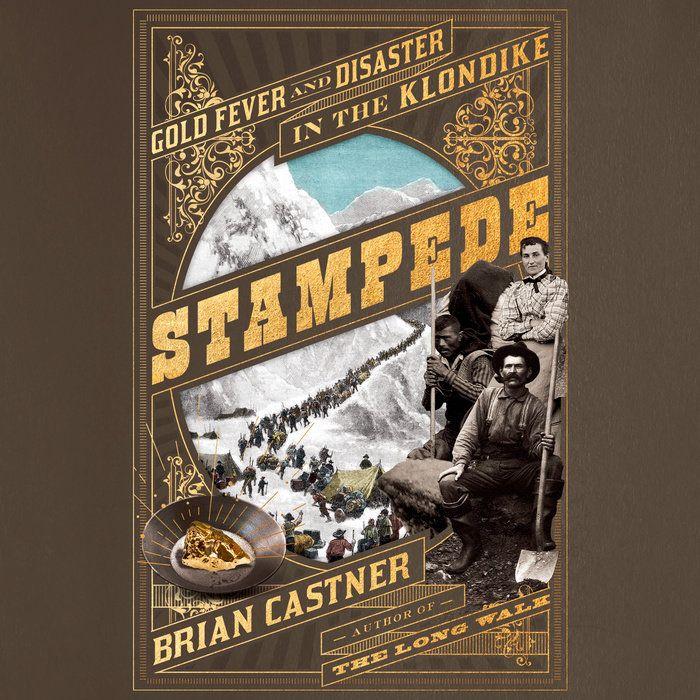
Stampede: Gold Fever and Disaster in the Klondike
Last updated 06:44 AM EDT • Read time: 10m
In an essay titled “On Going Places,” the artist Thomas Hart Benton wrote about the reasons so many people in America pick up and move. “They move on the wildest hearsay that for many results in more hardship and more violent and dangerous battles for mere food and shelter than would ever have been known had they rested content in familiar localities.” Unlike reasonable people, who give up freedom of movement for the security of a home place, these movers are “the most hilariously hopeful people imaginable,” Benton wrote. “The mere fact that they were off somewhere gave them an immense vitality.”
Benton’s description sheds some light on the motivations of people chronicled in Brian Castner’s excellent new book, Stampede: Gold Fever and Disaster in the Klondike (Doubleday, 2021). In the summer of 1896, a prospector named George Carmack claimed discovery of gold on a Klondike River tributary called Bonanza Creek, setting off the “Klondike stampede” that drew some 100,000 prospectors to Alaska. Unfortunately, the vast majority suffered incalculable hardship. Castner, a former Air Force EOD officer, estimates that 75 percent of all prospectors were “shipwrecked, shot, suffocated, frozen, starved, drowned, or gave up and went home.” Less than one-third of all prospectors who set off for the Yukon even completed the journey. Where Benton saw romance and the spirit of adventure in people who got up and moved under the “persuasive voice of rumor,” Castner focuses on the hard reality that most prospectors were desperate and found only misfortune. I spoke with the author about the Klondike Gold Rush, his research, and his previous work. Our conversation has been condensed and lightly edited for clarity.
Klondike Gold Rush happened between the American Civil War and World War I. What does the Gold Rush represent from a historical perspective?
The action in Stampede began in 1897. That’s about 50 years after the California Gold Rush and only 30 or so years after the Civil War. We think of those years as the heart of the story of the Old West. Tombstone, Arizona, and the gunfight at the O.K. Corral happened in the early 1880's—those frontier stories shape our imagination. By 1897, people were calling the Klondike Gold Rush the “last chance,” so to speak. The last place without a telegraph; last place without a railroad. This was the last chance to start over and your last chance to find an undiscovered or unclaimed town. Obviously, Alaska was inhabited by indigenous people, but the myth was, "look at this incredible, massive country that we can move into and take over.” There were former Civil War generals that went to the Klondike, and even Wyatt Earp ends up going to Alaska, though his trip happened after the period of time covered in my book. Then, immediately after the Klondike Gold Rush—as soon as 1900 hits, actually—Teddy Roosevelt is on the scene, and everything becomes about the future. McKinley was assassinated in 1901 and, suddenly, he represents an old legacy, and there are new people coming in and looking ahead. The Klondike Stampede immediately became history; by 1899, Dawson City was a tourist trap. So, you can see this is a myth from the very beginning, and I like demythologizing.
I’ll add one more thing. To me, it's okay to read about the past without there being an immediate hook to the present day. The amount of time people spend thinking about now is immense. We have become very focused on "time now," and so our proportion of now is off the charts. I enjoyed writing this book because I was not thinking about "now" but about a bygone era. I wanted this book to be immersive and transportive. The Klondike Gold Rush was a kind of Ponzi scheme in that the first comers did find riches, and all those who came afterward were lost and taken advantage of. If people are looking for parallels, we see people moving all over the world and facing the same challenges of seeking opportunity and enduring hardship.
Where did the research begin?
I started with a broad survey of the overall landscape and Pierre Berton’s Klondike Fever, which was published in 1958. This is the essential and definitive story, and Berton has a strong, writerly voice that gave me a good sense of what was going on overall. Now, I put that book away after the very beginning in order to keep myself from writing like Berton, as I've noticed another writer's voice can start to creep into my writing. Next, I went to the Yukon archives and the Snow Papers from Dartmouth and the old newspapers from that era. I write chapter-by-chapter and each chapter focuses on one character, so the book breaks down into mini-biographies or stories. For me, writing is like framing a house in that once I have a pretty good sense of what the thing looks like, I can frame it out – windows go here, and door goes there and so forth. I made four trips to Alaska for the research. The most important trip was hiking the Chilkoot Trail—that’s s the iconic experience that sets the story.
You didn’t graduate from a writing program or journalism school. You're not a historian. How did you learn to write this book?
Practice, I guess, but I suppose you’re asking ‘what qualifies me to do this job?’ I didn't try to become an academic historian, and I didn't pretend I was going to find a new theory or new lens from the archives. I was just trying to tell the best story I could and make an interesting narrative. These are the skills I bring from writing a couple books and doing journalism through the years. I also looked for characters. For example, Anna DeGraf is not a principal character in most stories of the Klondike Gold Rush, but there was so much material—journals, memoirs, diaries—and I used all of it as interview notes, as if somebody else interviewed Anna and others, and I took their notes to make my own story. My background helps, too, because being a bomb tech taught me to notice a lot of small things and details, which is what makes good writing. For instance, I hiked the Chilkoot Trail and made a lot of observations, and then I compared my observations to Jack London’s because those mountains haven’t changed in 100 years. There’s another question embedded in what you’re asking, and that’s ‘why do it at all?’ Well, I love the outdoors; I love Alaska; and I love stories of the Arctic and Antarctic. This is what I read, and I’m always on the lookout for stories. The other thing that drew me to the Klondike was that I hate glorification and mythmaking and romance in these stories. I felt this on my last book, Disappointment River (Anchor, 2018). Being on the Klondike Gold Rush was mostly about being cold and wet and dying of scurvy or shipwreck or an avalanche. Now, that’s not the story or the American myth. We think of plucky prospectors with lots of gold, and so whenever I encounter that kind of myth, I need to pop the bubble. It’s the same way I think about war.
You mention your interest in characters—there are plenty in the book. Tell me about Robert Henderson.
He was a guy who worked hard and ate untold piles of dog crap and put his body on the line and he gets screwed over by other miners and by the environment. He is ill-fated.
Henderson is credited with helping kick off the Klondike Gold Rush, finding gold at the mouth of the Klondike River on Gold Bottom Creek in the summer of 1896. He invited other miners to join him on Gold Bottom Creek, but those other miners didn’t return the favor when they struck gold on nearby Bonanza Creek. Not sharing information was a violation of the unwritten prospectors’ code, I gather.
Well, the other side to that is Henderson was such a bigot that he ends up getting what was coming to him and that if he had just been more open-minded, he could have been more successful.
Henderson disparaged indigenous people.
Henderson was unlikable. The law was not enforced. It was a military district and not a state. The only law they had was how they treated each other and how they enforced treating each other. The miner’s code was not Athens and Sparta – they were not forming new ideals. The miners’ moral code was purely pragmatic, a “this is what it takes to stay alive” sort of thing. If you find a strike, you should tell everybody else, and if you tell everybody else, then we're all going to do better together.
Jack London appears in this story. Tell me what you found.
I found that London was more legit than I thought. Norman Mailer was a cook. Hemingway exaggerated his wartime exploits. London was an oyster pirate in San Francisco Bay. He had awful factory jobs. He once took the job of a guy who was shoveling coal, where he was not paid by the hour but by the load, and it was literally impossible to shovel all the coal. All London’s stories and novels came from the real substance.
The Call of the Wild and White Fang were set in the Klondike Gold Rush.
Yes, the early Jack London was for real, no matter what he turned into afterward. London had very staunch political views. Later, he got into the eugenics craze and drifted politically, but the early London was an oyster pirate and sailor and adventurer.
Stampede includes an ancestor of former President Trump. What does that mean?
I went looking for Frederick Trump, who was the grandfather of Donald Trump. I had heard somewhere along the line he was part of the Klondike. There is actually very little about him in the records. There was a brothel involved and horsemeat dinners, and this means that Frederick Trump was like any other businessman up there, and I think it’s really only interesting in retrospect. I wouldn’t want to overstate the case.
Let me ask for recommendations. Best book you’ve read recently?
Michael Patrick Smith’s The Good Hand about the oil boom in North Dakota. Smith had been a folk singer in New York and this story is about working on the oil patch in 2013. It’s his first book.
What about movies?
The Thin Red Line is one of my favorites. I love Terrence Malick. Tree of Life is a movie that breaks me every time. In fact, it might be my favorite of all time.
Your memoir The Long Walk was made into an opera. How did you experience your memoir as opera?
It was odd to see my memoir become an opera. Of course, it was an honor, and it was incredibly stimulating on an intellectual level. Singers, librettist, everything—how it all fit together. The opera is better than my book because the story slimmed down into something more high-density, more emotional. From the experience, I think opera works because it is all of human artistic endeavors in one place. Music. Performance. Orchestra. Theater. Visual art. The effect is emotional heroin directly into your veins—the best and purest version, artistically. Yeah, the people involved understood what I was trying to do, and so my only wish is that the opera had made it more places.
John Waters is a writer based in Nebraska.

A Defense Win for Americans and Israelis in Arkansas
By Bradley Bowman • RealClearDefense
A Path to Success Against Iran
By Michael Schwartz • RealClearDefense
The World Cup Is Over. The Drone Threat Isn’t.
By Mitzi Perdue • RealClearDefense
AI Should Speed Veterans’ Benefits, Not Decide Them
By Rob Schroder • RealClearDefense
Don’t Be Swayed by Tactical Nukes
By Benjamin Giltner • RealClearDefense

Big Surface Combatants are so Hot Right Now
By CDR Salamander
USS Stout Loses Power During Port Visit Due to ‘Engineering Casualty’
By USNI News
Air Force Lessons Learned From Operation Epic Fury
By Tabitha Reeves, National Defense
Marines Need Nine More Amphibious Warships To Carry Out Its Missions
By TWZ
AFRL, ACC Fly XQ-67A Drone To Test Autonomous Teaming
By Airforce Technology