
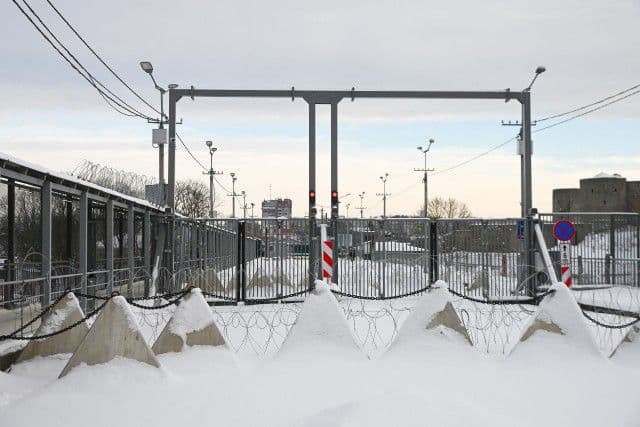
The Baltic Is NATO's New Front Line
Last updated 04:48 AM EDT • Read time: 4m
In July 1940, just days after the Soviet Union occupied Lithuania, Soviet foreign minister Vyacheslav Molotov warned the Lithuanian deputy prime minister that ‘in the future, small nations will have to disappear.’ The Baltic states and Finland, Molotov added, would ‘have to join the glorious family of the Soviet Union.’
Historical analyses of European security have tended to relegate the Baltic region to the sidelines, focusing instead on major players, such as Britain, France, Germany and the Mediterranean states. Russia’s war of aggression in Ukraine has forced us to rethink this traditional perspective.
In Baltic, Oliver Moody explains how in the space of just a few years, the Baltic region has moved to centre stage, becoming the geopolitical key to Europe’s future. Moody has been the Berlin bureau chief of The Times since 2018, covering Germany and northern and central Europe.
Moody’s argument is straightforward. Of all Russia’s possible invasion plans, the most predictable is an attack towards the west. And in this scenario, Russia is most likely to start with the Baltic peninsula, the smallest and most vulnerable part of NATO. As a result, it has never been more important to understand the political and security issues surrounding the Baltic.
Moody starts with a review of the littoral states: the Baltic republics of Estonia, Latvia and Lithuania; their Nordic neighbours Denmark, Finland and Sweden; and fellow NATO members Germany and Poland. Russia has access to the Baltic Sea through its second largest city, Saint Petersburg, and its military exclave Kaliningrad, which is squeezed between Poland and Lithuania.
Each of the Baltic borderlands is different. The small size and populations of the three Baltic republics make them particularly vulnerable to Russian incursion. Their defence is made more difficult by each having large Russian-speaking minorities.
Militarily, Poland is by far the best prepared. History has taught Poland many bitter lessons. It was overrun in rapid succession by Nazi Germany and the Soviet Union in World War II and, according to Moody, now sees itself as having ‘a special responsibility to defend the frontiers of Europe against Moscow’s designs.’
Poland’s military expenditure last year was 4.7 percent of GDP. It’s rapidly expanding its armed forces of more than 200,000 active personnel and already has almost as many tanks as Britain, France and Germany combined. It has also been Ukraine’s most outspoken supporter, providing shelter for an estimated two million displaced people.
Sharing a 1,340 km-long border with Russia, Finland is also used to living in Russia’s shadow and has maintained a strong and well-equipped military.
In stark contrast, Germany, Europe’s economic powerhouse, has for decades neglected its armed forces and been ambivalent towards Russia. When Russia attacked Ukraine, the head of Germany’s army complained publicly that his forces had been left ‘more or less naked.’ Heavily reliant on energy imports from Russia, Germany delayed revamping its military and was not always fully behind Ukraine, to the frustration of its allies. With a new chancellor, Friedrich Mertz, elected last year, Moody is optimistic that this is changing.
What does Russian President Vladimir Putin ultimately want? Optimists think he will be satisfied with weakening the West and chipping away at its cohesion. They argue that the Baltic republics were never an integral part of Russia and are not at risk. Others are less sanguine and assume that Putin is preparing for a possible invasion of the Baltic states.
To lay the groundwork for direct military intervention, Moody reminds us that ‘special operations’, ‘active measures’ and the ‘torment of shadows’ have well-established places in Russia’s strategic toolkit, as do disinformation and subversion. In recent years, Russia has built up its expertise in hybrid operations and electronic warfare. And its economy, although precarious, is geared up for war.
Everything, Moody stresses, depends on what happens in Ukraine. ‘The weaker Russia’s position becomes on the ground, the less likely it is to gamble on military adventures elsewhere.’ Consequently, the West has an existential interest in helping Ukraine to win the war. Putin must be made to understand that Russia cannot win in Ukraine or anywhere else.
As George Kennan, the master strategist behind the United States’ postwar containment policy, observed, Moscow may be ‘impervious to the logic of reason’, but it is ‘highly sensitive to the logic of force.’
Thoroughly researched and a gripping read, Baltic provides a timely reminder of how rapidly the global strategic outlook is changing.
Robert Wihtol is an adjunct faculty member at the Asian Institute of Management and former Asian Development Bank country director for China and director general for East Asia.
AI contributed no ideas to this article – Robert Wihtol.
This article appeared originally at The Strategist (ASPI).

In Pursuit of Nuclear Abolition
By Peter Huessy • RealClearDefense
Innovation Alone Won’t Prepare the U.S. for the Future Battlefield
By Joshua Segal • RealClearDefense
The sUAS Tactical Trifecta
By Bryan T. Woody • RealClearDefense
The Revolutionary War: When Strategic Options Share the Same Weakness
By Henry Yep • RealClearDefense
The Houthis Are Testing the Limits of Collective Defense
By Saima Afzal • RealClearDefense

Who Shoots Down the Drone Over the Shipyard?
By John Ferrari & Dillon Prochnicki • RealClearDefense
Northrop Grumman Breaks Out the Big Guns at AUSA
By Daniel Terrill, Defense News
Army Pursuing Diverse Array of New Anti-Air Interceptors
By Trevithick, The WarZoneWho Shoots Down the Drone Over the Shipyard?
By John Ferrari & Dillon Prochnicki, RCD
F-35C Lands for the First Time on a Ford-Class Aircraft Carrier
By The Aviationist