
The Guardians
Last updated 06:56 AM EDT • Read time: 8m
"Who controls the past controls the future. Who controls the present controls the past." — George Orwell, 1984
Orwell understood something authoritarian regimes still understand today: control over history is a form of power.
During three decades working in conflict zones, I met men and women willing to risk their lives not simply to defend their countries, but to defend their history. They were police officers, archaeologists, museum curators, customs officials, border guards, and ordinary citizens. They came from different nations and spoke different languages, yet they shared a common conviction: preserving a people's cultural heritage was essential to preserving the people themselves.
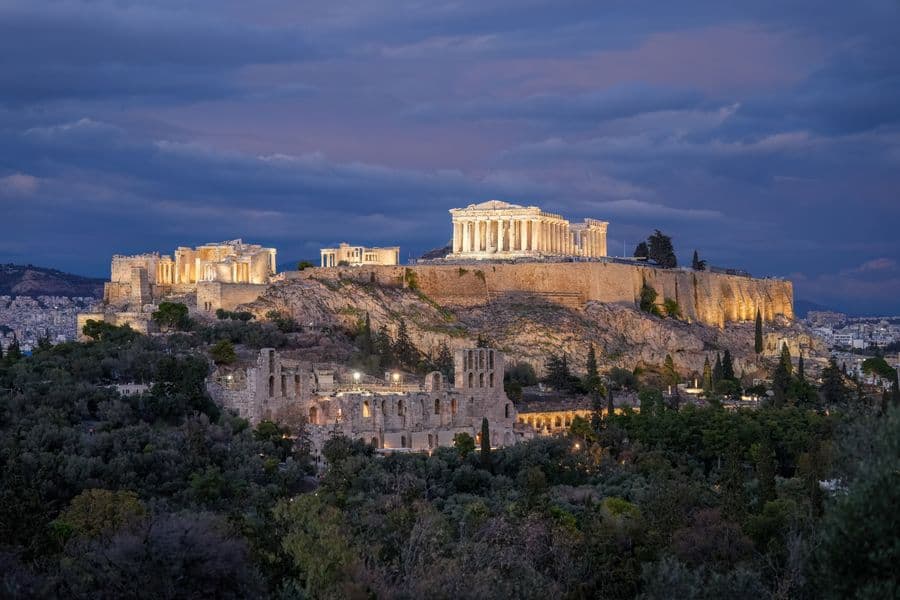
I first came to understand that truth not in a museum or a classroom, but on a sunlit hillside overlooking Athens. As a young naval midshipman visiting the Acropolis, I expected to see remarkable ruins. Instead, I encountered something far more enduring: the living connection between a people and their past.
During a six-month deployment, I found myself running down the slopes below the Acropolis in Athens, pursued by police dogs after climbing over the fence well past closing time. Looking back, the youthful mischief is far less memorable than the setting itself. Towering above stood one of history's enduring symbols of democracy and Western civilization—the Parthenon.
At the time, I saw the Acropolis simply as an ancient monument. I gave little thought to the generations who had struggled to build, preserve, and defend it, or to what it represented to the Greek people and to civilization itself. Years later, after spending much of my career investigating crimes involving cultural heritage, I often found myself thinking back to that evening. Long before I understood the strategic importance of protecting cultural heritage, the Acropolis—and perhaps the Greek gods themselves—had quietly planted the first seed of curiosity about the relationship between history, identity, place, and those who dedicate their lives to protecting them.
That lesson would return in an unexpected setting. My first professional encounter with cultural heritage crime came not in Greece, but during an FBI investigation that revealed just how deeply people will risk everything to protect their heritage.
It came in the mid-1990s while investigating a criminal organization smuggling diamonds, gold, and stolen works of art from Russia into the United States. Among the stolen objects were priceless Fabergé Imperial Eggs—treasures whose significance extended far beyond their extraordinary craftsmanship.
What surprised me most, however, was not the investigation itself but the investigators. Working alongside Russian law enforcement officers, I expected colleagues focused on solving another international crime. Instead, I found men and women driven by something deeper: a determination to recover pieces of their nation's history. To them, these objects were not simply valuable works of art. They represented Russia's cultural memory and identity.
Until then, I had viewed art theft as another form of organized crime. That investigation taught me that cultural heritage is rarely just property. It is history made tangible, and its loss is felt not only in museums or auction houses but in the collective memory of a people.
The next lesson came while investigating chemical attacks against the Kurdish people in northern Iraq. I noticed dozens of unusual hills scattered across the landscape. I learned they were ancient tells—the accumulated remains of settlements built one atop another over thousands of years. Having recently joined the FBI Art Crime Team, I visited an archaeologist at the University of Sulaymaniyah to better understand the challenges of protecting the region's extraordinary archaeological heritage.
She led me into a room where a large map covered with hundreds—perhaps thousands—of colored pins lay spread across a table. Each pin marked a known archaeological site. Astonished by their number, I asked how authorities could possibly protect them all.
She looked at me almost quizzically.
"The people protect them."
She explained that local communities regarded these places as the resting places of their ancestors. Families visited some of them during weddings, holidays, and other important occasions. The thought of looting them for profit was unthinkable.
At that moment, I realized these sites were being protected not primarily by police or governments, but by the people themselves. Years later, watching ISIS deliberately destroy archaeological sites across the region, I often thought back to that map and wondered how many of those countless pins now marked places that had disappeared forever.
The final lesson came during the war in Ukraine.
While traveling from Zagreb to Pula, Croatia, I noticed two women chatting animatedly in Russian aboard a small propeller aircraft. Assuming they were tourists, I paid little attention.
I was traveling to help lead an advanced workshop for senior law enforcement, border, and customs officials responsible for investigating crimes involving works of art, antiquities, archaeological site destruction, and museum security.
Waiting for our luggage in the arrivals terminal, I discovered the women were not tourists at all. They were Ukrainian officials selected by their government to participate in the week-long training program. Introducing myself in Russian, I learned they had spent more than forty-eight hours traveling by bus, train, and plane from a country at war.
They had not come seeking refuge.
They had come to learn how to better investigate and document Russia's systematic looting and deliberate destruction of Ukraine's museums, archaeological sites, churches, archives, and works of art.
Throughout the week they described museum collections hidden for safekeeping, archaeological sites destroyed, churches damaged, archives threatened, and cultural treasures stolen from occupied territory. The scale of the destruction was staggering.
Yet what impressed me most was not the devastation they described.
It was their determination.
They were neither defeated nor consumed by anger. They were calm, focused, and resolute. Every lecture, every practical exercise, and every discussion represented another opportunity to return home better prepared to protect what remained of their nation's history.
Listening to their firsthand accounts, I realized that the systematic destruction of Ukraine's cultural heritage was not simply an attack on buildings or museum collections. It was an assault on a nation's identity, memory, and history.
I had mistaken them for tourists.
They were guardians of their nation's history.
Over three decades, I have encountered guardians like them on several continents. They have worn different uniforms, spoken different languages, and defended different histories. Yet they all understood something I had to learn slowly over the course of a career.
Cultural heritage is never simply about preserving old stones, ancient artifacts, or museum collections. It is about preserving the evidence of who we are, where we came from, and what binds one generation to the next.
When authoritarian regimes seek to erase that evidence, they are not merely destroying objects. They are attempting to sever a people's connection to its own past.
The true guardians of civilization are rarely famous. They are the archaeologists, curators, police officers, border guards, customs officials, scholars, and ordinary citizens who quietly refuse to allow that past to disappear.
If peace finally comes to Ukraine, negotiators will rightly focus on borders, security, reconstruction, and the return of prisoners. They should also remember the quiet guardians who spent the war protecting something no less essential: their nation's history. The museums, churches, archives, archaeological sites, and works of art that survive this war are more than property to be restored. They are the physical evidence of a people's existence, memory, and identity. Those who stood watch over that history throughout the war deserve a voice in shaping the peace that follows—not because they seek recognition, but because they understand what is at stake.
I often think back to the archaeologist in Iraqi Kurdistan and the map covered with thousands of colored pins marking ancient settlements. When I asked how anyone could possibly protect them all, she looked at me almost quizzically and replied, "The people protect them."
Only years later did I fully understand what she meant.
She was not simply describing how one community protected its past. She was reminding me that civilization survives because ordinary people choose to protect the inheritance of those who came before them for those who will come after. The Russian investigators, the Kurdish villagers, the two Ukrainian women, and countless others whose names history may never record all understood that truth.
In the end, we are all the people.
Dennis T. Cosgrove is a former FBI Special Agent, legal attaché, and former Head of the Border Security and Management Unit at the Organization for Security and Co-operation in Europe in Vienna. He worked extensively in Central Asia, the former Soviet Union, and the Balkans in a variety of law enforcement, diplomatic, and international security roles, including numerous assignments with U.S. Embassies overseas. He writes on geopolitics, transnational threats, and strategic affairs, and is the author of two published books with a third currently in progress.

In Pursuit of Nuclear Abolition
By Peter Huessy • RealClearDefense
Innovation Alone Won’t Prepare the U.S. for the Future Battlefield
By Joshua Segal • RealClearDefense
The sUAS Tactical Trifecta
By Bryan T. Woody • RealClearDefense
The Revolutionary War: When Strategic Options Share the Same Weakness
By Henry Yep • RealClearDefense
The Houthis Are Testing the Limits of Collective Defense
By Saima Afzal • RealClearDefense

Who Shoots Down the Drone Over the Shipyard?
By John Ferrari & Dillon Prochnicki • RealClearDefense
Northrop Grumman Breaks Out the Big Guns at AUSA
By Daniel Terrill, Defense News
Army Pursuing Diverse Array of New Anti-Air Interceptors
By Trevithick, The WarZoneWho Shoots Down the Drone Over the Shipyard?
By John Ferrari & Dillon Prochnicki, RCD
F-35C Lands for the First Time on a Ford-Class Aircraft Carrier
By The Aviationist