
The Logic Behind U.S.-ROK Nuclear Submarine Deal
Last updated 05:48 AM EST • Read time: 6m
South Korea is no longer merely buying American security; it is building in interdependence.
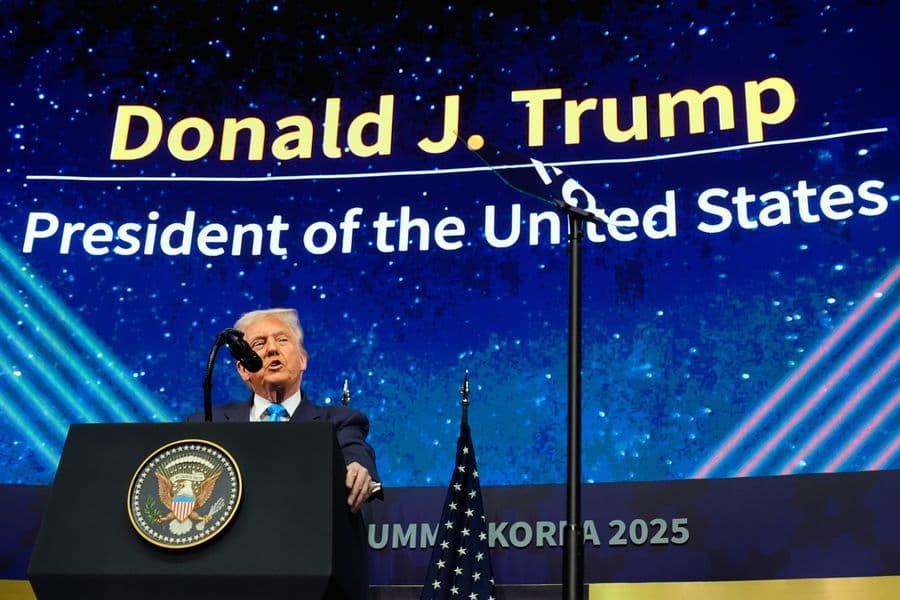
The dust from the APEC summit in the South Korean city of Gyeongju has settled, and the commentariat has, perhaps understandably, focused on the tactical U.S.–China truce. But the real, lasting tectonic shift of the week was not the temporary rhetorical ceasefire between Donald Trump and Xi Jinping. It was the permanent, structural deal struck between Trump and South Korean President Lee Jae-myung.
President Donald Trump’s declaration that he had given South Korea a green light to build a nuclear-powered submarine (SSN) was a geopolitical earthquake. It marks a departure from seven decades of U.S. non-proliferation doctrine and appears to elevate South Korea into the most exclusive tier of U.S. allies – a group previously limited to the United Kingdom and, more recently, Australia.
Scepticism, as captured in South Korea’s Yonhap News analysis, was immediate and understandable. How can such a deal be genuine or sustainable? Trump’s foreign policy style has often been described as transactional and unilateralist. The U.S. Congress has not voted on this matter. Future administrations could reverse course. And, most critically, the AUKUS pact to provide Australia with SSNs is already mired in delays, constrained by a U.S. industrial base that cannot even meet its own navy’s quota of two Virginia-class submarines per year.
Why, sceptics ask, would the Korean case be any different?
This line of questioning is logical – but it overlooks the stark reality of the new arrangement. The sceptics are asking the wrong question. They ask: Will the United States keep its promise? They should be asking: Has Lee engineered a situation in which the United States cannot afford to break its promise?
The answer appears to be yes.
This agreement is not a promise built on the shifting sands of political trust. It is a structural transaction anchored in steel, jobs, and mutual industrial dependency. South Korea – long perceived as the junior partner in the alliance – has just executed one of the most sophisticated strategic-industrial plays in modern history.
The myth of the gift
First, we must discard the notion that this was a gift. Lee did not approach Trump as a supplicant; he approached him as a buyer. He understood the transactional nature of contemporary U.S. diplomacy – that “America First” translates into allies shouldering greater responsibility – and he called Washington’s hand.
The price was the $350 billion investment package. But this is not a simple transfer of funds; it is a long-term industrial merger.
South Korean President Lee Jae Myung speaks during a visit to a shipyard owned by South Korean business conglomerate Hanwha Group in Philadelphia on 26 August 2025 (Matthew Hatcher/AFP)
Of this, $150 billion is earmarked for shipbuilding cooperation. This is not an abstract pledge. South Korea’s Hanwha Group – among the most efficient and technologically advanced shipbuilders in the world – is committing $5 billion to revitalise its U.S. shipyard in Philadelphia. The remaining $200 billion, heavily concentrated in semiconductors, follows the same logic: South Korean industrial capacity is being physically embedded into the U.S. economy.
This move dismantles the old anmi-gyeongjung (security with the United States, economy with China) framework. South Korea is no longer merely buying American security; it is integrating its industrial base with that of the United States to form a single, strategic-economic bloc.
Why this isn’t AUKUS – it’s stronger
Comparisons to Australia’s AUKUS deal are frequent but misleading. The Australian and Korean arrangements are inverses of each other.
Australia is a technology recipient – it is asking a strained U.S. industrial base to supply submarines, which American lawmakers often view as a zero-sum diversion from their own naval needs. AUKUS drains U.S. resources.
South Korea, by contrast, is a technology partner and industrial contributor. It is not requesting U.S.-built submarines; it is offering to help solve America’s shipbuilding shortfall.
As Washington-based think tank CSIS notes, the U.S. defence industry is struggling to meet its own naval production targets. The U.S. shipbuilding sector lags dangerously behind China’s in both scale and efficiency.
Lee and Hanwha Group have entered this crisis as problem-solvers. Their message is clear: We can help rebuild America’s naval capacity. South Korea brings proven technology, disciplined efficiency, and capital investment to U.S. shores.
The SSN approval, therefore, is not a political concession – it is the dividend of South Korea helping to rescue a critical American industry.
This transforms the calculus in Washington. Whereas AUKUS asks Congress to fund projects that strain U.S. resources, the South Korea deal enables lawmakers to support one that replenishes them.
A “too intertwined to fail” alliance
The structure of this deal makes it resilient – perhaps even immune – to political swings in Washington.
1. The congressional hurdle
It is true that South Korea’s ability to enrich uranium or reprocess spent fuel for naval propulsion requires amending the U.S.–ROK Civil Nuclear Agreement (the so-called 123 Agreement). This triggers a 90-day congressional review, during which lawmakers could pass a joint resolution of disapproval.
But how could a member of Congress from Pennsylvania vote no? Doing so would mean rejecting the revitalisation of the Philadelphia shipyard, terminating thousands of jobs, spurning a $350 billion investment, and weakening the U.S. Navy’s ability to compete with China. The deal has been structured so that opposing it is politically self-destructive.
2. The future administration hurdle
This is the essence of the “lock-in”. The agreement is not dependent on Trump’s personal reliability; it is grounded in industrial realities.
By the time a new administration takes office, Hanwha will be one of the largest employers in the U.S. defence-industrial base. Billions in capital will be sunk. A generation of South Korean naval officers will already be embedded in U.S. nuclear training programs. Semiconductor and shipbuilding supply chains will be so intertwined that separation would be economically and strategically ruinous.
A future president could, in theory, cancel the deal – but doing so would sabotage the U.S. Navy, damage domestic employment, and hand Beijing a significant strategic victory.
The risk, therefore, is not that Washington will abandon Seoul, but that the United States has become structurally dependent on South Korea to sustain its own maritime power.
This is the hard reality of the new alliance. South Korea has anchored the partnership not in abstract assurances of friendship but in the physical foundations of a shared industrial base. In this new era, the ultimate security guarantee is mutual, irreversible interdependence.
The nuclear-powered submarine is merely the symbol; the real transformation lies in industrial fusion. This deal is not speculative. It is already underway.
Seong-Hyon Lee, PhD, is a senior fellow at the George H. W. Bush Foundation for U.S.-China Relations and an associate-in-research at the Harvard University Asia Centre. He resides in Boston.
This article appeared originally at Lowy Institute's the interpreter.

Iranian Cyber Operations
By Michael Groen • RealClearDefense
Reflecting on an Epic Horse Campaign in the Mountains of Afghanistan
By Brian Glyn Williams • RealClearDefense
The Godfather of American Foreign Policy Realism Speaks to Today’s World
By Francis P. Sempa • RealClearDefense
In Pursuit of Nuclear Abolition
By Peter Huessy • RealClearDefense
Innovation Alone Won’t Prepare the U.S. for the Future Battlefield
By Joshua Segal • RealClearDefense

Navy Civilianizes Six Former Flag Billets, Reduces Six to Captains
By Mongilio, USNI N.
Raytheon's $8B Contract for Strategic Comms Terminal Modernization
By M+A El
America’s Maritime Moment Will Not Wait
By CDR Salamander
Armor Up?
By Marine Corps Compass Points
Who Shoots Down the Drone Over the Shipyard?
By John Ferrari & Dillon Prochnicki • RealClearDefense