
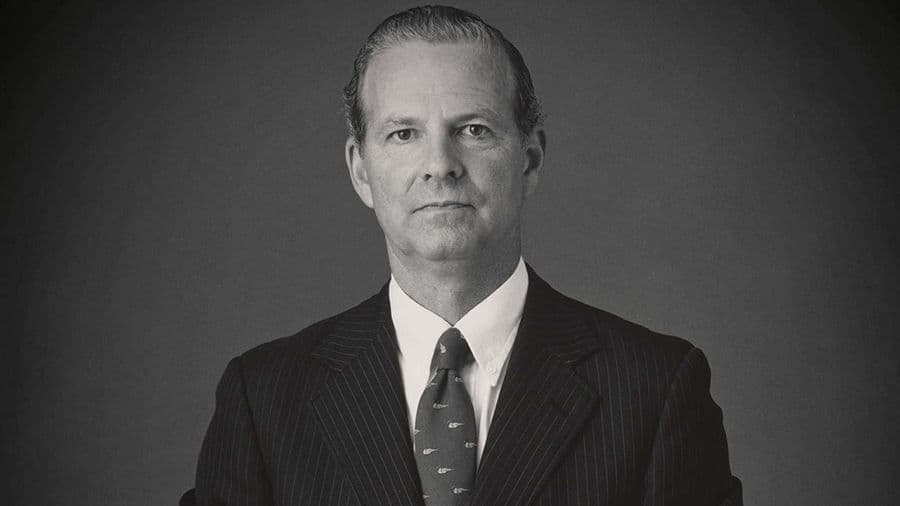
The Man Who Ran Washington: The Life and Times of James A. Baker III
Last updated 05:31 AM EDT • Read time: 11m
Susan Glasser and Peter Baker’s new book, The Man Who Ran Washington: The Life and Times of James A. Baker III, chronicles the life of an important political figure who catapulted to prominence during the last three decades of the post-World War II American century. The life of James A. Baker III, the consummate deal-maker and Washington insider, touches on several themes. Most notably, Glasser and Baker’s new biography touches upon the profound relationship between former tennis partners Jim Baker and President George H.W. Bush and gives that relationship human depth in telling of the forging of that relationship during the illness of Baker’s late wife, Mary Stuart.
In the best of the biographic tradition, the authors tell of an important and consequential man in a consequential era. In Baker's case, that is the story of a deeply-rooted Houstonian attorney who became involved in politics, eventually overcoming (to some degree) his public image as a mere political agent to become a principal and a statesman in his own right. The book also chronicles an era in Washington policymaking where bipartisan deals were possible, such as the overhaul of the Internal Revenue Code in 1986 under President Reagan.
While the authors’ interviews with Baker in the present day indicate that Baker laments that his Republican party has deserted him, he remains ever the canny politician. Deeply respectful of the democratic process, Baker finds himself unable to repudiate the current President.
The following is a condensed and lightly edited account of my interview with Ms. Glasser and Mr. Baker.
Two questions to start, why write a book about James Baker now, and what is the valence of his story in our current political moment.
Peter Baker: We actually started before Trump was even on the scene. We started writing the book in 2013, and we had become struck by how much Washington, even then, had collapsed upon itself, how it had become increasingly dysfunctional and increasingly unable to do even the most basic blocking and tackling, much less the really hard stuff.
Baker, to us, represented a different time and a different way that Washington worked. It wasn't like it was perfect; it was hardly paradise. It was harsh and partisan and mean, but at the same time, there were times when people would sit down from different parties and tackle big issues. So, we thought that his story was kind of an important story about Washington—what's changed, what things were like in the past, and what things are like today.
The most critical relationship in this book is between President George H. W. Bush and James Baker. Talk generally about that relationship, and also the relationship with Baker and the wider Bush family.
Susan Glasser: That relationship is at the center of the book, no question.
What's fascinating is the intertwining of these two stories. Jim Baker couldn't have been Jim Baker without George Bush and vice versa. I think it is the case that George H.W. Bush would not have been President without having the great good luck of having Jim Baker as his best friend.
So, that makes their stories intertwined, and it also was a reminder of how history is not inevitable. Here, there was this incredible quirk of fate that Jim Baker and George H. W. Bush become doubles partners at the Houston Country Club— in fact, Jim Baker was already a two time singles champion at the Houston Country Club when George Bush showed up looking for a doubles partner.
But ultimately, what we found in the book was evidence—real evidence—of the closeness of their friendship. There is a letter in the book that's not been previously published that is from Baker to Bush where Baker reveals that his wife [Mary Stuart] has been given a fatal cancer diagnosis and that he hasn't told anyone, not his mother, not even his wife, not his children about that diagnosis. [Confiding that to Bush] created the kind of bond that is unlike any other that we've seen between a President and a Secretary of State. It's really an extraordinary thing.
When they come to Washington, and they're working together, it's like any kind of family business. There's the inevitable tensions and jockeying. Barbara Bush clearly harbored some sourness at Baker after the 1992 election defeat, in particular. But, look at how it ended up. Look at how Baker was the last person with Bush [prior to President Bush’s death]. He was there to the very end, rubbing his feet; he was at his house on the day that Bush died. The image of Baker weeping in the National Cathedral, for me, that was just a really powerful sight. Maybe their relationship began as sort of older brother/younger brother relationship, and I think that’s how their relationship concluded.
Another theme of the book and Baker's life is the tension of being an agent versus being a principal. When he starts out, he is more on the staff side, but he always wanted to cross over to be a principal. That comes through after the 1992 election, where the book discusses his semi-serious consideration of running for the presidency.
Peter Baker: For him, the quest to get away from being a handler defined a lot of his time in Washington. He was very good at being a handler. He came into Ford's campaign with no real experience, helped President Ford beat off Ronald Reagan at the Republican convention, and then helped engineer an almost 30 point comeback against Carter in the general election, although President Ford did not end up winning that election. He also helped put George H.W. Bush in 1980 on the map in the race for the Republican nomination, ultimately earning him a spot on the ticket as Vice President.
I think he got tired of that though and wanted to be a statesman, wanted to be a principal. He wanted to be doing the big things, and that was the driving force for him for so long. Which is why, in 1992, when Bush wants him to come back to salvage his flagging campaign against Bill Clinton, Baker was so reluctant because he felt had finally transcended his role as a fixer. Baker wanted to make Middle East peace; he wanted to be on the world stage. He didn't want to be counting balloons and confetti that was going to fall at a convention. The day he leaves the State Department [to help run President Bush’s unsuccessful reelection campaign], I think, is the only day people can remember him having tears in his eyes until the Bush funeral, as Susan mentioned. I think that tells you how much he wanted to transcend this idea of being a handler. He didn't want to be just a handler. He wanted to be a statesman, he wanted to be a principal. In fact, he was—he took those skills of being an operative and translated them to that statesman role, and in the end, he was Secretary of State in some of the most extraordinary moments of our recent history.
What are the conditions that would allow for a kind of a new James Baker type figure to come back to Washington?
Susan Glasser: Well, that is the question, with a capital "T."
Number one, we do conclude, reluctantly, that Baker was a product of his times in the sense that it's not like if someone just like Jim Baker came along right now, he or she could magically fix things, just by exercising Baker’s famous negotiating skills. Even Jim Baker couldn't fix this by himself. Second, the structural incentives in Washington for Baker’s kind of bipartisan governing and deal-making have been exploded. They just aren't there anymore. While certain kinds of structural reforms or reforms on Capitol Hill might increase slightly at the margins, the incentive to engage in constructive negotiation with the other party, the political polarization seen in Washington, is one major reason for the lack of that deal-making.
One other reason is that campaigning has retreated away from the persuasion of a mass of undecided voters in the center and to the mobilization of your own committed fan base, as Newt Gingrich and others first identified. In that situation, you have no incentive for responsible governing and every incentive for permanent campaigning and offering people rhetoric that gives them what they want, regardless of what you actually do in office. You also have to say that Baker's Republican Party, in particular, has waged war on the very concept of the government and of good governance over the last two decades. The Party's core principle has been that the Federal government is too big and shouldn't exist in the format it exists now. So it's not entirely surprising that it has not produced great practitioners of the art of governing. Its official ideology is to make war on it.
Baker himself absolutely was a small government conservative but was a product of the post-war American century. There was a different view about the role of public service than there is now.
Baker’s life illuminates the recent history of the Republican Party, too. Develop that concept.
Peter Baker: I think there's only a few people probably in the last half century who have done more to shape what the Republican Party was prior to President Trump than Baker. Trump's arrival on the scene has crystallized or consolidated a change that had begun before him. But the Republican Party has moved away from the Baker view of the party. That's what he means in the book when he says the party has left him behind [in reference to the nomination of Trump]. I mean, Baker stood for free trade, he stood for alliances and internationalism, and for, at least in theory, anyway, fiscal responsibility. You can argue that he didn't always practice that, but these are all things that the current president has taken the exact opposite view on.
And so, the evolution of the party through Baker's life and through the lens of his career is really fascinating. Part of it's a post-Cold War redefinition of a party that had been, whose core unifying principle had been fighting the Cold War and then standing against the Soviets. Once the Soviets were gone after the 1991 collapse, they searched for a unifying force and, ultimately, through Newt Gingrich, ushered in an age that became far more partisan and far more divisive than it had been before.
Baker's story is, in some ways, the parable of the modern Republican party. His own struggle with how to think about Trump reflects that of the larger Republican establishment. He didn't like Trump. He thinks that Trump is irresponsible, and kind of buffoonish, and all the things that a lot of other people think, yet he wouldn't break with the Republican Party, in at least some things he thought were too important to give up, like deregulation and taxes and conservative judges.
President Trump became the nominee in part for his stance on what he viewed as the failures of the George W. Bush presidency in the Iraq War—a president Baker helped install through the Supreme Court’s review of the Florida recount in the 2000 Election. Unlike members of the Bush family, such as George W. Bush or George H.W. Bush, Baker never completely repudiated the candidacy of President Trump. Does that complicate the perceived closeness between Baker and the Bush family?
Susan Glasser: While that is a fair interpretation, I think the post-politics story is one of real closeness and almost familial affection. Politically they were their own persons. Baker's story is the story of Republicans and the Republican Party establishment. Baker had a clear read on Trump's character flaws. Baker's discomfort with him is both ideological, he doesn't agree with him on core tenants of foreign policy, but he is also somewhat offended by the incompetence of Trump's White House. The failure to institute even basic managerial controls, which of course, would offend someone like Jim Baker, who's widely held by both political parties to be the gold standard of a White House Chief of Staff.
Baker also told us in interviews that he also understood Trump's character and that he thought he was "crazy" and he thought he was "nuts," and yet his unwillingness to denounce him totally and his voting for him once at least and it looks like twice this fall, is a sign that Trump has largely succeeded. It may have been, as his son-in-law Jared Kushner told Peter recently, a "hostile takeover" of the GOP. But it's a takeover nonetheless, and I think that sort of anguished back and forth of Jim Baker helps to understand why it's succeeded.
But, it does seem like he has real respect for elections.
Susan Glasser: He may have more respect for that than the President himself.
Neil Hassler is a contributor to RealClearDefense and an attorney in private practice in Omaha, Nebraska.

In Pursuit of Nuclear Abolition
By Peter Huessy • RealClearDefense
Innovation Alone Won’t Prepare the U.S. for the Future Battlefield
By Joshua Segal • RealClearDefense
The sUAS Tactical Trifecta
By Bryan T. Woody • RealClearDefense
The Revolutionary War: When Strategic Options Share the Same Weakness
By Henry Yep • RealClearDefense
The Houthis Are Testing the Limits of Collective Defense
By Saima Afzal • RealClearDefense

Navy Civilianizes Six Former Flag Billets, Reduces Six to Captains
By Mongilio, USNI N.
Raytheon's $8B Contract for Strategic Comms Terminal Modernization
By M+A El
America’s Maritime Moment Will Not Wait
By CDR Salamander
Armor Up?
By Marine Corps Compass Points
Who Shoots Down the Drone Over the Shipyard?
By John Ferrari & Dillon Prochnicki • RealClearDefense