
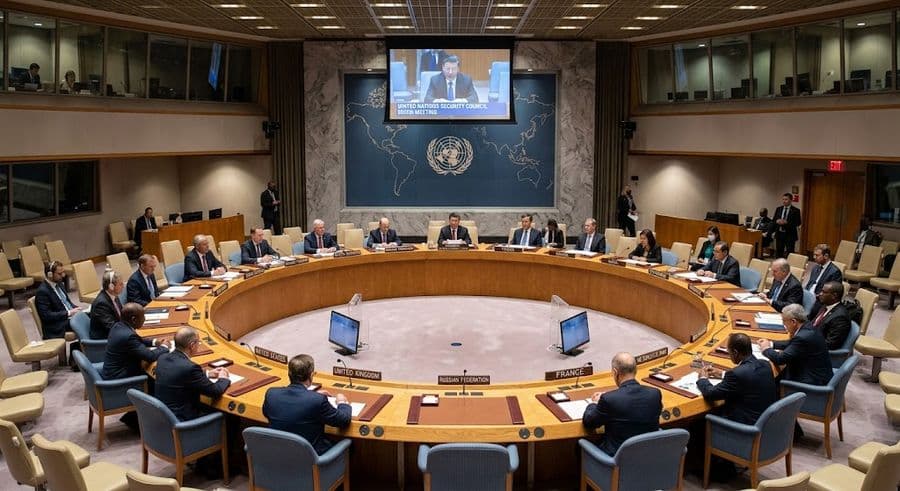
The Wrong Question in UN Security Council Reform
Last updated 06:34 AM EDT • Read time: 6m
When world leaders gather in New York for the 81st session of the United Nations General Assembly in September 2026, Security Council reform is once again expected to feature prominently on the diplomatic agenda. Nearly seventeen years after Intergovernmental Negotiations (IGN) formally began, Member States remain as divided over reform as they were at the outset. While almost every government agrees that the Council no longer reflects contemporary geopolitical realities, consensus disappears when the discussion turns to how it should change.
The persistence of this deadlock suggests that the reform debate may be framed around the wrong question. Most proposals begin by asking which countries deserve permanent seats. A more fundamental question, however, is whether expanding permanent membership is the most effective way to strengthen the Security Council's legitimacy, accountability and effectiveness. In an increasingly multipolar world, the challenge is no longer simply to enlarge the Council but to determine what kind of institution it should become.
A Council Designed for a Different World
The Security Council was established in 1945 to preserve international peace and security after the Second World War. Its structure reflected the geopolitical realities of that era. Five permanent members-the United States, Russia, China, the United Kingdom and France were entrusted with special responsibilities, including the veto, to ensure that the major powers remained committed to the new international order. The arrangement was intended to prevent direct confrontation among the victors while preserving the credibility and continuity of the United Nations.
That institutional design has remained remarkably resilient. Apart from the 1965 expansion of elected membership from six to ten seats, bringing the Council's total membership to fifteen, the basic architecture has remained unchanged for six decades.
The world, however, has changed dramatically. United Nations membership has expanded from 51 states to 193. The world's population has surpassed eight billion. Economic influence is no longer concentrated in a handful of Western powers, while Asia, Africa, Latin America and the broader Global South play increasingly important roles in international politics. Regional organisations have become more influential, new economic centres have emerged, and global governance now operates in a far more complex and multipolar environment than the one that existed in 1945.
This widening gap between institutional design and geopolitical reality explains why Security Council reform has become unavoidable. Africa remains without permanent representation despite accounting for more than one-quarter of UN membership. Latin America has no permanent seat, while influential regional actors across Asia and the wider developing world argue that the Council no longer reflects the diversity of today's international system. Institutions lose legitimacy when they cease to reflect the world they were created to govern. The Security Council's legitimacy challenge is therefore institutional rather than historical.
Recognising this imbalance, the General Assembly established the IGN framework in 2008, with formal negotiations commencing in 2009. The discussions focus on five issues: categories of membership, the veto, regional representation, the size of the Council and its working methods. Yet after almost two decades of negotiations, progress remains limited because governments continue to disagree not on whether reform is necessary, but on what reform should actually achieve.
The Permanent Membership Dilemma
The reform debate increasingly reflects two competing philosophies of institutional change. One argues that legitimacy requires expanding permanent membership to include today's leading powers. The other argues that legitimacy is better served by broadening representation without creating additional permanent centres of authority.
The first approach is represented by the Group of Four (G4)-Brazil, Germany, India and Japan which supports expanding both permanent and elected seats. The African Group similarly argues that historical injustice can only be corrected through permanent African representation with the same rights and responsibilities as existing permanent members. The France-Mexico Initiative, meanwhile, focuses on limiting the use of the veto in situations involving mass atrocities while leaving the Council's overall structure largely intact.
Each proposal addresses genuine concerns regarding representation, equity and legitimacy. Yet they also share an important underlying assumption: that expanding permanent membership is the natural solution to the Council's representational deficit. That assumption deserves closer examination.
The Security Council's legitimacy challenge is often described as a problem of representation. Yet representation and permanence are not synonymous. An institution can become more representative without becoming less accountable, just as it can become more inclusive without creating new permanent hierarchies. The real question is therefore not how many permanent members the Council should have, but whether permanence itself remains the most appropriate institutional model for twenty-first-century global governance.
The experience of the existing permanent members illustrates this dilemma. The veto has repeatedly shaped Council outcomes on issues ranging from Syria and Ukraine to Israel and Palestine, often reflecting national interests and strategic alignments rather than broad international consensus. Whatever position one takes on individual cases, these episodes demonstrate how concentrated permanent authority can complicate collective decision-making during major international crises.
Recent divisions over Gaza, Ukraine and Sudan have reinforced a broader concern: legitimacy depends not only on representation but also on the Council's ability to act during major international crises. A Security Council perceived as unable to act risks weakening confidence in the broader multilateral system, regardless of how representative its membership may appear.
Expanding permanent membership could improve representation for some regions, but it would also introduce additional permanent geopolitical interests into an institution that already struggles to reach consensus. Permanent membership is effectively irreversible. Once granted, it is not subject to elections, performance review or periodic renewal. Reform intended to increase legitimacy today could therefore reduce the Council's ability to adapt tomorrow.
Representation Without New Privilege
An alternative philosophy is advanced by the Uniting for Consensus (UfC) coalition, whose members include Italy, Pakistan, Mexico, Argentina, Canada and South Korea. Rather than expanding permanent membership, the coalition proposes increasing elected representation through longer-term and renewable seats while preserving the Council's existing institutional framework.
Ultimately, Security Council reform should not become a contest over which states deserve permanent status. Its central purpose must be to strengthen the legitimacy, effectiveness and adaptability of the United Nations’ principal security institution. Broader elected representation offers a promising path by widening regional participation while preserving accountability through periodic elections and renewable mandates. Although questions of regional allocation, mandate duration and re-election require careful negotiation, they should not obscure a fundamental principle: representation alone cannot guarantee legitimacy if authority becomes permanently entrenched. A more representative Council must also remain responsive to changing geopolitical realities. The future of reform therefore depends not simply on redistributing seats, but on reconsidering the institutional assumptions that have shaped the debate for decades. In an increasingly multipolar world, meaningful reform requires moving beyond the expansion of permanent privilege toward a Security Council in which representation, accountability and adaptability reinforce one another.
Saima Afzal is a researcher specializing in South Asian security, counterterrorism, and broader geopolitical dynamics across the Middle East, Afghanistan, and the Indo-Pacific. Her work examines strategic affairs and evolving patterns of regional conflict. She is currently a Research Scholar at Justus Liebig University, Germany.

Innovation Alone Won’t Prepare the U.S. for the Future Battlefield
By Joshua Segal • RealClearDefense
The sUAS Tactical Trifecta
By Bryan T. Woody • RealClearDefense
The Revolutionary War: When Strategic Options Share the Same Weakness
By Henry Yep • RealClearDefense
The Houthis Are Testing the Limits of Collective Defense
By Saima Afzal • RealClearDefense
Radio Frequencies in the Intelligence Ecosystem
By Craig Brower • RealClearDefense

Who Shoots Down the Drone Over the Shipyard?
By John Ferrari & Dillon Prochnicki • RealClearDefense
Northrop Grumman Breaks Out the Big Guns at AUSA
By Daniel Terrill, Defense News
Army Pursuing Diverse Array of New Anti-Air Interceptors
By Trevithick, The WarZoneWho Shoots Down the Drone Over the Shipyard?
By John Ferrari & Dillon Prochnicki, RCD
F-35C Lands for the First Time on a Ford-Class Aircraft Carrier
By The Aviationist