
Ukraine and "The New Ministry of Truth"
Last updated 09:25 PM EDT • Read time: 10m
Maurice “Chipp” Naylon graduated from the U.S. Naval Academy and commissioned as an infantry officer in the U.S. Marine Corps. In 2014, Naylon deployed as a combat advisor to Bagram, serving alongside soldiers from the Republic of Georgia as part of ISAF’s mission to provide “long-term security” to Afghanistan. Despite its small size, the Republic of Georgia deployed combat units to Afghanistan every year from 2010 until all troops were withdrawn at the end of August 2021.
In his memoir The New Ministry of Truth (Hellgate Press, 2019), Naylon describes his work as a combat advisor, training and deploying with the Georgian army, as well as his experiences on-the-ground when America declared an “end to combat operations” in the final days of 2014. Though the book's subject is war, this is not a traditional war story. “If you’re looking for the daily grind of battle that so many Marines and soldiers faced during their time in Afghanistan, this isn’t it,” Naylon writes.
Instead, this is one man’s story of what it was like to fight a war without a clear political objective, where the rules of engagement changed on the whims of image-obsessed, dealmaking politicians in Washington, DC. We talked with Naylon about Afghanistan, the consequences of political doublespeak, and what his firsthand experience training a post-Soviet military can teach us about the war in Ukraine. This transcript has been modified for clarity.
Your book is a critical perspective on the War in Afghanistan circa 2014-15. What happened there and why did you write this memoir?
The book follows the timeline from the moment I found out I was going to be a combat advisor through traveling over to Georgia, training with the Georgians, going to Germany for a month to do a mission rehearsal exercise, and deploying with them for seven months.
I wrote this book to provide lessons from the combat advisor perspective but also reflections on the Afghan war experience. The skills we learned by screwing up should be relevant to military advisors because there will be more advisors in some future conflict. Selfishly, I also wrote the book for catharsis. I left Afghanistan with tremendous anger about America’s policy - or lack thereof - in that country.
Combat operations in Afghanistan technically ended on December 31, 2014. What changed between December 31, 2014 and January 1, 2015? Did you guys hang up your kit and kick back with Netflix and a hot canteen cup of tea?
No. Nothing changed in our day-to-day operations. But suddenly the rules had changed.
Meaning American forces could no longer close with and destroy the enemy. The sands had trickled through the hourglass. Your time was up. Your role was to teach and assist the Afghan forces as they fought. Do we have that right?
Yes, but my point is that the risks were still the same. The enemy was still the same. The IEDs and rockets were still the same. Nothing changed besides what we were calling our operations in the media and Washington, DC, and the fact that we were suddenly restricted from fighting back. That’s where the title of the book comes from.
The book is “New Ministry of Truth,” a phrase you cribbed from George Orwell. What’s it like for troops on the ground when the government engages in doublespeak?
Well, no punches pulled, it fucking sucks. Tremendously detrimental to the morale of the troops on the ground. The thoughts of the guys out there operating are: “I don’t have support from the leaders above me; I don’t know why I’m risking my life.” So much of what we had to do as officers was to justify the risk our guys were taking to train the Afghan army and help rebuild their country. How much harder does it get to justify the risks taken when your government suddenly changes how it speaks about your sacrifice? Yes, I have tremendous frustration about U.S. policy in Iraq and Afghanistan. I adhere to the philosophy that military force should achieve some greater political objective. If you have military force committed without a clearly defined political objective, then you are wasting time, lives, and resources. I think guys and gals on the ground were thrown into this cavalierly by our legislative and executive branch policymakers. For 20 years they failed to define clear and attainable political objectives to focus the military’s efforts in Afghanistan. Simply put, we were fighting for the sake of fighting, with no obvious outcome to achieve.
You're upset about American foreign policy in Afghanistan. Why did we fail?
Groupthink. Sunk costs. Confusing measures of performance with measures of effectiveness. If you count the number of wheat fields, you get one number. But measures of effectiveness are a way of quantifying whether those wheat fields achieved their intended gains, or whether they provided enough food to feed the village. We tracked the number of troops deployed. Years spent. Money spent. Schools built. Enemies killed. The harder analysis would have been to evaluate whether the performance measures we obsessed over actually achieved their intended effectiveness.
Let's switch gears. You trained and deployed with the Georgian Army. Describe the morale of the Georgians.
Georgians had even less reason to fight in Afghanistan than we did. Their presence had everything to do with NATO accession— “if we contribute to the ISAF mission, it is more likely we will be accepted.” That’s what it seemed they believed. Yes, it was frustrating enough being an American in Afghanistan. It would be even more demoralizing to be a Georgian.
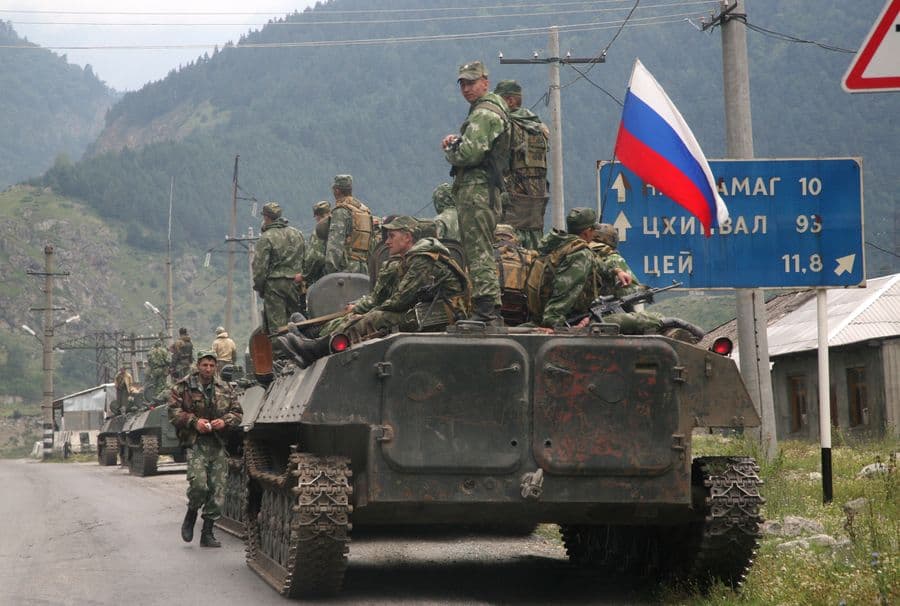
And how did Georgian soldiers feel about Russia and the Russian army?
Complete and utter disdain for Russians. The Georgians disliked the Russians even more than the Ukrainians disliked the Russians at that time. Georgians got their punch in the nose from Russia back in 2008. But, Ukrainian animosity towards the Russian invaders is most certainly on par - if not greater - now.
You’ve got recent, on-the-ground experience training a post-Soviet military. What was the biggest difference between the Georgians’ style of fighting and ours?
Lack of initiative and subordinate empowerment. The American military pushes leadership and decision-making down to the lowest levels of command. But the Soviets prefer to ask for permission. The Soviets instilled in their military leaders that you better ask “higher” for permission before making a decision, or else prepare to get punished when you screw up. There’s an old saying in Russian: “initiative fucks the initiator.” I think we’re seeing this model more so in Russia than Ukraine. Russia is top-down across the board. If something happens in Russia, it’s because the Kremlin allowed it. Ukraine is a much different model, much more horizontal, and I think it’s translating into military operations on the ground, where Ukrainians are more willing to seize fleeting opportunities when they arise. In the post-Soviet model, if you screw up as a subordinate, there is very little positive reinforcement or support—you will get thrashed. The Russians are currently dealing with this toxic climate, a reality clearly demonstrated by the many senior officers and generals dying on the battlefield. You have generals and colonels running to the front lines to try to get their troops to take action, an entirely different mindset than the initiative shown at all levels of the Ukrainian military.
Can you give an example of this mindset, something you wrote about in your memoir?
We were in Germany and working with U.S. Army soldiers who ran an IED training lane for our Georgian counterparts. I remember watching a fire team of Georgians go through the lane, identifying and navigating IEDs and other obstacles to execute their patrol. After finishing the lane, I saw the Georgian team leader go back and sort of surreptitiously tell the next Georgian team leader, the one in the chute, where the IEDs were located. Then, the next team went through the lane and, obviously, had no trouble identifying the IEDs.
Georgians thought they were “winning” the training event, is that right?
Right. We noticed this was happening and told the U.S. Army lane leader that the Georgians were basically doing it the wrong way—“gaming the game,” as we say in the military. So, the lane leader moves the IED. When the next team heads straight for that previous IED location and—lo and behold—there’s nothing there, the team leader is surprised and upset. It became a teaching moment of the difference between the mindset “do we look at training as a chance to improve” or do we want to “win the training.” Once we paused training and explained to them that the training is supposed to be unpredictable to simulate real-life combat, they were bashful but understood what we were attempting to teach and applied themselves as instructed.
You have some expertise in instructing a foreign military, specifically a post-Soviet military. How do you see the fight in Ukraine?
I’m just observing like everyone else, but I do have a vested interest. My wife is Ukrainian and her family lives there. From what I see and hear, the Ukrainians’ performance is driven by necessity. We either fight or disappear as a country, is how they see it. If Russia stops fighting, the war ends. If Ukraine stops fighting, Ukraine ends.
How do you reconcile the war drive you seem to regret with the blitheness of American public support for a long war in Ukraine?
I volunteered to join the military. Even if you disagree with the bigger picture or root causes for a war, there’s still value in joining up to serve and lead and do your best to help people who are suffering. I was able to balance my frustrations and disagreements with my desire to serve. Coming back can reinforce the beauty of what America stands for, and it can cause cynicism. I came back from Afghanistan very cynical as a result of my service there. And yet, there was no fear that I was going to be prosecuted for criticizing the war. I was able to speak my mind. But look at this Russian paratrooper Pavel Filatyev who just released his memoir criticizing Russia’s invasion of Ukraine, how he had to flee to France or else be captured and probably murdered. In America, you can come back home and criticize what happened over there and not be afraid of retribution. That’s part of the beauty of this country.
On policy, I believe we should provide Ukraine as many weapons as possible for as long as they are willing to fight, but I do not think we should commit U.S. troops to this fight. I will be the first to admit that Ukraine is not perfect and is still tackling elements of corruption, but it’s moving the right direction. Ukraine seeks Western-style democracy, education, and economics - not the kleptocratic, post-Soviet model of rampant corruption. The Ukrainian people demonstrated this in Maidan in 2013 and 2014, and they’re demonstrating it on the battlefield now.
Supporting the Ukrainians is also an effective way to fight back against Russia, our clear adversary. The Ukrainian troops are a no-kidding buttress against Russian advances deeper into Europe. There is no doubt in my mind that, if not stopped in Ukraine, it’s just a matter of time before Russia pushes deeper into eastern Europe and the Baltics. We need to support Ukraine for the long-haul to avoid such an outcome.
John Waters and Neil Hassler are writers in Nebraska.

In Pursuit of Nuclear Abolition
By Peter Huessy • RealClearDefense
Innovation Alone Won’t Prepare the U.S. for the Future Battlefield
By Joshua Segal • RealClearDefense
The sUAS Tactical Trifecta
By Bryan T. Woody • RealClearDefense
The Revolutionary War: When Strategic Options Share the Same Weakness
By Henry Yep • RealClearDefense
The Houthis Are Testing the Limits of Collective Defense
By Saima Afzal • RealClearDefense
Navy Civilianizes Six Former Flag Billets, Reduces Six to Captains
By Mongilio, USNI N.
Raytheon's $8B Contract for Strategic Comms Terminal Modernization
By M+A El
America’s Maritime Moment Will Not Wait
By CDR Salamander
Armor Up?
By Marine Corps Compass Points
Who Shoots Down the Drone Over the Shipyard?
By John Ferrari & Dillon Prochnicki • RealClearDefense