
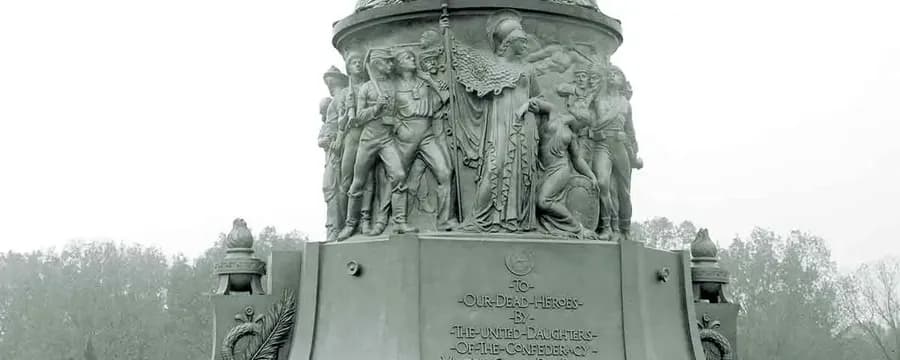
Arlington's Reconciliation Monument Should Return as a Soldier's Memorial
Last updated 06:28 AM EDT • Read time: 8m
The expected return of Moses Ezekiel’s Arlington monument should not be treated as a partisan trophy or cultural provocation. It should be treated as something more solemn: an opportunity to remember that soldiers, even when divided by cause, uniform, and flag, share a terrible common bond.
They fight. They suffer. They bury friends. Many never return home.
Arlington National Cemetery has announced that the U.S. Army entered an agreement with the Commonwealth of Virginia to display one of Moses Ezekiel’s historic sculptures at Ezekiel’s burial site, with display expected in 2027 after refurbishment.[1] The same Arlington page notes that the bronze elements of the Confederate Memorial were removed in December 2023 to comply with a congressionally mandated requirement to remove the memorial by January 1, 2024.[2]
That restoration gives the country a second chance to think more carefully. Arlington is sacred ground where the nation remembers the cost of war and the lives of those who gave everything they had. The question of what belongs there should therefore be handled with more care than the usual shouting match over monuments, politics, and public memory.
The monument sculpted by Moses Ezekiel was not merely a political object. It was created by a soldier-artist who personally understood the grief of war. Ezekiel was a Jewish-American sculptor, a Virginia Military Institute cadet, and a veteran of the Battle of New Market. Arlington identifies him as the noted American sculptor who designed the Confederate Memorial, a Confederate veteran, and the first Jewish graduate of VMI.[3] He was later buried at the base of his creation in 1921.[4]
That distinction matters.
To say that Confederate soldiers believed they were fighting for a just cause is not to say their cause was just. It is not to condone slavery, defend secession, or romanticize the Confederacy. But it is to recognize an enduring truth about soldiers: men often go to war believing they are defending home, family, duty, honor, and country. Whether history ultimately judges their cause right or wrong, the human tragedy of lives cut short remains real.
Captain Franklin Town, a Union veteran of the Battle of New Market, understood this. Reflecting on the charge of the VMI cadet battalion — the only time in American history that an entire student body of an American college fought in pitched battle as a unit — Town described the cadets’ charge in terms that still carry moral weight.[5] The Shenandoah Valley Battlefields account records that the cadets’ average age was 16, and that ten VMI cadets were killed or mortally wounded while another 50 were wounded.[6]
Town later wrote:
“As a military spectacle it was most beautiful, and as a deed of war it was most grand. When such young men fall in a cause in which they believe, whether it is intrinsically right or wrong, one may realize the sadness of cutting off a life so full of promise, yet all—those who approved and those who opposed the cause they died for—will accord them the tribute of sincere respect and admiration.”[7]
That statement is remarkable because it came from the other side of the battlefield. Town did not need to approve of the Confederate cause to recognize courage, sacrifice, youth, and loss. He could oppose the cause and still mourn the boys.
Ronald Reagan expressed a similar truth at Arlington National Cemetery on Veterans Day in 1985. Speaking of those who died in war, he said, “But most of them were boys when they died, and they gave up two lives—the one they were living and the one they would have lived.”[8]
That statement is not limited by uniform color, political cause, or battlefield position. It is true of Union soldiers. It is true of Confederate soldiers. It is true of Americans who died in Europe, the Pacific, Korea, Vietnam, Iraq, Afghanistan, and every other place where young men were asked to surrender futures they never got to live.
War is not abstract to soldiers. It is the loss of friends, the silence after battle, the empty chair at home, and the buried future of a life that might have been.
Moses Ezekiel understood that. His Arlington monument, unveiled in 1914, stood for more than a century as part of the nation’s attempt to remember the Civil War not only as a conflict of principle, but as a national catastrophe that required reconciliation. Arlington notes that in 1900 Congress authorized Confederate remains to be reinterred at Arlington, that the Confederate Memorial was erected in 1914, and that the creation of the Confederate section and memorial followed the cemetery’s customary practice of creating sections and monuments for the dead of particular wars.[9]
The monument was not placed at Arlington to restart the war. It was placed there because the war had ended, and because a divided country had to become one country again. Arlington notes that after the Spanish-American War, President William McKinley spoke in Atlanta of sharing in the care of Confederate graves “in the spirit of fraternity,” saying that “sectional feeling no longer holds back the love we feel for each other” and that “the old flag again waves over us in peace with new glories.”[10]
In recent years, more than 160 Confederate monuments have been removed from public land, some through official action and others by mobs.[11] In some cases, removal may be understandable. Not every monument was erected for the same reason, in the same context, or with the same purpose.
But Arlington’s monument occupies a different category. It was not simply a monument to a defeated cause. It was a reconciliation monument, created by a veteran who had known the cost of battle personally and installed in a national cemetery where military sacrifice is the central language of memory.
To remove such a monument without preserving its full meaning does not correct history. It narrows it.
The Civil War was not a crowning achievement in American history. It was a wound — perhaps the deepest wound the nation has suffered. But wounds must be remembered honestly if they are to teach anything. The proper response to difficult history is not erasure. It is context, humility, and truth.
A restored monument should include serious historical explanation. Visitors should be told who Ezekiel was, what happened at New Market, why Union veterans like Franklin Town could oppose a cause and still honor courage, and why the monument was erected at Arlington as part of a broader effort toward national reconciliation. They should also be told why Civil War memory remains painful and contested.
Soldiers understand that the man across the battlefield may be an enemy, but he is still a man. He may be wrong. He may be fighting under a flawed banner. But he may also be brave, loyal, disciplined, and willing to die for what he believes to be his duty. Recognizing that does not blur moral lines. It restores human ones.
The monument should return not as a celebration of the Confederacy, but as a soldier’s memorial and a reconciliation monument. It should remind us that war destroys futures, that honorable conduct can exist even in tragic and flawed causes, and that national unity, once shattered, is painfully difficult to restore.
If Moses Ezekiel’s monument returns, let it return with context, solemnity, and restraint. Let it stand as a tribute to American valor, a warning against national division, and a reminder that soldiers on both sides of a battlefield often share more in death than politicians are willing to admit in life.
CAPT Jonathan K. Corrado, U.S. Navy reserve, is a graduate of Virginia Military Institute class of 2005.
Notes:
[1] Arlington National Cemetery, “Confederate Memorial,” updated August 6, 2025,
https://www.arlingtoncemetery.mil/Explore/Monuments-and-Memorials/Confederate-Memorial.
[2] Arlington National Cemetery, “Confederate Memorial.” The page states that the bronze elements were removed as of December 22, 2023, to comply with a congressionally mandated requirement to remove the memorial by January 1, 2024,
https://www.arlingtoncemetery.mil/Explore/Monuments-and-Memorials/Confederate-Memorial.
[3] Arlington National Cemetery, “Confederate Memorial.” The page identifies Moses Jacob Ezekiel as the noted American sculptor, Confederate veteran, and first Jewish graduate of the Virginia Military Institute who designed the memorial,
https://www.arlingtoncemetery.mil/Explore/Monuments-and-Memorials/Confederate-Memorial.
[4] Arlington National Cemetery, “Confederate Memorial.” The page notes that Ezekiel was buried at the base of the monument in 1921,
https://www.arlingtoncemetery.mil/Explore/Monuments-and-Memorials/Confederate-Memorial.
[5] Scott Harris, “‘Put the Boys In’: The VMI Cadets at New Market,” Shenandoah Valley Battlefields National Historic District,
https://www.shenandoahatwar.org/put-the-boys-in-article.
[6] Scott Harris, “‘Put the Boys In’: The VMI Cadets at New Market.” The article states that the cadets’ average age was 16 and that ten cadets were killed or mortally wounded, with another 50 wounded,
https://www.shenandoahatwar.org/put-the-boys-in-article.
[7] Scott Harris, “‘Put the Boys In’: The VMI Cadets at New Market.” The article reproduces Captain Franklin Town’s reflection on the VMI cadets’ charge,
https://www.shenandoahatwar.org/put-the-boys-in-article.
[8] Ronald Reagan, Veterans Day Remarks, Arlington National Cemetery, November 11, 1985, U.S. Department of Veterans Affairs,
https://www.va.gov/opa/vetsday/speakers/1985remarks.asp.
[9] Arlington National Cemetery, “Confederate Memorial.” The page notes that Congress authorized Confederate remains to be reinterred at Arlington in 1900, that the memorial was erected in 1914, and that the creation of the Confederate section and memorial followed customary Arlington practice,
https://www.arlingtoncemetery.mil/Explore/Monuments-and-Memorials/Confederate-Memorial.
[10] Arlington National Cemetery, “Confederate Memorial.” The page quotes President William McKinley’s Atlanta Peace Jubilee remarks on Confederate graves and sectional reconciliation,
https://www.arlingtoncemetery.mil/Explore/Monuments-and-Memorials/Confederate-Memorial.
[11] Arlington National Cemetery, “Confederate Memorial Removal,”
https://www.arlingtoncemetery.mil/About/Confederate-Memorial-Removal

In Pursuit of Nuclear Abolition
By Peter Huessy • RealClearDefense
Innovation Alone Won’t Prepare the U.S. for the Future Battlefield
By Joshua Segal • RealClearDefense
The sUAS Tactical Trifecta
By Bryan T. Woody • RealClearDefense
The Revolutionary War: When Strategic Options Share the Same Weakness
By Henry Yep • RealClearDefense
The Houthis Are Testing the Limits of Collective Defense
By Saima Afzal • RealClearDefense

Who Shoots Down the Drone Over the Shipyard?
By John Ferrari & Dillon Prochnicki • RealClearDefense
Northrop Grumman Breaks Out the Big Guns at AUSA
By Daniel Terrill, Defense News
Army Pursuing Diverse Array of New Anti-Air Interceptors
By Trevithick, The WarZoneWho Shoots Down the Drone Over the Shipyard?
By John Ferrari & Dillon Prochnicki, RCD
F-35C Lands for the First Time on a Ford-Class Aircraft Carrier
By The Aviationist