
The Demand Challenge in Army Aviation Sustainment
Last updated 06:24 AM EDT • Read time: 6m
Diversifying Execution Isn’t the Same as Diversifying Demand
Public-private partnerships have become a central element of the Army’s strategy for strengthening the Organic Industrial Base (OIB). From the perspective of rotary-wing aviation sustainment, however, they may be diversifying how work is executed more than where demand originates. An effective business does not diversify its revenue by opening a second cash register. It diversifies by expanding its customer base. Yet the Army often treats public-private partnerships as a means of diversifying the OIB.
The Army is not creating a new demand signal; it is simply changing the path appropriated dollars take through the rotary-wing sustainment enterprise. If both the government depot and the original equipment manufacturer (OEM) depend upon the same congressional appropriation, the customer has not changed, only the checkout lane. A company with one customer is inherently more vulnerable than one with ten. The same principle applies to Army aviation sustainment.
The Army Transformation Initiative reduced aviation force structure, eliminated approximately 6,500 aviation-related positions, and continues shifting investment toward unmanned systems and future aircraft. Planned reductions in helicopter procurement will reduce demand for OEM production lines while simultaneously reducing future workload at the Corpus Christi Army Depot (CCAD), the Army’s Center of Industrial and Technical Excellence for rotary-wing aviation sustainment.
Although OEMs manufacture new aircraft and CCAD sustains the Army’s current fleet, both depend upon a predictable demand signal. Today, both face the same underlying challenge: declining demand. At the same time, publicly reported aircraft readiness rates remain under pressure, increasing the urgency to improve sustainment performance across Army aviation.
Future aircraft are not expected to replace the current fleet on a one-for-one basis. The Army will continue operating thousands of Black Hawks, Chinooks, and Apaches for decades. Sustaining that fleet requires more than engineering expertise or innovative contracting models. It requires consistent, predictable demand.
That reality became evident during a recent public-private partnership workshop where OEM representatives described many of the same challenges government depots face today. They were not asking for another contracting mechanism or additional engineering support. They were asking for something much simpler: a predictable demand signal.
The implications extend well beyond workforce planning. Supply chains are built around expected demand. Suppliers invest in materials, tooling, facilities, and labor based on anticipated production volumes, not simply because the Army may need additional capacity in the future. When demand remains suppressed for years before suddenly surging during a crisis, the industrial base cannot simply flip a switch.
The same is true for skilled labor. Artisans, supplier networks, tooling, and engineering expertise require years to develop. Industrial surge capacity cannot be created after conflict begins; it must be sustained beforehand.
Without confidence that future demand will materialize, OEMs cannot efficiently size their workforce or justify long-term capital investments. Government depots face the same challenge. Retaining artisans, maintaining proficiency, modernizing facilities, and preserving critical manufacturing skills all depend upon confidence that future demand exists. The issue is therefore not simply whether government artisans or OEM employees perform the work. It is whether enough funded demand exists to sustain either enterprise over time.
To address these challenges, the Army has increasingly looked to public-private partnerships. As aircraft readiness rates remain constrained and depot demand declines, partnerships with industry are rightly viewed as a means of improving sustainment performance, accelerating repair development, leveraging OEM expertise, and expanding access to technical data and intellectual property. Those are worthwhile objectives.
The question, however, is whether these partnerships are being asked to solve a problem they were never designed to solve. Direct Sales Partnership Agreements, Government-owned contractor-operated arrangements, and the emerging Government-Owned Government-Operated Contractor-Assisted construct each address legitimate operational challenges. They improve execution through closer collaboration between government and industry. What they do not do by themselves is fundamentally change where demand originates.
In most cases, the underlying funding source remains unchanged. Work that once flowed directly to a government depot may instead pass through an OEM before returning to the depot under a partnership agreement. That routing may improve execution, collaboration, and access to technical expertise, but it does not represent a new source of demand. This is an organizational change, not an economic one.
The distinction is relevant because changing how appropriated dollars flow through the enterprise is not the same as diversifying the enterprise itself. These partnership models answer important operational questions: Who performs the work? Where is it performed? Under what contractual arrangement? They do not answer the more fundamental question: Where will the demand come from?
If the objective is genuine diversification, the Army must look beyond reorganizing existing demand and begin creating new sources of demand. Foreign Military Sales, commercial maintenance, intergovernmental work, homeland security requirements, allied sustainment, and non-defense industries all offer opportunities to broaden the customer base. Army depots already possess precision machining, advanced composite repair, nondestructive inspection, corrosion prevention, industrial painting, and highly specialized artisans; capabilities that are valuable well beyond military applications.
None of this should be interpreted as criticism of partnership arrangements. Each provides meaningful operational value by improving execution, strengthening collaboration between government and industry, and expanding access to capabilities that neither possesses independently. But partnership models primarily solve execution problems - they do not independently generate demand.
If the Army intends to rely upon the enduring aviation fleet for decades to come, it must pursue both sides of the equation by expanding its customer base while consistently funding the industrial capacity required to sustain the enduring fleet it intends to retain. Commercial demand can supplement Army demand, but it cannot replace it.
Public-private partnerships can improve execution; they cannot, by themselves, create demand. Confusing one for the other risks asking an organizational solution to solve an economic problem.
COL Kevin Consedine commands the Corpus Christi Army Depot, the Army’s Center of Industrial and Technical Excellence for rotary-wing aviation sustainment. A U.S. Army aviator with more than 25 years of service, he has previously served as Director of Operations and Readiness for Army Aviation in the Pentagon and commanded an aviation battalion in the 82nd Airborne Division. His commentary on defense industrial policy and military readiness has appeared in War on the Rocks and RealClearDefense.
The views expressed in this article are the author's own.
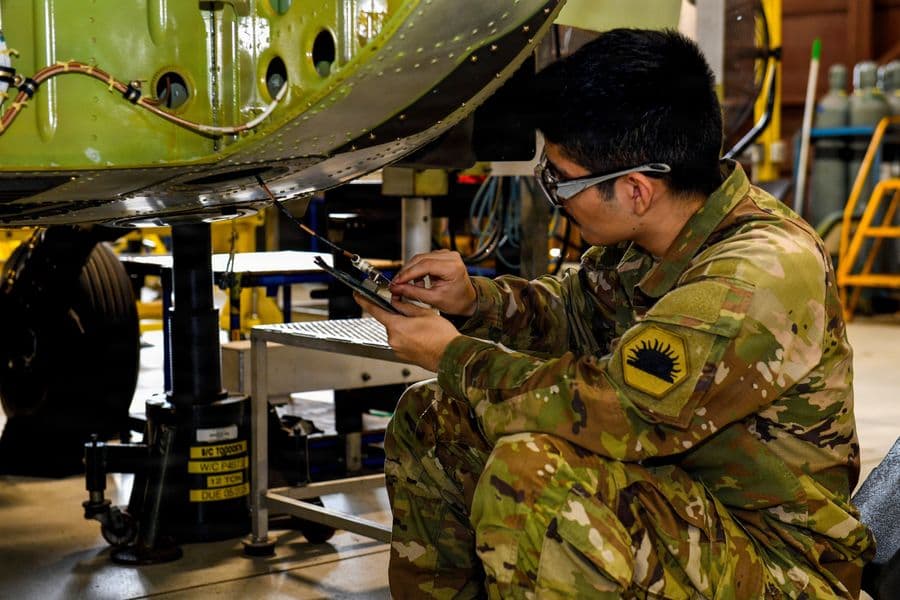
image: CORPUS CHRISTI ARMY DEPOT, Texas (Sept. 20, 2026) — SPC Alfredo Delgado trains on installing a radar altimeter on a UH-60 Black Hawk helicopter during maintenance training at Corpus Christi Army Depot. Delgado is part of a team from A Company, 1106th Theater Aviation Sustainment Maintenance Group (TASMG) conducting training at Corpus Christi Army Depot (CCAD). CCAD artisan Guillermo “Will” Diaz (left) points out key installation techniques during the training. (U.S. Army photo by Ervey Martinez, Corpus Christi Army Depot)

In Pursuit of Nuclear Abolition
By Peter Huessy • RealClearDefense
Innovation Alone Won’t Prepare the U.S. for the Future Battlefield
By Joshua Segal • RealClearDefense
The sUAS Tactical Trifecta
By Bryan T. Woody • RealClearDefense
The Revolutionary War: When Strategic Options Share the Same Weakness
By Henry Yep • RealClearDefense
The Houthis Are Testing the Limits of Collective Defense
By Saima Afzal • RealClearDefense

Who Shoots Down the Drone Over the Shipyard?
By John Ferrari & Dillon Prochnicki • RealClearDefense
Northrop Grumman Breaks Out the Big Guns at AUSA
By Daniel Terrill, Defense News
Army Pursuing Diverse Array of New Anti-Air Interceptors
By Trevithick, The WarZoneWho Shoots Down the Drone Over the Shipyard?
By John Ferrari & Dillon Prochnicki, RCD
F-35C Lands for the First Time on a Ford-Class Aircraft Carrier
By The Aviationist