
Large-Scale Combat Operations Mean Everything, Which Means Nothing
Last updated 05:46 AM EDT • Read time: 9m
The Army's Transformation Initiative is the most significant restructuring of the force in a generation. Twenty-one Brigade Combat Teams—fourteen Regular Army and seven National Guard—convert to Mobile Brigade Combat Teams by end of FY26. Air cavalry squadrons are cut. Army Futures Command and Training and Doctrine Command merged. Counter-UAS integrates at the platoon level. Long-range precision fires expand across the force. The Secretary of Defense's directive authorizing this transformation justified it on the grounds of building a leaner, more lethal force to prioritize defending the homeland and deterring China in the Indo-Pacific—with priority investment in long range precision fires, air and missile defense, cyber, electronic warfare, and counterspace capabilities.
The Army's doctrinal framework tells a different story. Since the 2017 revision of the Army's capstone Operations doctrine, Field Manual (FM) 3-0, large-scale combat operations (LSCO) has become "the focus of tactical and strategic thought from the smallest units to the most influential publishing houses in the Army." The 2022 FM 3-0 uses the term over a hundred times. When then-Secretary of the Army nominee Daniel Driscoll was asked directly whether the Army must maintain the ability to conduct large-scale ground combat operations, his answer: yes. That answer reflects how the Army understands what it is building for. The problem is that LSCO is a doctrinal category masquerading as a strategic argument, and the Army has been using it long enough that the masquerade has become load bearing. The last time the Army successfully built itself around a coherent operational concept, it knew exactly what it was building for. That concept was AirLand Battle, and what distinguished it from LSCO is not a matter of degree. It is a matter of kind.
What AirLand Battle Actually Was
AirLand Battle was not a buzzword. It was a complete operational argument published in FM 100-5 and developed by General Donn Starry and the Training and Doctrine Command to solve a specific, named problem: NATO could defeat a Soviet first echelon on the Central European plain, but the Soviet operational system was designed to follow the first echelon with a second before NATO could reconstitute. The first echelon would fix NATO forces; the second echelon would break them.
AirLand Battle's answer was deep battle—identify, interdict, and destroy the second echelon before it could reach the front, combining Army long-range fires with Air Force interdiction to collapse the Soviet operational system before it could develop. This was a theory of victory tied to a specific adversary, a specific geography, and a specific operational sequence. Every major capability decision that followed was traceable to that theory. The M1 Abrams needed mobility and protection to survive a high-tempo fight against Soviet armor. The Apache existed to kill Soviet tanks deep. The multiple launch rocket system was the long-range fires system for interdicting the second echelon. The Joint Surveillance Target Attack Radar System was developed to find it. Each capability answered a specific question the concept had asked.
Crucially, AirLand Battle could be falsified. A capability either contributed to defeating the Soviet second echelon on the Central European plain or it did not. That testability was the mechanism by which the Army made choices. It could say no to things that didn't fit.
What LSCO Is
LSCO was introduced when FM 3-0 was revised in 2017 to signal that the Army was returning to conventional warfighting after two decades of counterinsurgency. That signal was necessary and it worked. The problem is that the Army has since asked LSCO to do something it was never designed to do: justify specific force structure choices.
LSCO is a category of warfare. It encompasses every conventional conflict at brigade scale or above: a Taiwan Strait scenario, a Russian push into the Baltics, a Korean Peninsula ground war, or a contingency in the Western Hemisphere. It does not name an adversary, terrain, an operational problem, or a theory of victory. Because it names none of these things, it excludes nothing. Any capability is justified against it. A heavier, more mass-capable force is justified against LSCO. So is a lighter, more distributed force. Aviation cuts are justified against LSCO's peer air defense environment. So are aviation expansions for deep battle. Organic counter-UAS at the platoon is justified. So is centralized counter-UAS. Every ATI choice is correct against LSCO because LSCO cannot tell you any choice is wrong.
This is the test: can a concept tell you no? AirLand Battle could but LSCO cannot. The intellectual foundation the transformation rests on is the problem.
The Cost
When a doctrinal category replaces an operational concept, force design becomes a procurement list dressed in strategic language. Analysis of ATI describes what the transformation does in careful detail—which units convert, which headquarters consolidate, which programs cancel. It cannot supply what the Army has not provided: the specific operational problem ATI is designed to solve and the wargaming that demonstrates the new force design solves it better than the one it replaces. That analysis may exist in classified planning documents. But the absence of a public operational concept means the transformation cannot be evaluated publicly, allied planning cannot align to it, and Congress appropriates against a justification it cannot test.
LSCO covers scenarios that pull force design in opposite directions. A Pacific scenario requires distributed formations, reduced logistics signatures, and joint integration for denial operations along the First Island Chain. A European scenario has historically required mass, depth, and sustained logistics for attrition-capable ground operations — though Ukraine has complicated even that picture, demonstrating that concentrated formations present targeting opportunities that precision fires and drones systematically exploit.
The Army cannot optimize for all this simultaneously. An operational concept forces the choice. LSCO allows the Army to avoid it. The consequence is visible in the Army's own congressional testimony. Army senior leaders made a readiness statement which opened by declaring homeland defense the "top priority" and leads with Western Hemisphere Command, then designates the Indo-Pacific as "our priority theater for deterrence and warfighting." Both statements appear in the same document without tension, because LSCO cannot generate tension between them.
There is a practical cost of this ambiguity. As of April 2026, the Army is conducting active combat operations against Iran and its proxies under Operation Epic Fury—employing long-range precision fires against Iranian land and naval assets, running PATRIOT and THAAD layered defense against one-way attack drones, cruise missiles, and ballistic missiles, and sustaining logistics formations across the theater.
The Army is simultaneously reforming for LSCO, optimizing for the Indo-Pacific, standing up Western Hemisphere Command as a homeland defense priority, and fighting a medium-intensity air and missile defense campaign in the Middle East. The Army must reconcile these commitments or explain which informs force design and which does not. That is strategic ambiguity wearing flexibility as a disguise.
What an Operational Concept for This Era Requires
AirLand Battle was unclassified. Its authors published it and argued it in public. Transparency was what made it a genuine strategic argument rather than a budget justification. An operational concept for this era does not need to reveal classified OPLANs to do the same work.
It needs four things. A named adversary system—not "peer competitor" but the specific operational logic of the PLA or Russian ground forces, the capabilities they have built, and the problem they are designed to impose on the joint force. A named theater and the operational constraints it generates. The specific problem the Army is designed to solve within the joint force—not "win" but how, and in what sequence, against what adversary actions. And a theory of victory: what does success look like, what does the Army contribute to it, and how do specific capability choices advance it.
The 2026 NDS has named China as the pacing threat and the First Island Chain as the primary military construct. The Army has taken concrete steps in that direction: the $1.3 billion Pacific Deterrence Initiative in FY26, the Integrated Battle Command System serving as the backbone of the Guam Defense System, Maneuver Support Vessels forward-stationed for Indo-Pacific lift. These capability choices are traceable to a named theater, and they represent exactly the kind of connective tissue an operational concept produces.
The remaining work is to build the public argument around them: what problem the Army is designed to solve within the joint force in that theater, in what sequence, against what adversary actions, and what success requires. That argument would transform a collection of Pacific-oriented investments into a coherent operational concept. The Army built AirLand Battle by making that argument in public. The foundation exists to do it again.
The Argument the Army Owes
AirLand Battle did not emerge from a bureaucratic process. It emerged from a specific intellectual effort—Starry and his team at TRADOC studying the Yom Kippur War, war-gaming Soviet operational concepts, and committing in public to a theory of how the Army would fight and win. That commitment was what made the force design coherent. Every capability either fit the theory, or it didn't.
LSCO is the absence of that commitment. The Army has announced a generational transformation, justified by a category that can justify anything. It owes its soldiers, its allies, and Congress the harder argument—not what it is building, but what it is building for, and why that choice is the right one. The Army did this once and it needs to do it again.
Michael Carvelli is an Army officer who writes on operational planning, protection, and engineering. He has written on large-scale combat operations for Real Clear Defense, War on the Rocks, Parameters, Modern War Institute, and Small Wars Journal.
The views expressed are his own and do not represent those of the U.S. Army, the Department of Defense, or any part of the U.S. government.
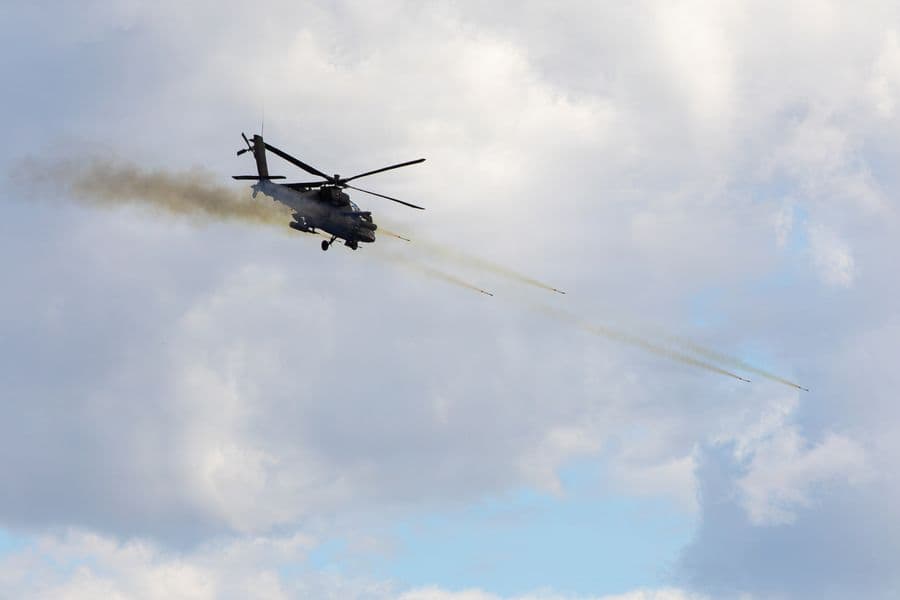
image: A U.S. Army AH-64E Apache conducts a strafing run near Torun, Poland, on May 28, 2026. V Corps and our Allies are fielding a multi-domain strike capability that is unmatched in the European theater through the Polish Apache Initiative and the European High Mobility Artillery Rocket System (HIMARS) initiative. By pairing the world’s most advanced attack aviation platform with synchronized, long-range precision fires, we ensure that our combined forces can locate, target, and destroy threats with absolute precision-delivering the right round at the right time, in the right place. (U.S. Army Reserve photo by Pfc. Luis Daniel Torres)

In Pursuit of Nuclear Abolition
By Peter Huessy • RealClearDefense
Innovation Alone Won’t Prepare the U.S. for the Future Battlefield
By Joshua Segal • RealClearDefense
The sUAS Tactical Trifecta
By Bryan T. Woody • RealClearDefense
The Revolutionary War: When Strategic Options Share the Same Weakness
By Henry Yep • RealClearDefense
The Houthis Are Testing the Limits of Collective Defense
By Saima Afzal • RealClearDefense

Who Shoots Down the Drone Over the Shipyard?
By John Ferrari & Dillon Prochnicki • RealClearDefense
Northrop Grumman Breaks Out the Big Guns at AUSA
By Daniel Terrill, Defense News
Army Pursuing Diverse Array of New Anti-Air Interceptors
By Trevithick, The WarZoneWho Shoots Down the Drone Over the Shipyard?
By John Ferrari & Dillon Prochnicki, RCD
F-35C Lands for the First Time on a Ford-Class Aircraft Carrier
By The Aviationist