
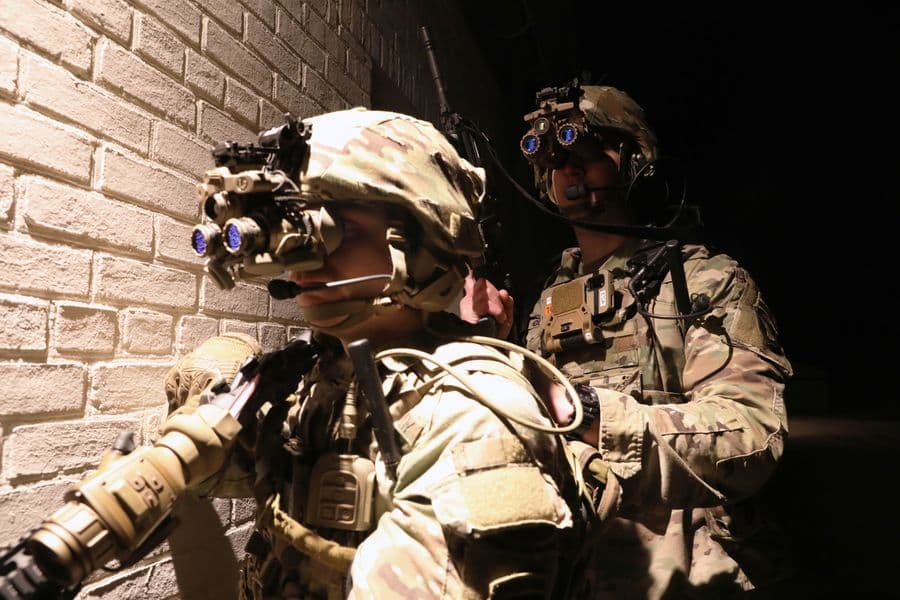
Seeing Clearly: The Need To Fund ENVG-B
Last updated 06:03 PM EDT • Read time: 4m
Night vision devices are critical to delivering overmatch on modern battlefields. The Army has recently developed two overlapping but distinct systems to deliver situational awareness in everything from close combat to combat support operations, enabling uninterrupted operations in multi-domain battlespaces devoid of clearly established front lines. As these devices serve distinct purposes and represent differing levels of maturity, the Army should continue with its strategy to procure both the Enhanced Night Vision Goggle-Binocular (ENVG-B) and the Integrated Visual Augmentation System (IVAS).
Anyone familiar with historical or existing night vision and situational awareness systems would recognize ENVG-B, a digital thermal sensor fused with binocular image intensification (I2) capabilities. The ENVG-B system provides Soldiers with vision in no- and low-light environments. However, ENVG-B goes beyond legacy night vision systems when paired with Nett Warrior by including augmented reality heads-up display capabilities, meeting the Army’s requirements for a fused night vision capability with enhanced situational awareness. Also, when wirelessly paired with a thermal sight, the Family of Weapon Sights – Individual, the ENVG-B enables Soldiers to experience a digital reticle and deliver rounds on target without exposure to enemy fire. Since its initial deployment almost three years ago, ENVG-B has proven its ability to meet Army requirements in both training and combat.
The success of ENVG-B stems from a deliberate and incremental evolutionary process, incorporating Soldier feedback iteratively into both its requirements and development. The result is a suite of capabilities that was all but unimaginable a decade ago.
By contrast, IVAS is an aggressive effort to bring next-gen capabilities into the present. Since being presented to then-Secretary of Defense James Mattis in 2018 as a glimpse of what the warfighters of the future could be wearing, IVAS has had an accelerated development and deployment timetable. Working hand in hand, teams from the government and industry (especially Microsoft) have been identifying and attempting to overcome a litany of obstacles to IVAS deployment. These include, but are by no means limited to, incorporating digital I2 technologies in lieu of existing analog I2 capabilities, doubling the field of view from traditional binocular capabilities, and incorporating situational awareness data and other sensors into a digestible format. None of these challenges are trivial; addressing all of them is a time-consuming exercise.
IVAS therefore is moving from the “leap-ahead” model that gave it birth to more of an iterative design-and-feedback process. The IVAS team is already incorporating the lessons learned from recent tests performed by Soldiers in controlled environments (Soldier Touchpoints). These tests revealed serious shortcomings with the system, including problems with GPS accuracy, latency, and comfort. Based on these evaluations, IVAS delayed its Initial Operational Test & Evaluation from July 2021 to May 2022, and results are still pending.
These difficulties have given rise to reasonable concerns about the program, which is understandable in view of IVAS’s recent struggles; however, there is another way to view the two programs. ENVG-B and IVAS should not be considered rivals for funding. Rather, ENVG-B is the current state-of-the-art connected night vision system while IVAS continues to develop toward a command-and-control system with training and rehearsal capabilities. Even once IVAS starts reaching frontline units, the two systems can interact in complementary ways to multiply force effectiveness. As Soldiers at the touchpoints remarked, “not all personnel in close-combat formations should be equipped with IVAS” and “equipping select Soldiers with [non-IVAS] equipment could make the formations more effective.” Beyond that, the idea has never been to equip every Soldier in the Army with IVAS, and there will always be formations with a need for upgraded night vision capability, such as that provided by ENVG-B.
Congress should therefore allow the Army to continue with the dual-prong strategy of maintaining the procurement of ENVG-B while pursuing further development of IVAS. Rather than treating the two programs as zero-sum competitors, it should be recognized that ENVG-B helps the Army meet the readiness challenges of today while remaining sustainable into the future, if properly scaled for wide deployment. Meanwhile, IVAS should continue incrementally developing towards being the first-choice, game-changing system of the future.
The U.S. military is better at looking into the dark than any other military on earth. By focusing its efforts on both ENVG-B and IVAS, it gives itself the best chance of looking into the future as well.
Paul is a graduate of the United States Military Academy at West Point, and has earned a Master of Science in Systems Acquisition Management from the Naval Post Graduate School, and a Master of Science in National Resource Strategy from the Industrial College of the Armed Forces/Eisenhower School in Washington D.C.

In Pursuit of Nuclear Abolition
By Peter Huessy • RealClearDefense
Innovation Alone Won’t Prepare the U.S. for the Future Battlefield
By Joshua Segal • RealClearDefense
The sUAS Tactical Trifecta
By Bryan T. Woody • RealClearDefense
The Revolutionary War: When Strategic Options Share the Same Weakness
By Henry Yep • RealClearDefense
The Houthis Are Testing the Limits of Collective Defense
By Saima Afzal • RealClearDefense

Who Shoots Down the Drone Over the Shipyard?
By John Ferrari & Dillon Prochnicki • RealClearDefense
Northrop Grumman Breaks Out the Big Guns at AUSA
By Daniel Terrill, Defense News
Army Pursuing Diverse Array of New Anti-Air Interceptors
By Trevithick, The WarZoneWho Shoots Down the Drone Over the Shipyard?
By John Ferrari & Dillon Prochnicki, RCD
F-35C Lands for the First Time on a Ford-Class Aircraft Carrier
By The Aviationist