
Weekly Recon – 19 August 2017
Last updated 05:48 PM EDT • Read time: 6m
Good Saturday morning and welcome to Weekly Recon. On this day in 2010, the last U.S. combat brigades departed Iraq in the early morning. Convoys of U.S. troops had been moving out of Iraq to Kuwait for several days, and NBC News broadcast live from Iraq as the last convoy crossed the border. While all combat brigades left the country, an additional 50,000 personnel (including Advise and Assist Brigades) remained in the country to provide support for the Iraqi military.
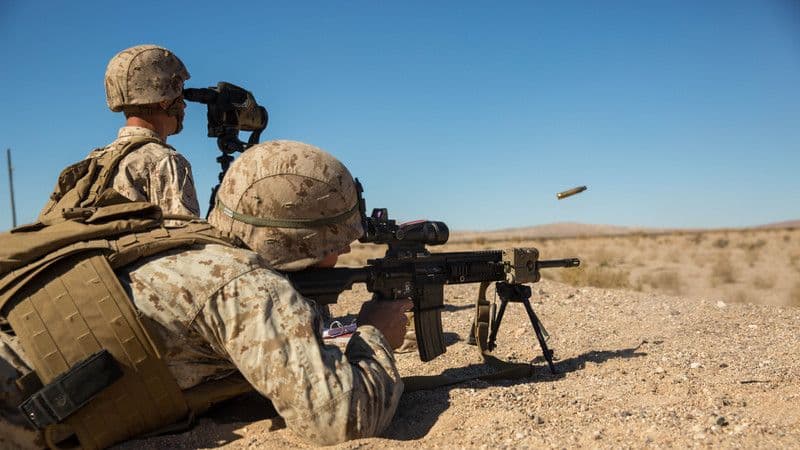
Ground Combat – The U.S. Marine Corps, ever proud of its marksmanship prowess, is taking steps to upgrade its standard infantry rifle. This past week, the Corps issued a request for an additional fifty thousand M27 Infantry Automatic Rifles (IARs). These rifles will replace a large stock of the Marines’ current standard rifle, the M4 carbine, only recently replacing to the long barrel M16A4.
The gradual transition to the M27 IAR also coincides with the Marine Corps rapid decline in combat veterans. As Jeff Schogol notes at Marine Corps Times, “In today’s Corps, fewer than one in five Marines has a single deployment under their belt, and the number of Marines who have deployed twice is now less than one in 10, according to Marine Corps officials.” Partly due to normal turnover, the Corps is experiencing trouble retaining combat veterans from the non-commissioned officer cadre, a vital element of Marine Corps leadership, and lethality. The hope is that retention bonuses and other incentives will keep these combat hardened veterans to pass along their warrior arts along onto future generations of Marines.
Russia’s preparations for quadrennial military drills known as Zapad (translating to “West”) in proxy Belarus have raised concerns in the West. Concerns are that Zapad could be an opportunity to launch a war in the Baltics. Russia used Zapad as cover to launch military operations in Georgia in 2008, and Ukraine in 2013. Writing for RealClearDefense, Daniel Urchik argues that a Baltic invasion is unlikely this time. Russia has neither the fiscal nor geopolitical capital to launch yet another war. NATO’s deterrent forces throughout the Baltics, Poland, and Eastern Europe are possibly just enough to assuage concerns of a Russian invasion.
What Zapad does offer, however, is a view of Russia’s latest military technology and tactic. Zapad 2013 was a mere rehearsal for Russia’s invasion of Crimea. Although Zapad 2017 is unlikely to be a maskirovka operation predicating a Baltic invasion, it should give the West valuable insight into Russia’s evolving military capabilities.
Air Superiority – What does an A-10 need to land? This question was complicated this week when a Michigan Air National Guard pilot Capt. Brett DeVries landed his Warthog after its GAU-8/A Avenger 30mm cannon exploded during a practice strafing run, causing the plane’s canopy to rip off the fuselage, cut primary and secondary radio communication assets, and debilitated the aircraft’s landing gear. The pilot went on to safely land the aircraft, proving that just about the only thing an A-10 needs to land is a skilled pilot.
Maritime Matters – The U.S. Coast Guard is looking north for the next-generation of icebreakers as Russia and China compete for the Arctic’s resource rich environs. National Defense Magazine reports that Canada and the U.S. Coast Guard are working together on a new class of icebreaker, both in dire need of new heavy-duty icebreakers. Using a test tank as long as the Statue of Liberty is tall, and using a special technique to replicate Arctic sea ice, the two nations ran tests on scale models. By creating commonalities across ship classes, both nations hope to create efficiencies for conducting joint operations in the Arctic's contested waters.
National Defense Magazine reports that the Navy’s ‘Future Frigate’ may be in trouble over concerns regarding the Littoral Combat Ship, the baseline for the new Frigate. Jerry Hendrix (Center for A New American Security) and Bryan Clark (Center for Strategic and Budgetary Assessments), both contend that the Navy’s recent request for information (RFI) stipulates too many requirements, requiring it “to be good at all things.” Hendrix and Eric Labs of the Congressional Budget Office contend that if requirements for the Frigate are not properly balanced, the debate could shift to whether or not the Navy should be purchasing more Arleigh Burke-class destroyers. Clark suggests that ordering a frigate with fewer bells and whistles could alleviate this problem entirely.
Space Wars – Onboard a SpaceX Dragon rocket launched on Monday and docked with the International Space Station (ISS), was an Army microsatellite, roughly the size of a standard mini-fridge. Called Kestrel Eye, the satellite is a demonstrator “will test the utility of microsatellites in low-Earth orbit, providing images to war fighters on the ground at the tactical level during critical operations, according to Chip Hardy, the Kestrel Eye program,” reports Jen Judson at Defense News. If it proves to be effective, this technology could provide greater situational awareness to troops on the ground, as it more rapidly transmits battlefield imagery back to Earth.
The Fifth Domain – Is the U.S. prepared for the next big hack? Perhaps not, reports RealClearDefense’s Sandra Erwin. In a time when a coordinated, whole of government approach to cybersecurity is needed, attempts at enhancing cyber protections are disjointed, and the fetishization of technology risks the success of such efforts. Many companies are offering different technology solutions for cybersecurity problems, selling them as “silver bullets,” yet successful attacks are a continual reality. Beyond the technology, cyber security requires professionals that can exploit the tools, but also have the skills to communicate needs to policymakers. As former NSA official Debora Plunkett put it at a recent New America conference: “We also need lots of people who can think from the policy perspective, who can envision what the future looks like, who understand international norms, and people who can lead through difficult challenges.” Beyond technicians with shiny new tools, U.S. cybersecurity efforts need an overarching strategy to protect crucial data and infrastructure. Perhaps the creation of the unified combatant command, U.S. Cyber Command, will be a step towards a more robust cyber enterprise.
SEND RCD YOUR INPUT: Please send your tips, suggestions, and feedback to editors@realcleardefense.com. Make sure to follow us on Twitter at @RCDefense and follow Blake Baiers @BlakeBaiers

In Pursuit of Nuclear Abolition
By Peter Huessy • RealClearDefense
Innovation Alone Won’t Prepare the U.S. for the Future Battlefield
By Joshua Segal • RealClearDefense
The sUAS Tactical Trifecta
By Bryan T. Woody • RealClearDefense
The Revolutionary War: When Strategic Options Share the Same Weakness
By Henry Yep • RealClearDefense
The Houthis Are Testing the Limits of Collective Defense
By Saima Afzal • RealClearDefense

Who Shoots Down the Drone Over the Shipyard?
By John Ferrari & Dillon Prochnicki • RealClearDefense
Northrop Grumman Breaks Out the Big Guns at AUSA
By Daniel Terrill, Defense News
Army Pursuing Diverse Array of New Anti-Air Interceptors
By Trevithick, The WarZoneWho Shoots Down the Drone Over the Shipyard?
By John Ferrari & Dillon Prochnicki, RCD
F-35C Lands for the First Time on a Ford-Class Aircraft Carrier
By The Aviationist