
National Security Challenges of Yesterday and Tomorrow: Reflecting on the Last 75 Years to Prepare for the Next 75
Published June 30, 2022 • Read time: 21m
Introduction
For the past 75 years, the United States has been the world’s dominant military and economic superpower. The collapse of the Soviet Union and success of the U.S.-led Liberal International Order (LIO) led some to celebrate its permanence, proclaiming an “American Century,” a “Pax Americana,” or even the “End of History.”[i] Thirty years on, this seems premature, if not naïve.
To be clear, the United States had—and retains—several advantages: the most potent conventional military on the planet, a vibrant defense industrial base, world-renowned service academies and military operational concepts, a robust nuclear arsenal, and the world’s strongest economy.[ii] On paper, these advantages seem unmatched, but a deeper look reveals serious challenges on many fronts. The current war in Ukraine, breakdown of U.S. policy in the Middle East and the rise of China as a true peer-competitor have shattered any illusion that great-power competition has ended and instead highlight the stark dangers of a changing strategic environment.
These problems are not merely theoretical. At the Atlantic Council, we ran a National Security Council (NSC) wargame with a group of military and civilian experts that simulated a “hybrid” or “gray zone” conflict over Estonia, where the United States and NATO allies were forced to confront a crisis below traditional thresholds of armed conflict.[iii] The results raised concerns about groupthink and responsiveness to hybrid challenges. Other datapoints are in unison. A classified Pentagon wargame of a Taiwan contingency “failed miserably,” according to former Vice Chairman of the Joint Chiefs of Staff General John Hyten, as did a RAND wargame considering a war in the Baltics between Russia and NATO.[iv] In the past 22 years, intelligence failures at the level of information sharing and synthesis resulted in a chaotic withdrawal from Afghanistan, failure to successfully execute a strategy in Iraq, and an inability to predict and prevent the devastating attacks of 9/11.[v]
Radio Frequencies in the Intelligence Ecosystem
The Strategic Technology Incubation Model
Exemptions and Enablers: The Accountability Gap in Unmanned Warfare
Why U.S. Intelligence Keeps Getting Blindsided
As the greatest military and economic superpower on Earth, is the United States failing? Current security policy is plagued with three core problems: an inability to deal with next-generation warfare, insufficient thoughtfulness for the allocation of limited resources in the face of overstretch, and a failure to share and synthesize intelligence adequately. To address this, when reimagining the National Security Act for the next 75 years, policymakers should retain—and reinvigorate—the role of the National Security Council as a deliberative forum for decision-making while adopting five key changes: intelligence reform, development of effective integrated deterrence, restructuring of decision-making for hybrid warfare, streamlining of defense acquisition, and innovative, whole-of-society educational initiatives.
Reflecting on the Past
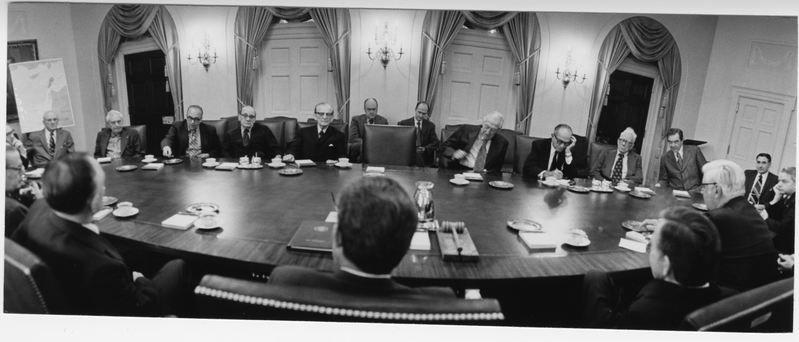
Any solution that has a chance to last 75 years first requires understanding the successes and failures of the past. Passed in the wake of World War II, the National Security Act of 1947 birthed the intelligence, military, and foreign policy apparatus as we know it.[vi] The NSC was of particular importance, serving as a key forum for deliberation and operational execution under the oversight and coordination of a National Security Advisor. The structure of the NSC was heavily influenced by a British predecessor, the Committee of Imperial Defense (CID), emerging after the Crimean War and First Boer War.[vii] In particular, the CID’s intention of being both advisory and coordinating was an inspiration for the NSC, allowing information to flow up to a principal while facilitating the flow downward supporting execution of commands.[viii]
Various NSCs have taken different approaches and, often, with mixed results. Many of the strategic and operational failures of the past 75 years—the wars in Iraq and Vietnam, the mishandled Iran Hostage Crisis, the Iran-Contra Affair, and more—are traceable to approaches adopted by the NSC. Amidst this, one NSC stands out in its procedural and substantive success: that of National Security Advisor Brent Scowcroft during the administration of George H.W. Bush. Its success in principally navigating the aftermath of the Cold War and waging the Gulf War have resulted in a body of scholarship studying what is dubbed the “Scowcroft Model” of NSC stewardship.[ix]
In a world markedly different than 30 years ago, the “Scowcroft Model” provides a viable framework for intelligence and national security success, providing useful insights into what should stay and what should go while building a new National Security Act.
Specific Challenges
We believe that the myriad problems presently faced by the United States can be distilled down to three core challenges.
Hybrid/Gray Zone Conflicts
First, the United States remains unprepared for a conflict that fails to fit the schema of a traditional competition in military capabilities, occurring in traditional domains at or above traditional thresholds for conflict. Traditional Western strategic thought has maintained a strict separation between “war” and “peace,” with successful military endeavors involving an attack around a “center of gravity” that overwhelms the enemy with military force[x] This is understandable, as it reflects how many of history’s recent wars have been fought. Measured by this yardstick, as demonstrated in the Gulf War, the United States fares well.
Impressed by U.S. dominance, great-power and regional competitors eschewed head-on military competition with the United States. They turned instead to “gray zone” strategies below traditional thresholds of conflict, becoming adept at creating exigencies where overwhelming military force cannot or will not be brought to bear. [xi] Disinformation campaigns, cyber-attacks, and “salami slicing” techniques to test resolve have become the modus operandi for American adversaries.[xii]
Even in traditional military conflicts, adversaries skirt traditional U.S. military advantages, as with Chinese development of Anti-Access/Area Denial (A2/AD) techniques following the humiliation of the Third Taiwan Strait Crisis.[xiii] If successful, the world’s greatest naval and air forces could be rendered irrelevant, unable to arrive to engage in time. Likewise, Russian thinking on low-yield nuclear use in conventional conflict aims to paralyze American responses, forcing policymakers to choose between escalation: “suicide” or weakness: “surrender.”[xiv]
Overstretch
Second, the United States is today confronting enemies that pose simultaneous economic, military, and political challenges. Russia meets or exceeds the United States in nuclear capabilities, with strategic parity and nonstrategic weapons complicating regional deterrence.[xv] In the Middle East, counterterrorism has proved to be a defining challenge for the past 20 years, while Iran knocks on the door of nuclear acquisition. Meanwhile, China is developing a world-class military and has spent decades studying the U.S. method of warfare, perfecting strategies to take advantage of geography when waging in-theater war with the United States.[xvi] A peer competitor that meets or exceeds the United States on numerous economic indicators, it aims to offer a compelling alternate vision to the U.S.-led LIO’s emphasis on capitalism and democracy, posing a whole-of-society challenge.[xvii]
Put simply: the United States is spread too thin. Given the “bow wave” of budgetary expenses arriving in coming decades, the DoD may have less money than ever to grapple with these challenges.[xviii] This will force difficult budgetary and strategic choices, necessitating peak efficiency.
Yet the DoD can hardly be called efficient at present. Bureaucratic in-fighting and old-fashioned pork result in unnecessary or redundant projects often continued far past their shelf life. Politics and funding dictate strategy and capabilities, instead of the other way around. Recent examples include cost overruns and delays across the services for major end items such as aerial refueling tankers, main battle tank replacement and the Ford Class carrier.[xix] Legacy systems like carriers continue to absorb resources, even in the face of a future where contingencies over Taiwan, for example, demand more dispersed and flexible capabilities.[xx]
At present, the DoD is plagued by both inefficiency and inertia. A new National Security Act must align incentives away from playing (bureaucratic) politics towards agile procurement based on strategy.
Intelligence: Stove-piping and Groupthink
Third, intelligence is facing twin failures relating to stove-piping (creating separate, independent processes in a particular issue area that results in information being held instead of shared) and groupthink (where information might be heard but not listened to). In the context of national security intelligence, stove-piping manifests itself with information being collected, processed, and held, but ultimately not shared with those for whom the information is actionable.[xxi] The most famous example of this phenomenon took place in the months leading up to 9/11, when portions of the intelligence community had insights into the deadly attack but failed to share it.[xxii]
Closely related is the challenge of groupthink. Psychological research has confirmed that humans, in the face of social pressures, often fail to act rationally, falling prey to conformist tendencies and confirmation bias.[xxiii] Tight-knit, cohesive groups that create expectations for group behavior only exacerbate these already-innate tendencies. Examples abound, with the Iraq War being the quintessential case: key strategic and operational questions were either not posed or were brushed aside, leading to entirely foreseeable short- and long-range errors.[xxiv]
Time after time, the United States has shown itself to be exceptional at collecting and obtaining human, signals, and imagery intelligence. The U.S.’ impressive predictions preceding Russia’s invasion of Ukraine notwithstanding, problems continue to arise with the sharing, synthesis, and actionability of intelligence.
Recommendations for a 21st Century National Security Act
In the face of these challenges, we propose five recommendations—legislative, executive, whole-of-government, and whole-of society— for rehaul of the existing 1947 National Security Act to better prepare the United States for 21st century national security challenges. However, not everything will change. Importantly, the present conceptualization of the NSC should endure; the general purpose of a deliberative and coordinating body ought to remain a fixture. It is naïve to expect a tectonic shift in strategic thinking and planning overnight, but such a shift is necessary and can be ushered in by a responsive and capable NSC. Our recommendations require oversight and coordination from someone with a broad perspective and an executive mandate. The National Security Advisor is a natural fit.
First, a new National Security Act should include a series of legislative reforms aimed at limiting stove-piping and groupthink. As discussed above, these are at the roots of many security crises: either missing information or, upon receiving information, not acting upon it.
To correct stove-piping and agency parochialism, standing interagency cross functional teams must be established and staffed with priority. Areas where this can be implemented include trade and cyber/information policy spaces. Work in the counter drug realm has already demonstrated that this method can be successful. The law enforcement and military cooperation seen in these cases should be emulated across the spectrum of competition where hybrid warfare is increasingly prevalent.[xxv]
New command structures that incorporate broader roles for military and diplomatic leadership across both the Department of Defense (DoD) and the Department of State should also be considered. Moving away from a model of clearly divided scopes of responsibility to one that matches the reality of blurred lines and coalescing interests, the U.S. should have regional military, diplomatic, and commercial missions with shared authorities, bringing an interagency approach to its management of global security. Given its innateness, groupthink, will prove harder to weed out. However, to reduce conformist tendencies, principals on the NSC must be codified to assure their status in the “inner circle” and thus empower them speak their mind. The National Security Advisor should be selected based on a commitment to engage in “honest brokerage” by willingly hearing all viewpoints. Finally, a study group should be commissioned to study ways of metering presidential involvement in key decisions, modeled after the Kennedy administration’s Executive Committee, which met separately without the president to foster open dialogue.[xxvi]
Second, a new National Security Act should enshrine integrated and whole-of-government deterrence. Previous steps to create a unified strategy for conflict across traditional and nontraditional military domains remain incomplete.[xxvii] Thinking of deterrence as “domain-specific” (i.e., through a lens of nuclear, space, cyber, or conventional deterrence) is reductive and fails to address cross domain implications. Further, it is entirely out of step with the way that adversaries conceptualize deterrence.[xxviii] Instead, deterrence should be seen as a unified goal to be pursued, with actions in specific domains as part of a holistic strategy of deterrence.
As a result, a special congressional committee ought to be commissioned to study potential restructuring of the national security community with an eye towards integrated deterrence, including the study of other nation’s national security structures for new insights. Aspects of deterrence that have traditionally been conceptualized as separate (economic, homeland defense, and cyber) may need to integrate, transfer agencies or be operationalized through new interagency bodies. Such shifts will facilitate policy implementation in a more strategic and unified manner.
Third, the executive branch ought to tailor the NSC—and the broader national security apparatus—to hybrid warfare. To facilitate this, a mandate must be enshrined at the principals’ level of the NSC to convene regular, standing meetings that deal with long-range, non-traditional conflict planning. There is precedent for NSC engagement with long-range strategic planning, and a directive to do so with particular focus on hybrid conflict is prudent.[xxix] Additionally, the creation of a new policy coordination committee aimed at facilitating interagency coordination on issues relating to hybrid threats will foster integration.[xxx] Taken together, these should impel whole-of-government responses and yield improvements in planning and execution.
Fourth, a legislative mandate for streamlined defense acquisition processes is needed. A revised competitive bidding process should be inaugurated for the award of all DoD contracts to bring the power of the free market to bear on defense acquisition.[xxxi] Reform that drives more agile acquisition by accepting risk and reducing barriers to entry for commercial players will capitalize on the key strength of the American economic system and tap into ingenuity. This change should include an annual public review and scoring of DoD spending considering inefficiency and budget allocation decisions conducted by the Government Accountability Office (GAO). This will allow governmental and academic communities to assess how money is spent, spur greater efficiency, and drive strategically sound acquisition, all critical to coping with overstretch in an era of limited resources.
Fifth, steps ought to be taken to enhance domestic resilience through education. This would focus on raising public awareness of threats emerging from disinformation, hardening society against the propaganda that serves as a key tool in our adversary’s hybrid war toolkits.[xxxii] It will be incumbent upon American society to embrace “information literacy.” Finally, educational and governmental institutions should democratize information about conflict. Creative wargaming is one vehicle for doing so, allowing the public an engaging window into how conflict is conducted.[xxxiii] Indeed, a number of academic or non-profit institutions could advance such an initiative, holding wargame competitions at the high school, collegiate, or professional level, encouraging the next generation of national security leaders to submit their ideas on how conflicts will unfold.
Conclusion
The National Security Act of 1947 was not without limitations but succeeded in keeping the peace for the last 75 years. The next 75 years pose an array of challenges, necessitating the reimagination of existing institutions. Reforming intelligence, developing effective integrated deterrence, restructuring national security decision-making for hybrid warfare, streamlining of defense acquisition, and instituting whole-of-society educational initiatives, will better equip the national security community to navigate conflicts that arise in the next 75 years, ensuring a secure 21st century.
Lieutenant Colonel Matthew R. Crouch: Lieutenant Colonel, United States Marine Corps; Senior Marine Corps Fellow, 2020-2021, Atlantic Council; Olmsted Scholar, Class of 2009, Shanghai
Colonel Christopher P. Mulder: Colonel, United States Air Force; Senior Air Force Fellow, 2020-2021, Atlantic Council
Raphael J. Piliero: Fulbright Scholar (Taiwan), United States Department of State; Young Global Professional, 2021, Atlantic Council
Opinions, conclusions, and recommendations expressed or implied within are solely those of the authors and do not necessarily represent the views of the United States Marine Corps, United States Air Force, the Department of Defense, or any other U.S. government agency.
Notes:
Graham Allison, “The Thucydides Trap: Are the U.S. and China Headed for War?” The Atlantic, September 24, 2015, https://www.theatlantic.com/international/archive/2015/09/united-states-china-war-thucydides-trap/406756/.
Elizabeth M. Bartels, “Wargames as an Educational Tool,” The RAND Blog, February 8, 2021, https://www.rand.org/blog/2021/02/wargames-as-an-educational-tool.html.
Dean Cheng, “An Overview of Chinese Thinking About Deterrence,” NL Arms Netherlands Annual Review of Military Studies, (2020): 177-200. https://doi.org/10.1007/978-94-6265-419-8_10.
Skye Christensen, “Why American Intelligence Failed in Afghanistan and Elsewhere,” The Hill, August 26, 2021, https://thehill.com/opinion/national-security/569499-why-american-intelligence-failed-in-afghanistan-and-elsewhere/.
J. Michael Cole, “The Third Taiwan Strait Crisis: The Forgotten Showdown Between China and America,” National Interest, March 10, 2017, https://nationalinterest.org/feature/the-third-taiwan-strait-crisis-the-forgotten-showdown-19742.
Anthony H. Cordesman, Grace Hwang, “Updated Report: Chinese Strategy and Military Forces in 2021,” CSIS, August 3, 2021, https://www.csis.org/analysis/updated-report-chinese-strategy-and-military-forces-2021.
Tara Copp, “‘It Failed Miserably’: After Wargaming Loss, Joint Chiefs Are Overhauling How the U.S. Military Will Fight,” DefenseOne, July 26, 2021, https://www.defenseone.com/policy/2021/07/it-failed-miserably-after-wargaming-loss-joint-chiefs-are-overhauling-how-us-military-will-fight/184050/ “Counterdrug Operations,” February 5, 2019, https://irp.fas.org/doddir/dod/jp3-07-4.pdf.
Brent Eastwood, “Abrams : The 40 Year Old Super Tank The U.S. Military Can’t Get Rid Of, ” 1945, October 4, 2021, https://www.19fortyfive.com/2021/10/abrams-the-40-year-old-super-tank-the-u-s-military-cant-get-rid-of/.
Francis Fukuyama, The End of History and the Last Man (New York: Penguin Books Limited, 1993).
Jim Garamone, “Military Must Be Ready to Confront Hybrid Threats, Intel Official Says,” U.S. Department of Defense, September 4, 2019, https://www.defense.gov/Explore/News/Article/Article/1952023/military-must-be-ready-to-confront-hybrid-threats-intelligence-official-says/.
Dan Grazier, “Air Force’s Tanker Aircraft Continues to Struggle,” Pogo, June 11, 2020, https://www.pogo.org/analysis/2020/06/air-forces-tanker-aircraft-continues-to-struggle/.
Dan Grazier, Pierre Sprey, “How Not to Build a Ship: The USS Ford,” Pogo, May 30, 2017, https://www.pogo.org/investigation/2017/05/how-not-to-build-ship-uss-ford/.
Stephen J. Hadley, “The Role and Importance of the National Security Advisor,” Scowcroft Institute of International Affairs, April 2016, https://oaktrust.library.tamu.edu/bitstream/handle/1969.1/158834/Stephen%20J.%20Hadley%20The%20Role%20and%20Importance%20of%20the%20National%20Security%20Advisor.pdf?sequence=1&isAllowed=y.
Robert Hale, “How DoD Can Manage The Great Bow Wave,” Breaking Defense, March 14, 2016, https://breakingdefense.com/2016/03/how-dod-can-manage-the-great-bow-wave/#:~:text=In%20a%20November%202014%20study,to%20%2480%20billion%20in%202030.
Valerie Insinna, “A U.S. Air Force War Game Shows What the Service Needs to Hold Off—Or Win Against—China in 2030,” DefenseNews, April 12, 2021, https://www.defensenews.com/training-sim/2021/04/12/a-us-air-force-war-game-shows-what-the-service-needs-to-hold-off-or-win-against-china-in-2030/.
Matthew Kroenig, Mark Massa, Christian Trotti, “Russia’s Exotic Nuclear Weapons and Implications for the United States and NATO,” Atlantic Council, July 2020, https://www.atlanticcouncil.org/wp-content/uploads/2020/07/Russias-Exotic-Nuclear-Weapons.pdf.
Paul Lettow, “U.S. National Security Strategy: Lessons Learned,” National Security Policy, Vol. 4, No. 2 (Spring 2021), http://dx.doi.org/10.26153/tsw/13195.
Qiao Liang and Wang Xiangsui, Unrestricted Warfare (Beijing: PLA Literature and Arts Publishing House, February 1999).
Henry R. Luce, “The American Century,” Diplomatic History, Vol. 23, No. 2 (Spring 1999), 159-171.
Chad T. Manske, “The Machinery of Government Needs a Tune-Up,” Air University Press, (March 2009): 9, https://media.defense.gov/2017/Nov/22/2001847939/-1/-1/0/WP_0015_MANSKE_MACHINERY_OF_GOVERNMENT.PDF.
James Mattis and Frank G. Hoffman, “Future Warfare: The Rise of Hybrid Wars,” Proceedings 131/11/1233 (November 2005), David Kilcullen, The Dragons and the Snakes: How the Rest Learned to Fight (Oxford: Oxford University Press, 2020).
Kevin V. Mulcahy, “Rethinking Groupthink: Walt Rostow and the National Security Advisory Process in the Johnson Administration,” Presidential Studies Quarterly, Vol. 25, No. 2 (Spring 1995): 237,250, https://www.jstor.org/stable/27551420.
Christopher P. Mulder, “#28: Court Every-Day National Security Influencers,” The Atlantic Council, February 16, 2021, https://www.atlanticcouncil.org/content-series/100-ideas-for-the-first-100-days/28-court-every-day-national-security-influencers/.
Christopher Mulder, Raphael Piliero, “Honest Brokers in the Gray Zone: Adapting the NSC for the 21st Century,” (Expected, 2022).
Si-Fu Ou, “China’s A2AD and Its Geographic Perspective,” Sinica, 2014, https://www.rchss.sinica.edu.tw/files/publish/1239_4394902e.pdf.
“Pax Americana,” Taegan Goddard’s Political Dictionary, https://politicaldictionary.com/words/pax-americana/.
Andrew Preston, “The Little State Department: McGeorge Bundy and the National Security Council Staff, 1961-1965,” Presidential Studies Quarterly, Vol. 31, No. 4 (December 2001): 638, https://www.jstor.org/stable/27552344.
“Reshaping Intelligence for an Age of Information,” RAND Corporation, https://www.rand.org/natsec_area/products/intelligence.html.
Mangesh Sawant, “Why China Cannot Challenge the U.S. Military Primary,” Air University, December 13, 2021, https://www.airuniversity.af.edu/JIPA/Display/Article/2870650/why-china-cannot-challenge-the-us-military-primacy/.
Marc Selinger, “U.S. DoD Seeks More Industry Competition,” Janes, February 16, 2022, https://www.janes.com/defence-news/news-detail/us-dod-seeks-more-industry-competition.
David A. Shlapak and Michael W. Johnson, “Reinforcing Deterrence on NATO’s Eastern Flank,” RAND Corporation, 2016, https://www.rand.org/pubs/research_reports/RR1253.html.
Clementine G. Starling, Lt Col Tyson K. Wetzel, Christian S. Trotti, “Seizing the Advantage: A Vision for the Next U.S. National Defense Strategy,” Atlantic Council (December 2021): 38, https://www.atlanticcouncil.org/wp-content/uploads/2021/12/Seizing-the-Advantage_A-Vision-for-the-Next-U.S.-National-Defense-Strategy.pdf.
Richard S. Tracey, “Trapped by a Mindset: The Iraq WMD Intelligence Failure,” Air University, 2006, https://www.airuniversity.af.edu/Portals/10/ASPJ/journals/Chronicles/tracey.pdf.
Elizabeth G. Troeder, “A Whole-Of-Government Approach to Gray Zone Warfare,” Strategic Studies Institute, U.S. Army War College, https://www.jstor.org/stable/resrep20085.
Tevi Troy, “All the President’s Yes Men,” The Wall Street Journal, August 22, 2021, https://www.wsj.com/articles/president-decision-making-biden-kennedy-johnson-taliban-afghanistan-bay-of-pigs-vietnam-saigon-blinkin-sullivan-11629641380.
Alex A. Vardamis, “Nuclear Weapons and Foreign Policy: Faulty Rationale for Current Practice,” Naval War College Review, Vol. 31, No. 2 (Fall 1978): 91.
Bob Work and Gen. Paul Selva, “Revitalizing Wargaming is Necessary to be Prepared for Future Wars,” War on the Rocks, December 8, 2015
Amy B. Zegart, “September 11 and the Adaptation Failure of U.S. Intelligence Agencies,” International Security, Vol. 29, No. 4 (Spring 2005): 78-80.
80th U.S. Congress - 1st Session, 1947.
[i] Henry R. Luce, “The American Century,” Diplomatic History, Vol. 23, No. 2 (Spring 1999), 159-171; “Pax Americana,” Taegan Goddard’s Political Dictionary, https://politicaldictionary.com/words/pax-americana/; Francis Fukuyama, The End of History and the Last Man (New York: Penguin Books Limited, 1993).
[ii] Mangesh Sawant, “Why China Cannot Challenge the U.S. Military Primary,” Air University, December 13, 2021, https://www.airuniversity.af.edu/JIPA/Display/Article/2870650/why-china-cannot-challenge-the-us-military-primacy/.
[iii] The results are included in the forthcoming paper: Christopher Mulder, Raphael Piliero, “Honest Brokers in the Gray Zone: Adapting the NSC for the 21st Century,” (Expected, 2022).
[iv] The results of this wargame are cited in the following: Tara Copp, “‘It Failed Miserably’: After Wargaming Loss, Joint Chiefs Are Overhauling How the U.S. Military Will Fight,” DefenseOne, July 26, 2021, https://www.defenseone.com/policy/2021/07/it-failed-miserably-after-wargaming-loss-joint-chiefs-are-overhauling-how-us-military-will-fight/184050/; David A. Shlapak and Michael W. Johnson, “Reinforcing Deterrence on NATO’s Eastern Flank,” RAND Corporation, 2016, https://www.rand.org/pubs/research_reports/RR1253.html.
[v] Skye Christensen, “Why American Intelligence Failed in Afghanistan and Elsewhere,” The Hill, August 26, 2021, https://thehill.com/opinion/national-security/569499-why-american-intelligence-failed-in-afghanistan-and-elsewhere/; Richard S. Tracey, “Trapped by a Mindset: The Iraq WMD Intelligence Failure,” Air University, 2006, https://www.airuniversity.af.edu/Portals/10/ASPJ/journals/Chronicles/tracey.pdf; Amy B. Zegart, “September 11 and the Adaptation Failure of U.S. Intelligence Agencies,” International Security, Vol. 29, No. 4 (Spring 2005): 78-80.
[vi] 80th U.S. Congress - 1st Session, 1947.
[vii] Chad T. Manske, “The Machinery of Government Needs a Tune-Up,” Air University Press, (March 2009): 9, https://media.defense.gov/2017/Nov/22/2001847939/-1/-1/0/WP_0015_MANSKE_MACHINERY_OF_GOVERNMENT.PDF.
[viii] Andrew Preston, “The Little State Department: McGeorge Bundy and the National Security Council Staff, 1961-1965,” Presidential Studies Quarterly, Vol. 31, No. 4 (December 2001): 638, https://www.jstor.org/stable/27552344.
[ix] Stephen J. Hadley, “The Role and Importance of the National Security Advisor,” Scowcroft Institute of International Affairs, April 2016, https://oaktrust.library.tamu.edu/bitstream/handle/1969.1/158834/Stephen%20J.%20Hadley%20The%20Role%20and%20Importance%20of%20the%20National%20Security%20Advisor.pdf?sequence=1&isAllowed=y.
[x] Jim Garamone, “Military Must Be Ready to Confront Hybrid Threats, Intel Official Says,” U.S. Department of Defense, September 4, 2019, https://www.defense.gov/Explore/News/Article/Article/1952023/military-must-be-ready-to-confront-hybrid-threats-intelligence-official-says/.
[xi] James Mattis and Frank G. Hoffman, “Future Warfare: The Rise of Hybrid Wars,” Proceedings 131/11/1233 (November 2005), David Kilcullen, The Dragons and the Snakes: How the Rest Learned to Fight (Oxford: Oxford University Press, 2020).
[xii] Qiao Liang and Wang Xiangsui, Unrestricted Warfare (Beijing: PLA Literature and Arts Publishing House, February 1999).
[xiii] J. Michael Cole, “The Third Taiwan Strait Crisis: The Forgotten Showdown Between China and America,” National Interest, March 10, 2017, https://nationalinterest.org/feature/the-third-taiwan-strait-crisis-the-forgotten-showdown-19742; Si-Fu Ou, “China’s A2AD and Its Geographic Perspective,” Sinica, 2014, https://www.rchss.sinica.edu.tw/files/publish/1239_4394902e.pdf.
[xiv] The phrase originated with Henry Kissinger. For more, see: Alex A. Vardamis, “Nuclear Weapons and Foreign Policy: Faulty Rationale for Current Practice,” Naval War College Review, Vol. 31, No. 2 (Fall 1978): 91.
[xv] Matthew Kroenig, Mark Massa, Christian Trotti, “Russia’s Exotic Nuclear Weapons and Implications for the United States and NATO,” Atlantic Council, July 2020, https://www.atlanticcouncil.org/wp-content/uploads/2020/07/Russias-Exotic-Nuclear-Weapons.pdf.
[xvi] Anthony H. Cordesman, Grace Hwang, “Updated Report: Chinese Strategy and Military Forces in 2021,” CSIS, August 3, 2021, https://www.csis.org/analysis/updated-report-chinese-strategy-and-military-forces-2021.
[xvii] Graham Allison, “The Thucydides Trap: Are the U.S. and China Headed for War?” The Atlantic, September 24, 2015, https://www.theatlantic.com/international/archive/2015/09/united-states-china-war-thucydides-trap/406756/.
[xviii] Robert Hale, “How DoD Can Manage The Great Bow Wave,” Breaking Defense, March 14, 2016, https://breakingdefense.com/2016/03/how-dod-can-manage-the-great-bow-wave/#:~:text=In%20a%20November%202014%20study,to%20%2480%20billion%20in%202030.
[xix] Brent Eastwood, “Abrams : The 40 Year Old Super Tank The U.S. Military Can’t Get Rid Of, ” 1945, October 4, 2021, https://www.19fortyfive.com/2021/10/abrams-the-40-year-old-super-tank-the-u-s-military-cant-get-rid-of/; Dan Grazier, “Air Force’s Tanker Aircraft Continues to Struggle,” Pogo, June 11, 2020, https://www.pogo.org/analysis/2020/06/air-forces-tanker-aircraft-continues-to-struggle/; Dan Grazier, Pierre Sprey, “How Not to Build a Ship: The USS Ford,” Pogo, May 30, 2017, https://www.pogo.org/investigation/2017/05/how-not-to-build-ship-uss-ford/.
[xx] Valerie Insinna, “A U.S. Air Force War Game Shows What the Service Needs to Hold Off—Or Win Against—China in 2030,” DefenseNews, April 12, 2021, https://www.defensenews.com/training-sim/2021/04/12/a-us-air-force-war-game-shows-what-the-service-needs-to-hold-off-or-win-against-china-in-2030/.
[xxi] “Reshaping Intelligence for an Age of Information,” RAND Corporation, https://www.rand.org/natsec_area/products/intelligence.html.
[xxii] Zegart, “September 11 and the Adaptation Failure of U.S. Intelligence Agencies,” 78-80.
[xxiii] Kevin V. Mulcahy, “Rethinking Groupthink: Walt Rostow and the National Security Advisory Process in the Johnson Administration,” Presidential Studies Quarterly, Vol. 25, No. 2 (Spring 1995): 237,250, https://www.jstor.org/stable/27551420.
[xxiv] Tracey, “Trapped by a Mindset: The Iraq WMD Intelligence Failure.”
[xxv] “Counterdrug Operations,” February 5, 2019, https://irp.fas.org/doddir/dod/jp3-07-4.pdf.
[xxvi] Tevi Troy, “All the President’s Yes Men,” The Wall Street Journal, August 22, 2021, https://www.wsj.com/articles/president-decision-making-biden-kennedy-johnson-taliban-afghanistan-bay-of-pigs-vietnam-saigon-blinkin-sullivan-11629641380.
[xxvii] Clementine G. Starling, Lt Col Tyson K. Wetzel, Christian S. Trotti, “Seizing the Advantage: A Vision for the Next U.S. National Defense Strategy,” Atlantic Council (December 2021): 38, https://www.atlanticcouncil.org/wp-content/uploads/2021/12/Seizing-the-Advantage_A-Vision-for-the-Next-U.S.-National-Defense-Strategy.pdf.
[xxviii] Dean Cheng, “An Overview of Chinese Thinking About Deterrence,” NL Arms Netherlands Annual Review of Military Studies, (2020): 177-200. https://doi.org/10.1007/978-94-6265-419-8_10
[xxix] Paul Lettow, “U.S. National Security Strategy: Lessons Learned,” National Security Policy, Vol. 4, No. 2 (Spring 2021), http://dx.doi.org/10.26153/tsw/13195.
[xxx] Elizabeth G. Troeder, “A Whole-Of-Government Approach to Gray Zone Warfare,” Strategic Studies Institute, U.S. Army War College, https://www.jstor.org/stable/resrep20085.
[xxxi] Marc Selinger, “U.S. DoD Seeks More Industry Competition,” Janes, February 16, 2022, https://www.janes.com/defence-news/news-detail/us-dod-seeks-more-industry-competition.
[xxxii] Christopher P. Mulder, “#28: Court Every-Day National Security Influencers,” The Atlantic Council, February 16, 2021, https://www.atlanticcouncil.org/content-series/100-ideas-for-the-first-100-days/28-court-every-day-national-security-influencers/.
[xxxiii] For some common arguments on the importance of wargaming, see: Bob Work and Gen. Paul Selva, “Revitalizing Wargaming is Necessary to be Prepared for Future Wars,” War on the Rocks, December 8, 2015; Elizabeth M. Bartels, “Wargames as an Educational Tool,” The RAND Blog, February 8, 2021, https://www.rand.org/blog/2021/02/wargames-as-an-educational-tool.html.
The Pressure Is the Message: What Xi and Putin Faced in Shenzhen
By Emzari Gelashvili • RealClearDefense
China’s Revised Mobilization Law and the Expanding Reach of National Defense
By Muhammad Shoaib • RealClearDefense
U.S. Putting Weapons in Space: A Strategic Blunder?
By Ajey Lele • RealClearDefense
The Clearance Myth Is a Readiness Problem
By Elijah Fernandez • RealClearDefense
The Pentagon's Next Readiness Test Should Begin When the Cloud Goes Dark
By Colton Overcash • RealClearDefense
U.S. Putting Weapons in Space: A Strategic Blunder?
By Ajey Lele • RealClearDefense
U.S. Senate Seeks to Exchange Shipbuilding Funds for More Munitions
By Naval News
F-35C Completes First Launch and Recovery Trials on a Ford-Class Carrier
By Navy T.
USS George Washington Leaves Mideast As Trump Mulls Ending Iran War
By S&S
ULA’s Latest Launch Failure Spells Trouble for Space Force
By Greg Hadley, A&SF