
Corruptio Optimi Pessima (Corruption of the Best is the Worst)
Last updated 06:50 AM EDT • Read time: 9m
Has the intellectual culture within the Marine Corps deteriorated to the point that it needs to institute a prize for intellectual courage?
A recent Wall Street Journal article by Roland Fryer and Bill Ackman outlines their noteworthy initiative to support and honor academic courage. The lead sentences provide essential context:
“One of us (Mr. Fryer) released a study in 2016—later published in the Journal of Political Economy—finding that police aren’t more likely to shoot black Americans than white Americans, after accounting for the relevant context. Colleagues who read the draft warned him not to publish: “You’ll ruin your career.” The paper was denounced on social media within minutes of release, and Mr. Fryer needed armed protection for more than a month.
Ruling ideologies on campus have become so powerful and intimidating that Mr. Fryer goes on to detail that hundreds of students have approached him with the questions, “Can I publish this?” and “Can I say this in public?”
Sadly, the Marine Corps, once vaunted for its rigorous and open debate about its “maneuver warfare” philosophy, has succumbed to the worst of academia’s practices. Now, thoughtful, potentially independent thinking Marine officers ask the same questions as Mr. Fryer’s students.
What is the back story?
The 38th Commandant supported by a small group of consultants developed Force Design based on a debilitating “divest to invest” plan.
Distinguished and widely experienced combat veterans met with him privately and then in small groups to ask him to re-consider the impacts on force and national readiness and to address the undeveloped logistic and supportability shortfalls. He refused.
The veterans then decided to alert the Executive and Legislative Branches to the readiness issues and to counter the marketing campaign underway.
The 38th Commandant and some senior officers then chose to discredit and silence those shedding light on readiness and operational shortfalls.
Among other actions, they:
- Pressured editors to deny publication of articles seeking to reframe discussion about Force Design.
- Denied the founder of the Marine Corps University speaking and teaching engagements.
- Used “myth buster” speeches and strawman arguments to create an environment to discredit and slander distinguished officers who were raising operational and readiness concerns.
In short, to avoid serious questions of their poorly developed plan, they chose to stifle independent thinking by imposing academia’s infamous cancel culture. Worse, they attacked and called into question the longstanding bond between those serving and those who served before.
For a Service known for “uncommon valor” in the face of great challenges, Marines have long honored those who served before both as exemplary examples and as great sources of strength and expertise in trying times. No plan, however good or bad, should endanger that bond.
Our purpose here is not to re-consider Force Design. Others have done so. Rather, as in our past articles (Decline of Senior Officer Integrity and Stifling of Independent Thought), we seek to address Marine ethos.
In asking how some of today’s senior officers could come to attack those who had served before, we see three interrelated phenomena at play: Authoritarianism, cognitive behaviors, and inflation. We posit that restoring a culture of independent thinking requires 1. recognizing their subtle but pernicious effects and 2. selfless leaders to counter the current wave of authoritarianism and individualism/egoism so harmful to problem framing, teamwork (Gung Ho) and E Pluribus Unum.
In its politics, its academia (elite schools), and its government, our Nation’s culture has shifted strongly toward authoritarianism. Rather than work together, seniors impose their ideas by force: cancel culture, executive orders, firing those not in alignment, and discrediting the characters and competence of those who have different understandings of the problem space, e.g., Dr. Fauci versus Simsbury Group.
By some twisted logic, such behaviors have come to be understood as “strong leadership.” It is not; it is authoritarianism run amok. The common thread in these behaviors is attacking the messenger rather than addressing the concerns raised by the message.
In his book, Outliers: The Story of Success, Malcolm Gladwell raises Geert Hofstede’s power distance index (PDI) in his chapter on “The Ethnic Theory of Plane Crashes.” “Power distance is concerned with attitudes toward hierarchy, specifically with how much a particular culture values and respects authority.” Gladwell sees Korean with its six different levels of conversational address as a high PDI language/culture. Hence, a contributing factor in Korean Air Lines accidents was an over-deference to those in authority. Clarity was obscured by deference.
We posit that the Marine Corps also has a high PDI culture. Its discipline and obedience are legendary. But these virtues can become serious limitations in education, innovation, planning and especially combat development. In short, Marines can be overly deferent to senior officers, even when missions and lives are at stake.
Exacerbating the phenomenon of authoritarianism are our human cognitive biases when dealing with complexity. Dietrich Dorner’s The Logic of Failure: Recognizing and Avoiding Error in Complex Situations shows how humans tend to focus on aspects of complex problems that they can see and “think” that they understand. Left out are aspects of the problem space they don’t understand, connections to other systems, and sensors to track system responses outside their narrow framings of topic and time. Lost is the capability to track how change ripples through inter-connected systems. Unintended consequences abound.
When Dorner provided nearly unconstrained power (authority) to individuals to implement change in complex systems, he discovered that most individuals took actions that wrecked the very system they were striving to improve. Worse, as the situation deteriorated, they actually increased their focus on their obviously failing “solution.” Rather than step back and reassess, they “doubled down” to destruction.
Fueling the phenomena of authoritarianism and cognitive behaviors is inflation. Our culture has suffered much inflation: Money, education, participation trophies, performance evaluations, resumes, and awards.
Study after study reports low reading comprehension scores; elite universities report special programs to address high school (and elementary school) math deficiencies; an 1880 sixth grade reader has readings in it assessed by MS CoPilot as collegiate level; and “grade inflation has become so endemic that 44% of students who scored below 1000 on the SAT—roughly the bottom half—reported receiving all or mostly A’s.
But, academic inflation, like all inflation, is not a new problem. All of us have risen, and are rising, in inflated systems. What makes inflation so serious is that it, like interest, compounds; the curve is getting worse. So, while older people (70s-80s) have experienced some inflation; younger people (40s-50s) have experienced more, and incoming military officers (20s) even more.
Impacts on ethos include:
Two generations of “esteem building” coupled with inflation has conditioned officers to rate themselves much higher than their objective thinking/reading/problem framing capabilities deserve.
A combination of historical ignorance and powerful technology makes it all too easy for some to see themselves as the greatest ever. AI’s nearly instant awareness and information about issues causes some to confuse awareness and wave-top information with the higher orders of knowledge, understanding and wisdom.
Inflated performance evaluations and awards mean that anything less than the equivalent of an academic A can be a career ender. Like Mr. Fryer’s students, officers become careful not to voice independent thoughts or even ask questions that might indicate that they are not perfectly aligned with prevailing narratives.
As graduates of academia, officers are already conditioned to behave and think within the stifling limitations of “cancel culture.” Hence, when military seniors employ the “cancel culture” tactics listed above, officers quickly submit.
Currently, senior Marine generals, like Dorner’s test subjects, are “doubling down”. They are applying the “divest to invest” idea they used with force structure to education: Within the Marine Corps University, they are replacing history and the study of war with avant guarde technology courses. Distinguished combat veterans are increasingly concerned that the Marine Corps’ ethos is being destroyed.
Rebuilding an open, discursive intellectual climate within the Marine Corps will take senior officers who have the moral courage to acknowledge and counter inflation and authoritarianism.
Such senior officers would need to begin by acknowledging that they were raised in inflated environments and that they too have cognitive biases that don’t track or understand how change, any change, ripples through complex systems. They would encourage subordinates and peers to think and to challenge.
A proposed manifesto for those senior officers seeking to lead a renaissance of independent thinking:
- Resist all forms of authoritarian problem framing and solving.
- Seek to form creative teams with broad (in time and space) backgrounds and diverse combat experience.
- Work to rebuild the bond between those on active duty and those who served before them.
- Recognize their limitations in selecting teammates and encourage those already on the team to invite others to the team as the team hits potholes of ignorance or inexperience.
- Reframe problems as new data, information, and understandings are uncovered.
- Invite serious red teaming of both problem framing and potential solutions.
- Devote considerable attention to the timing, degree, and intensity of interventions.
- Actively seek new sensors to identify potential side effects and unintended consequences.
- Recognize that they are only the stewards for a short while; that the teams they form will be guiding interventions in dynamic, interconnected systems long after their tenure.
All of us are better than any one of us. In the true spirit of Gung Ho, senior Marine officers need to disavow the current culture’s tendency for narrow, divisive narratives and restore open, rigorous discussion to identify, frame, and solve complex national security problems.
Brigadier General Keith T. Holcomb, (U.S. Marine Corps, ret.), is a former USMC Fellow at the Center for Strategic and International Studies. His last assignment was as Director of the Training and Education Division, U.S. Marine Corps Combat Development Command.
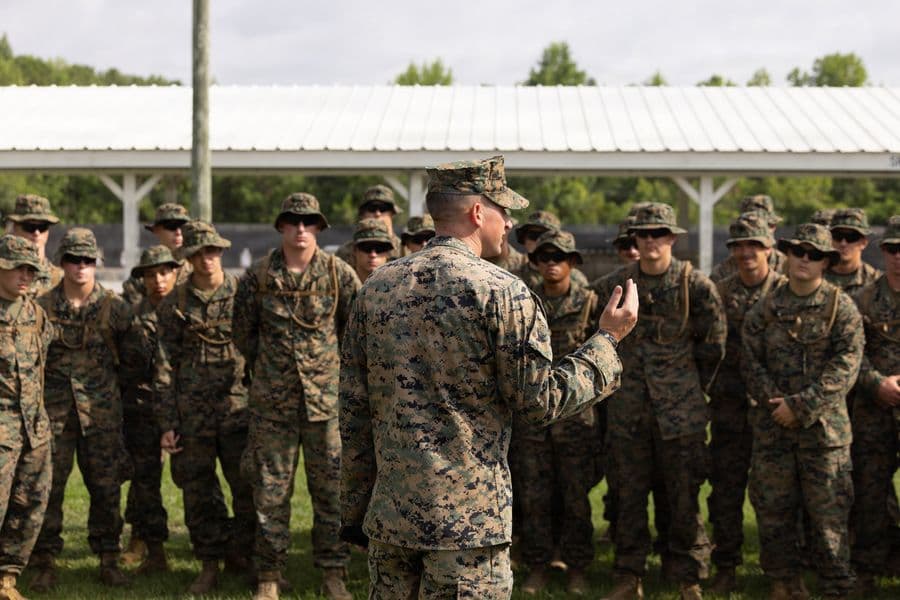
image: U.S. Marine Corps Staff Sgt. Patrick M. Blasko, range safety officer with Headquarters Battalion, 2nd Marine Division, conducts a range safety brief to Naval ROTC and Naval academy midshipmen during a Career Orientation and Training for Midshipmen East on Marine Corps Base Camp Lejeune, North Carolina, July 21, 2026. The CORTRAMID is a professional development program designed to provide Midshipmen with firsthand exposure to the Navy and Marine Corps communities. (U.S. Marine Corps photo by Lance Cpl. Steven Trevino)

In Pursuit of Nuclear Abolition
By Peter Huessy • RealClearDefense
Innovation Alone Won’t Prepare the U.S. for the Future Battlefield
By Joshua Segal • RealClearDefense
The sUAS Tactical Trifecta
By Bryan T. Woody • RealClearDefense
The Revolutionary War: When Strategic Options Share the Same Weakness
By Henry Yep • RealClearDefense
The Houthis Are Testing the Limits of Collective Defense
By Saima Afzal • RealClearDefense

Who Shoots Down the Drone Over the Shipyard?
By John Ferrari & Dillon Prochnicki • RealClearDefense
Northrop Grumman Breaks Out the Big Guns at AUSA
By Daniel Terrill, Defense News
Army Pursuing Diverse Array of New Anti-Air Interceptors
By Trevithick, The WarZoneWho Shoots Down the Drone Over the Shipyard?
By John Ferrari & Dillon Prochnicki, RCD
F-35C Lands for the First Time on a Ford-Class Aircraft Carrier
By The Aviationist