
Tactical Manufacturing: The 7th Function of Marine Corps Tactical Logistics
Last updated 07:23 AM EDT • Read time: 11m
For decades, U.S. forces moved through permissive global lines of communication (LOC), adhering to the “just-in-time” logistics model. Today, that era is over. America’s adversaries have created a contested environment to delay or deny sustainment. Two major factors threaten American sustainment in the Pacific: the People’s Liberation Army’s (PLA) capabilities and the Pacific theater's vastness. In a conflict with the PLA, they will seek to disrupt America’s way of war—projecting and sustaining combat power abroad. The new environment requires the Marine Corps’ tactical logistics doctrine to adapt. The
Expeditionary Advanced Base Operations require units to operate in distributed, interconnected nodes inside the weapons engagement zone (WEZ), as does Ground Combat Element (GCE) 2040.
This article does not argue for replacing traditional sustainment methods; rather, it proposes a hybrid model that gives the MAGTF a tactical manufacturing capability to support the commander’s requirements. The environment has changed, and technology has advanced. To sustain the force, the MAGTF commander needs another tool instead of relying exclusively on Continental United States (CONUS)-based LOC, augmented by pre-positioned stockpiles.
To retain lethality and increase survivability, the Service must shift in three ways: first, establish tactical manufacturing as the 7th tactical logistics function; second, create manufacturing units within the combat readiness regiments (CRR); and third, cultivate a manufacturing military occupational specialty (MOS).
Paradigm Shift
The Marine Corps logistics combat element (LCE) requires a shift in thinking. For decades, Marine Corps logistics and the Joint Logistics Enterprise have relied on host-nation warehousing, prepositioning (ashore and afloat), and secure supply lines. The Marine Corps’ Prepositioning Program is a classic example. Logistical success meant moving bulk items rapidly from rear areas to forward areas. This deep-seated reliance on mass distribution has shaped how America fights: firepower forward, always enough logistics to win. This, in turn, taught commanders to believe that when a part breaks, the ultimate solution would arrive via the traditional distribution network. Even if the system was slow, it always worked.
In a protracted, high-intensity conflict in the Pacific with the PLA, the necessary parts, vehicles, weapons, and other finished manufactured goods will not arrive in time. This necessitates a paradigm shift. The realities of contested logistics demand that commanders at all echelons view tactical-level manufacturing as an operational imperative to win.
At the strategic level, the shift began with the Department of War’s guidance. For its part, the Marine Corps has kept pace. Recently, the Service has fielded equipment to the Marine air-ground task force (MAGTF) and continues to innovate via Marine Depot Maintenance Command’s initiatives. While productive, this cultural pivot must extend deeper into the tactical level. The Service requires a tactical-level manufacturing capability: trained, manned, and equipped units backed by doctrine.
Six Functions of Tactical Logistics
MCDP 4 Logistics, MCWP 3-40 Marine Corps Logistics, and the MCTP series 3-40 outline Marine Corps logistics doctrine through six functions: supply, maintenance, distribution and transportation, general engineering, health services support, and services:
- Supply: Manages the procurement, processing, storage, salvage, inventory, or disposal of all classes of supply.
- Maintenance: Any action taken to return material to a service, including calibration, overhaul, reclamation, installation, and other support.
- Distribution and Transportation: The movement of personnel, equipment, and cargo across multiple domains through all ports of embarkation and debarkation.
- General Engineering: Enhances the physical environment to enable maneuver or support for construction to life support services.
- Health Services Support: Any care for Marines and Sailors, including their preservation, casualty care, medical logistics, and any other medical support.
- Service: Provides non-material support, such as operational contract support, disbursing, mortuary affairs, postal operations, and other unique subfunctions.
While these functions remain relevant, they depend on CONUS-based manufacturing and secure air and sea LOC for delivery through operational-level logistics networks to tactical units.
Enabling 21st-century logistics in a contested environment requires resiliency. Our current system is fragile. A tactical-level manufacturing capability provides flexibility and adaptability. The LCE needs those attributes to maintain the GCE by converting raw material into lethality at the point of need.
What’s the difference?
The Service must distinguish between traditional mechanical repair and new 4th Industrial Revolution capabilities. Within legacy doctrine, fabrication is a subfunction of maintenance: “fabricated items are intended to replace a like item, not create a new item.” It is the physical act of cutting, shaping, welding, or machining a material to repair or alter a piece of equipment. Fabrication is inherently corrective and localized, meant to restore an existing asset to an operational status. Manufacturing, by contrast, is a large-scale process that converts raw inputs into finished products and requires specialized training and education to operate.
While complementary, fabrication and manufacturing remain two distinct processes with distinct outcomes. The difference between fabrication and manufacturing lies in the size, scale, complexity, cost, education, and other factors. Fabrication responds to unique demands or repair requirements, sometimes employing subtractive methods (e.g., grinding or drilling). Manufacturing is an active capability that generates new items to answer customer demand. Manufacturers must acquire raw materials, process data packages, run mass-production lines to create several identical finished products, then ship them to a customer. Supply chain management is inherent in manufacturing. In simple terms, fabrication fixes broken brackets or creates unique adaptive solutions, welding metal to a vehicle. However, manufacturing creates new products, like unmanned systems. The MAGTF must do the latter in theater to remain lethal.
The Argument
To prepare for 21st-century warfare, the Corps must create a distinct doctrinal publication for tactical manufacturing to keep pace with the evolution of emerging technologies. Tactical manufacturing is forward-postured production of needed items, parts, and systems to support immediate MAGTF requirements, fully operated by Marines. A codified, structured doctrinal framework for incorporating additive manufacturing technologies and processes enables the Service to adapt as technology evolves over the next few decades. There are three primary reasons why tactical manufacturing must be a distinct logistics function rather than remain buried within the legacy functions.
First, establish a 7th Function of tactical logistics in a new publication: MCTP 3-40I Tactical Manufacturing. As a separate function, tactical manufacturing allows the Marine Corps to reduce its reliance on massive inventory storage and physical transportation networks. Instead of maintaining a large physical footprint of replacement parts at intermediate supply units, tactical manufacturing allows the MAGTF to carry digital print files, something already underway through the Digital Manufacturing Exchange.
Second, tactical manufacturing breaks traditional boundaries, enabling outputs across multiple supply classes. This provides commanders with logistics flexibility and responsiveness—two of the seven principles of logistics. A future manufacturing unit using advanced multi-material printers can produce or assemble tailored ammunition components and explosive casings, end items like unmanned vehicles, repair parts, and other non-military items.
A third advantage is that tactical manufacturing enables innovation. Warfare is a continuous cycle of adaptation, continually looking for asymmetric advantage. example, close collaboration between tactical additive manufacturing and Ukrainian combat units enables rapid drone adaptations. Today’s logistics system is not adaptive enough. Tactical manufacturing, as a doctrinal logistics function, gives commanders an organic capability to redesign and manufacture specialized equipment. This creates a MAGTF tactical adaptation advantage.
Manufacturing Unit
The Marine Corps can integrate the 7th function by creating a standalone or task-organized manufacturing unit within the CRRs. This enables the unit to work closely with existing units like the Supply Management Unit and Maintenance Battalions. Encouragingly, the 2026 summer exercises Valient Shield and Rim of the Pacific successfully executed the proof of concept. Mass scaling across the Corps is next.
The manufacturing unit would feature large-scale subtractive and additive manufacturing (LFAM) equipment; access to a Joint database of available parts, equipment, and munitions; and sufficient engineering capabilities to manage feeder materials. Merely adding new technology to old formations and sustainment systems will not enable winning tomorrow’s battles. A tactical logistics function requires trained professionals.
The Marine Corps must create a tactical manufacturing MOS focused on industrial manufacturing processes and procedures that complement existing specialties. While a fantastic step, the new 1321 MOS remains focused on maintenance-centric roles. The proposed manufacturing MOS would expand beyond legacy models to focus on data management of a digital blueprint repository and advanced materials science. This field would cultivate engineers who are experts in managing multiple LFAMs to support various materials (e.g., polymers, composites, metals). It would also include microminiature repair specialists, digital repository and code managers to protect digital intellectual property, and cyber experts to manage the digital threat matrix against cyber tampering.
It also requires material quality assurance and control specialists to test raw feedstocks and perform non-destructive testing to ensure printed parts can withstand operational stress. And finally, the unit requires traditional logistics support like motor transport and general engineering. By building a professional pipeline, the Marine Corps will possess both the tactical fabricators for field maintenance and manufacturers for tactical manufacturing. To be clear, the unit is not a replacement for traditional manufacturing. Rather, it is an adaptive tool within the logistics systems, providing the MAGTF commander with tactical-level manufacturing.
The Counterargument
Critics may argue that creating a 7th function of tactical logistics is redundant. Since fabrication is already an established subfunction of maintenance, opponents may claim that additive manufacturing technologies should be integrated into existing doctrine and units. The answer lies in the difference between fabrication and manufacturing, as well as in support requirements and final output.
While there is considerable overlap, the maintenance function is fundamentally different than manufacturing. The difference is the amount of manufacturing material. Maintenance operations handle discrete components and specific pieces of broken equipment. Maintenance Marines perform repairs or corrective actions on existing equipment and systems. For example, the Maintenance Battalion’s primary mission is supporting the Repairable Issue Point (RIP), which keeps the MAGTF operational. Double-stacking the RIP and additive manufacturing tasks on a single unit creates tension between highly critical missions.
Clearly, there is overlap, as in the commercial sector. However, expecting a maintenance shop to manage production lines distracts from its core mission of diagnosing and repairing complex mechanical and electronic weapon platforms, which is a tall order. Tactical manufacturing requires unique digital workflows, automated robotic operations, scalable production metrics that differ from those of standard maintenance procedures, and a host of new technologies that will continue to evolve rapidly in the coming decades. Treating manufacturing as a minor subfunction risks limiting its use to small-scale fixes and to preventive or corrective maintenance, rather than leveraging it to create a 21st-century sustainment network.
The proposal to add a new logistics function is not without precedent. A key example of this cognitive and substantive change is the aviation combat element’s induction of Aviation Ground Support as the 7th function of Marine aviation. Historically, Marine aviation only recognized six functions: assault support, anti-air warfare, offensive air support, electronic warfare, control of aircraft and missiles, and aerial reconnaissance. A similar organizational evolution took place with the activation of Marine Unmanned Maintenance Squadron 14. A last example is the elevation of Information as a Marine Corps and Joint Warfighting function. Emerging technologies and revolutionary systems necessitate new structures, training, and doctrinal shifts that go beyond legacy frameworks. Tactical logistics doctrine should follow suit.
Conclusion
Traditional systems work until they don’t. Today’s Marine Corps sustainment system would benefit from hybridization because tomorrow’s conflicts are protracted, logistically contested, and lethal. Maintaining MAGTF endurance requires a paradigm shift as the Service leverages new technology. To be sure, technology is no panacea. It is, however, a valuable tool that must be harnessed and deployed as a tactical-level capability, not just as pieces of equipment. To that end, Marine Corps logistics doctrine must adapt tactical manufacturing as the 7th function of logistics, create specific units within the CRRs, and establish a dedicated MOS. The recommendations enable the MAGTF to fight and win on tomorrow’s battlefields.
LtCol Steven Bancroft is an active-duty Marine Corps Officer and currently serves as the Commandant of the Marine Corps’ representative to the Hoover Institution as a Robert and Marion Oster National Security Affairs Fellows program. He has served in Iraq and Afghanistan and has 10 years of experience in the Pacific theater, including two cumulative years in the Philippines.
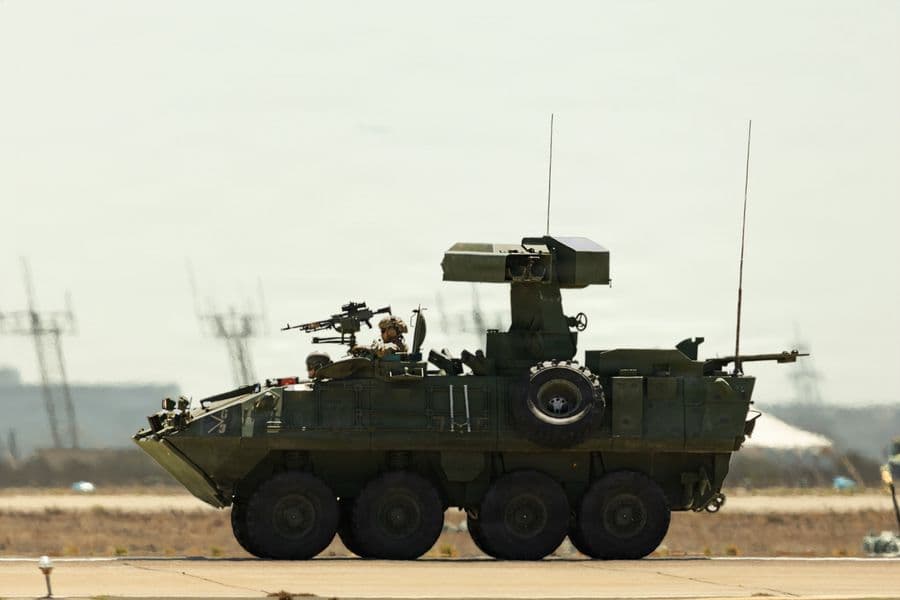
image: A U.S Marine Corps LAV-25 Light Armored Vehicles with 1st Reconnaissance Battalion, 1st Marine Division, and Joint Light Tactical Vehicles assigned to 1st Distribution Support Battalion, Combat Logistics Regiment 1, 1st Marine Logistics Group, roll past the flightline after the completion of the Marine Air-Ground Task Force demonstration during the 2026 Marine Corps Air Station Miramar Air Show in San Diego, Sept. 25, 2026. The MAGTF Demo displays the coordinated use of close-air support, armor, artillery, and infantry forces and provides a visual representation of how the Marine Corps operates. America's Air Show 2026 is a unique and incredible opportunity to witness Marine and joint aviation capabilities, civilian performers and the world-famous Blue Angels; to celebrate America’s 250th birthday alongside Marines and to see first-hand the innovative spirit of the Marine Corps through emerging technologies and forward-thinking. (U.S. Marine Corps photo by Lance Cpl. Janell B. Valerio Alvarez)
The views in this article are those of the author and do not represent the policy of the Marine Corps, the Department of War, or the U.S. Government.

In Pursuit of Nuclear Abolition
By Peter Huessy • RealClearDefense
Innovation Alone Won’t Prepare the U.S. for the Future Battlefield
By Joshua Segal • RealClearDefense
The sUAS Tactical Trifecta
By Bryan T. Woody • RealClearDefense
The Revolutionary War: When Strategic Options Share the Same Weakness
By Henry Yep • RealClearDefense
The Houthis Are Testing the Limits of Collective Defense
By Saima Afzal • RealClearDefense

Who Shoots Down the Drone Over the Shipyard?
By John Ferrari & Dillon Prochnicki • RealClearDefense
Northrop Grumman Breaks Out the Big Guns at AUSA
By Daniel Terrill, Defense News
Army Pursuing Diverse Array of New Anti-Air Interceptors
By Trevithick, The WarZoneWho Shoots Down the Drone Over the Shipyard?
By John Ferrari & Dillon Prochnicki, RCD
F-35C Lands for the First Time on a Ford-Class Aircraft Carrier
By The Aviationist