
Marines Die and the Corps Will Die Too
Last updated 12:32 AM EDT • Read time: 7m
Being ready is not what matters. What matters is winning after you get there. – Victor H. Krulak, Lieutenant General, USMC
The life cycle: Everyone and everything dies, eventually.
Last evening I read a post that a textiles company in the mill town where I was raised is shuttering their once giant operation after a run of 123 years. About 150 employees will be out of work.
During the 1960s and 1970s, my youth, that company, not a mill I worked for, was big, dominant, and had a lot more than 150 employees. But starting in the late ‘70s, and accelerating in the ‘80s, practically overnight, politics destroyed American textiles. Death hit the South. Those jobs went overseas, mainly in China, and so went the textile industry.
I was asked recently to write, not about the mills, but about the Marine Corps and ethos. It’s been a damn struggle.
Twenty plus years retired, the Marine Corps has changed significantly since I was commissioned 46 years ago. Trained as an infantryman I did dangerous things. But there were duties outside the operating forces, too. Important duties.
One of those assignments was supervising drill instructors (DIs). Three years (1983-1986) in 2d Recruit Training Battalion, Parris Island was a personal and professional life-changing experience. The impact is still being digested.
Forty-three years ago, 1 October, West Virginian Jerry Hurst, 17 years old, in the squadbay on line at reveille, collapsed at the foot of his rack. Despite his Dis heroic efforts, Recruit Hurst died. Their series commander said I was responsible.
The platoon and series changed that Saturday morning. The company, battalion, regiment, and depot changed, too. But training continued.
Fast forward to today, the core of recruit training is unrecognizable to me. Since 2006, 20 years after leaving ‘the street,’ I’ve visited the historic depot seven or eight times. During each visit I’ve seen committed DIs making Marines, however, I have seen a Corps dying, like the textile mills, from politics.
Is it good for mission readiness of the Corps that male and female recruits train together?
Is it good for mission readiness of the Corps male and female DIs engage with opposite gender recruits?
Is it good for mission readiness of the Corps that longstanding Obstacle courses and Confidence courses designed to challenge men have been made to be less challenging so females can successfully negotiate them?
Is it good for mission readiness of the Corps that male training battalions are commanded by women?
Those are just some of the questions that go into eating away at ethos – it is that difficult to describe something, but you know it when you see it, that graces Marines giving envious mystique to the Corps.
Last evening while preparing raw vegetables for roasting, sweet jazz in the background, I reflected on my Parris Island days and how to craft this essay that some expect me to.
I had befriended my former Commanding General while assigned to Parris Island years later after my many trips to Parris Island, and he has now, unfortunately, passed. Before his passing, we had an interesting conversation about Recruit Hurst. At the time, I had no idea the depth of his involvement with the family nor how that death impacted him.
My former Commanding General was General Robert H. Barrow, Commandant of the Marine Corps when I reported, who I met shortly afterwards, died 18 years ago next month. He was the commanding general of Parris Island in the early 1970s. And he was a recruit and DI in the early 1940s at the San Diego depot. A seasoned trainer and battle-hardened warrior, he held strong beliefs about the critical mission of recruit training. His words, “Recruit training is where the difference begins.”
During his final months as the Corps 27th Commandant, General Barrow visited Parris Island. Walking a recruit formation standing inspection he paused now and then to speak with recruits. Routinely, he’d ask a recruit what he’d learned during training.
Soon after that visit, during his retirement ceremony remarks, he recalled an exchange with one recruit. As to the rigors, testing, and challenges of difficult training he asked, “What did you get out of it, son? What did all of this give you?” “Discipline, Sir!” “And what does that mean to you?” “Sir, the private will always do whatever needs to be done.” He felt that was the best response he’d ever heard.
That, as every Marine knows, is the confident mindset seared into the heart, mind, and soul - that goes to ethos - achieved only through conquering seemingly impossible training led by the demanding of perfection and never-satisfied DI. There is no other way.
General Barrow did not believe, for a myriad of obvious physical and psychological reasons unique to males and females, gender integrated training was good for the mission readiness of the Corps.
Eight years after he retired, the Senate Armed Service Committee (SASC), believing his experiences still relevant, invited him to testify before a subcommittee holding a hearing not on recruit training, per se, but on women in combat. Recruit training is, however, integral to preparing young men for combat: Train like you will fight.
In his opening testimony to the SASC, Gen Barrow said: “This is not, should not be about women’s rights, equal opportunity, career assignments for enhancement purposes for selection to higher rank. It is about, most assuredly is about, as has already been pointed out, combat efficiency, combat readiness, winning the next conflict and so we’re talking about national security.”
In short, aligning with his objection to gender integrated entry level training, he opposed women in combat. He clarified, “Exposure to danger is not combat.” He felt deeply the requirements for strength and endurance rendered women unable to meet the demands of combat. His thoughts - precise, eloquent, passionate, and compelling, based on command of combat units in three wars. Though avoiding the gruesome, his chilling climax detailed some of the unimaginable hardships and horrors of the Chosen Reservoir fight.
Gen Barrow warned: “If you want to make a combat unit ineffective, assign some women to it.” And he shared thoughts of supposing if his unit had been15% to 20% women. His supposing led him to believe death, with his bones being tended to in North Korea.
He then made a dire forecast: “I know about my service, if you persist in pushing this down into the combat area it would destroy the Marine Corps. Simple as that. Something no enemy has been able to do in over 200 years.”
While still in my kitchen at the island tending to the vegetables, oven heating and deep in thought, Gen Barrow came to mind. On 10 November 2024, I stood at the foot of his grave following the annual wreath laying ceremony.
I wondered that if alive today, what would he say and do about what so many Marines believe – the Marine Corps being destroyed by way of a rotting ethos, the shedding of significant combat power needed for potential adversaries such as China. A dying Corps for gender integrated training and women in combat.
Say? “I predicted.”
Do? Nothing other than offer respectful silent prayer for the dead.
Those who take exception to Gen Barrow’s position, all other notable Marines and others, men and women, who echo his sentiments, and even me but a messenger for writing this short summary, take your politics-based quarrel up with heartless Mother Nature and human nature. Kill not commonsense, candor, integrity, voices of reason, and apolitical allegiance to what was the world’s most feared fighting force.
The old General is still relevant. Few defy the life cycle, but if any man can, put your faith in a Marine.
That’s all I have to say.
Andy Weddington, U.S. Marine (Retired)
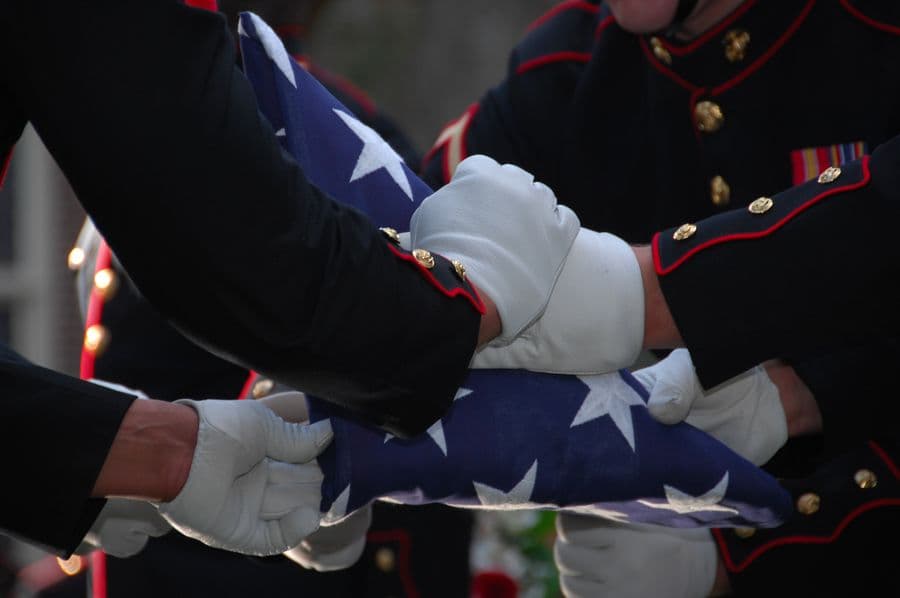
image: U.S. Marines from Marine Barracks Washington, D.C., fold a flag during the funeral ceremony for former Commandant of the Marine Corps Gen. Robert H. Barrow in Saint Francisville, La., on Nov. 3, 2008.

In Pursuit of Nuclear Abolition
By Peter Huessy • RealClearDefense
Innovation Alone Won’t Prepare the U.S. for the Future Battlefield
By Joshua Segal • RealClearDefense
The sUAS Tactical Trifecta
By Bryan T. Woody • RealClearDefense
The Revolutionary War: When Strategic Options Share the Same Weakness
By Henry Yep • RealClearDefense
The Houthis Are Testing the Limits of Collective Defense
By Saima Afzal • RealClearDefense

Who Shoots Down the Drone Over the Shipyard?
By John Ferrari & Dillon Prochnicki • RealClearDefense
Northrop Grumman Breaks Out the Big Guns at AUSA
By Daniel Terrill, Defense News
Army Pursuing Diverse Array of New Anti-Air Interceptors
By Trevithick, The WarZoneWho Shoots Down the Drone Over the Shipyard?
By John Ferrari & Dillon Prochnicki, RCD
F-35C Lands for the First Time on a Ford-Class Aircraft Carrier
By The Aviationist