
Former CMC's Letter Endorsing Amphibious Shipbuilding
Last updated 07:22 AM EDT • Read time: 5m
In an increasingly complex and volatile security environment, our Nation needs a force to deter aggression, contain conflicts, evacuate noncombatants, and respond quickly and effectively to other crises and contingencies. Without this capability, bullies thrive, crises become conflicts, our citizens abroad are at risk, and our National Command Authority lacks a full range of options to deter and respond.
The most common characteristic of threats to our national interests is that they occur in the world’s littorals where nearly 70 percent of the population lives within 90 miles of the ocean. Today, we find instability and active crises around Israel and the Levant, in the Red Sea, the South China Sea, perpetually in the powder keg of the Koreas, and, in fact, virtually wherever we look. History teaches us that persistent forward presence is the best way to deter, and if necessary, respond to threats before they become full blown crises. Naval forces have the flexibility, capability, and capacity to clearly signal United States intentions and resolve, while enabling a more robust joint and combined response if necessary. The proven solution requires forward locating both military capability and capacity, with geographic agility and the sovereignty protection of the sea as requirements.
While the U.S. historically has been preeminent in this role, our recent record is less than impressive. Lack of amphibious forces in the Mediterranean and Red Sea limited our ability to act when earthquakes struck Turkey and Syria, and a noncombatant evacuation was required in Sudan. And while an amphibious force was temporarily available off the coast of Israel or in the Gulf of Aden to act if required against the Houthis, the once persistent presence is now only occasional. A similar situation exists in the Pacific and Indian Oceans and the Persian Gulf, where amphibious capability once provided noncombatant evacuation operations, disaster relief, humanitarian assistance, peacekeeping forces, and a presence to ensure friend and foe of America’s commitment.
Until recently, America could count on a perpetual presence of amphibious forces in the Pacific, Persian Gulf, Mediterranean (capable of flexing to the Red Sea) and occasionally along the coast of South America. It no longer does, because amphibious ships simply aren’t available. The United States also maintained three maritime prepositioned squadrons with the stocks necessary for Marine operations in the Pacific Ocean, Mediterranean Sea, and Indian Ocean, but that capability is now down by half (and will be further reduced if reported additional deactivations take place). When continual forward presence is lost, the United States no longer possesses the robust capabilities to deter troublemakers and respond to crises. And deterrence is cheaper than intervention. This shortfall in shipping carries an even heavier price if conflict cannot be avoided, because sustainable forceful entry to assist our allies has been compromised.
In essence the nation needs to have enough amphibious ships to keep tailored Marine Air-Ground Task Forces continually deployed in the Mediterranean Sea, Western Pacific, and the Indian Ocean areas, while retaining additional capabilities to reinforce these areas or respond quickly and effectively to emerging crises in other theaters.
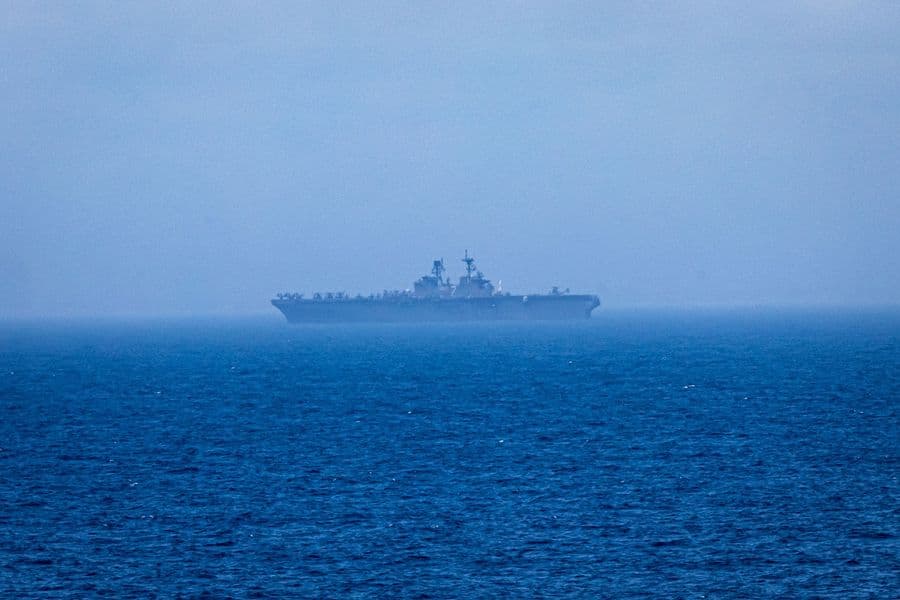
It is the Commandant’s responsibility in coordination with the Secretary of the Navy to determine the number of ships required. The former Secretary’s recently announced multi-ship procurement of one large deck Landing Helicopter Assault (LHA) ship and three multi-purpose and versatile Landing Platform Dock (LPDs) ships is a move the right direction, but there is still much work to be done. While fiscal constraints will continue to force tough decisions, the growing array of global and regional threats inimical to our national interests require a larger, well-resourced naval force. The Navy, with the help of the ship building industry, must replace worn out ships and correct shipyard inadequacies that for the past ten years have enabled amphibious ships to be available only 46 percent of the time.
The Navy must also take the actions needed to restore Maritime Prepositioning Force ships and recapitalize the strategic sealift fleet.
Individual members of Congress past and present have urged action, but now the gaps in coverage have become acutely dangerous. Years of flat and capped budgets, together with Continuing Resolutions, will require immediate action and strong leadership from our elected officials. National embarrassment or worse is only one pending crisis away. We, the undersigned, an association of former Commandants of the Marine Corps, having experienced the very real consequences of conflict, urge immediate action.
Charles C. Krulak, General, USMC (Ret.) 31st Commandant of the Marine Corps
James L. Jones, General, USMC (Ret) 32nd Commandant of the Marine Corps
Michael W. Hagee, General, USMC (Ret) 33rd Commandant of the Marine Corps
James T. Conway, General, USMC (Ret) 34th Commandant of the Marine Corps
James F. Amos, General, USMC (Ret) 35th Commandant of the Marine Corp
Joseph F. Dunford, General, USMC (Ret) 36th Commandant of the Marine Corps
Robert B. Neller, General, USMC (Ret) 37th Commandant of the Marine Corps
David H. Berger, General, USMC (Ret) 38th Commandant of the Marine Corps

Iranian Cyber Operations
By Michael Groen • RealClearDefense
Reflecting on an Epic Horse Campaign in the Mountains of Afghanistan
By Brian Glyn Williams • RealClearDefense
The Godfather of American Foreign Policy Realism Speaks to Today’s World
By Francis P. Sempa • RealClearDefense
In Pursuit of Nuclear Abolition
By Peter Huessy • RealClearDefense
Innovation Alone Won’t Prepare the U.S. for the Future Battlefield
By Joshua Segal • RealClearDefense

26th MEU – U.S. Needs Crisis Response MAGTF
By Marine Corps Compass Points
The Influence of History on a Sea Power
By CDR Salamander
Navy Civilianizes Six Former Flag Billets, Reduces Six to Captains
By Mongilio, USNI N.
Raytheon's $8B Contract for Strategic Comms Terminal Modernization
By M+A El
America’s Maritime Moment Will Not Wait
By CDR Salamander