
Marine Corps Global Response in the Age of Precision Munitions
Last updated 08:24 AM EDT • Read time: 8m
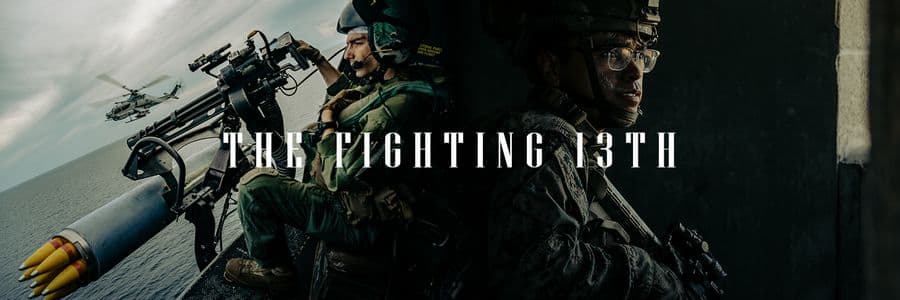
Editors Note: The graphic represents the Marine Corps 9-1-1 force, a capability quickly eroding under Force Design 2030.
Photo; A graphic created as a banner for 13th Marine Expeditionary Unit social media platforms to highlight the 13th MEU’s warfighting readiness at Camp Pendleton, California, June 11, 2024. The social media banner was designed to feature the 13th MEU as a forward deployed, flexible sea-based Marine Air Ground Task Force capable of conducting amphibious operations, crisis response and limited contingency operations. This graphic was created in Adobe Photoshop 2021. (U.S. Marine Corps graphic by Cpl. Kayla Halloran)
Four years ago, the United States Marine Corps embraced Force Design 2030 as its capstone operating concept. This unproven and unsolicited concept transitioned the Marine Corps from a global force in readiness to a regional force in waiting and was not vetted with most of the Geographic Combatant Commands or managed at Quantico by the Marine Corps Combat Development Command’s highly regarded and effective combat development process. Nevertheless, the 38th Commandant of the Marine Corps, using his Title X, U.S. Code authorities to organize, train, and equip the service, reorganized, and restructured the operating forces to fight a single known threat (People’s Liberation Army Navy) in a specific location (Western Pacific region).
Much has been written about the flaws and shortcomings of Force Design. The purpose of this article is not to relitigate these charges but to highlight an alternative vision, which has been previously articulated but conveniently overlooked.
The alternative option – Vision 2035 – provides the framework for developing an operating concept from which the Marine Corps through the combat development process can determine capabilities and requirements (doctrine, force structure, equipment, training and education, and facilities and support) needed to restore the Marines as the nation’s premier 9-1-1 force for the full spectrum of crises and contingencies.
To remain meaningful, the Marine Corps must be organized and equipped to meet the uncertainties of an increasingly dangerous world. This requires a Marine Corps that is built on four pillars. As articulated in Vision 2035, it is a Marine Corps that:
“is immediately ready to respond to crises and contingencies anywhere in the world.”
“is relevant, manned and equipped to support the Secretary of Defense’s requirements with scalable, flexible, adaptive, and lethal forces.”
“is capable of fighting and winning in any conflict.”
“has the capacity to rapidly converge and build to a Marine Expeditionary Force (MEF).”
Each of these pillars requires operating forces that are rapidly deployable and sustainable, which is only possible by full throated U.S. Navy support, especially a robust fleet of operationally ready amphibious shipping and a strategically positioned, immediately deployable maritime prepositioning force.
A lot has changed strategically since the publication of Force Design. The war in Ukraine; the fighting in Gaza; and a more belligerent Iran are just three examples. Like previous threat assessments, this year’s Annual Threat Assessment recognizes countries other than China as inimical to U.S. national interests, specifically North Korea, Iran, Russia, and various nonstate actors. We believe the Corps’ single focus on confronting China’s Navy along the First Island Chain in the Southeast Pacific, at the exclusion of other global threats, is a danger to our national security. In our opinion, a retooled Marine Corps flexibly organized, trained, and equipped for a full range of global contingencies in an increasingly unstable world is a better option.
The Marine Corps must also be enabled by capabilities that promote readiness and relevancy. Vision 2035 lays out seven enabling capabilities. Chief among them are sustainment and technology. Combat operations are not possible without adequate supplies and equipment, which must be moved by ships. Technology will allow the Marine Corps to adapt and evolve to changing threat environments and remain “adaptive, maneuverable, lethal, and survivable.”
Vision 2035 is anchored in two fundamental and enduring certainties: the United States is a maritime nation with global interest and the nature of war is unchanging, although the character of war does change. Force Design disregards both premises and assumes China will pursue limited objectives confined to the South China Sea.
To pursue transformation, the Marine Corps accepted a dramatic reduction in the number of amphibious assault ships and maritime prepositioning ships. Supporters of these reductions argue that amphibious landings on hostile shores are an anachronism and prepositioning ships are nothing more than targets (unlike aircraft carriers or fixed bases like Guam and Diego Garcia, one presumes). Serious strategists recognize that the amphibious and prepositioning fleets are vital to the rapid projection of decisive force into contested regions of the world where U.S. interests are at risk. Marine Air-Ground Task Forces (MAGTFs), operating afloat as Marine Expeditionary Units or Marine Expeditionary Brigades, ashore as Special Purpose MAGTFs (most recently in Africa, Europe and the Arabian Peninsula), or as Marine Expeditionary Forces can conduct a wide range of expeditionary operations to include persistent forward presence, military engagement, humanitarian response, and, if required, combat operations to defeat hostile threats and set conditions for decisive operations by the Joint Force.
Expeditionary forces provide US leaders with options to assert US influence in regions where access is limited or unavailable. The arrival of sea-based expeditionary forces operating in international waters near hotspots sends a powerful signal to both allies and adversaries alike without creating additional force protection challenges attendant with establishing land bases in low-security environments. Unfortunately, the structural changes mandated by Force Design have weakened US global force projection capabilities and reduced the range of response options available. Vision 2035 offers a plan for restoring them.
Many articles have already been published touting the tenets of Vision 2035. Two of the best are “Reduce the Risk to National Security: Abandon Force Design 2030” and “A Better Plan for the Marine Corps and the Nation: Vision 2035.” These articles convey our belief that precision weapons have not made maneuver impossible, which is counter to the underlying premise of Force Design. We know from history that for every advancement in military technology a countermeasure can be developed making the new shiny object irrelevant or at least manageable. The philosophical foundation for this contention can be found in another recently published article, “Force Design 2030 is Trying to Solve the Wrong Problem.”
Finally, America’s Marines must possess an enduring set of capabilities and values that define them. These are enduring requirements that make United States Marines different. Vision 2035 affirms nine requirements that are unassailable. The most important of the nine is arguably the mindset to retain an offensive orientation, which requires scalable Marine-Air-Ground-Logistics Task Forces and modern and effective combined arms. Others include remaining a versatile and resilient force. Marines must be ready for any mission, anywhere and large enough to continue the mission after taking casualties. And one that is often overlooked is to remain a youthful force. The strength of the Corps has always been the individual Marine and his or her willingness to march to the sounds of the guns, which is a hallmark of youth.
Vision 2035 may disappoint the armchair generals who want to talk numbers of ships, battalions, and squadrons, and so on. Others may find the vision lacking because it fails to specify numbers and types of tanks, artillery, airplanes, and the like. But no skilled carpenter would build a house without first getting the blueprint right. And no knowledgeable officer would build a certain force for an uncertain future without first getting the operating concept right. Once the concept is right, it’s a relatively easy task to determine the capabilities and requirements, which must be integrated and supportable.
Vision 2035 provides the framework for the Marines to develop an operating concept that better addresses all the nation’s threats, not just one of them. To paraphrase the authors of Vison 2035, “Our vision for the Marine Corps reduces risk to national security. The vision is a forward look at all threats, not a concept focused on one threat in a single theater. By returning to a more capable combat development process and leveraging innovation and technology, the Marine Corps can regain its offensive capabilities by restoring maneuver, which will enable the nation’s Corps of Marines to respond quickly and effectively to global threats across the spectrum of conflict.”
The Marine Corps leadership needs to work with the Navy and the Congress to ensure the Marine Corps is better positioned to meet the global challenges of the 21st Century. The time to start is now.
If you have not read Vision 2035, we encourage you to do so. If you disagree with it, attack the message. Too often informed and uniformed people only attack the messenger, which does nothing to further the national defense.
General Charles (Chuck) Krulak, (USMC, ret.) was a career infantry officer. His assignments include Commanding General, Marine Corps Combat Development Command. His last assignment was the 31st Commandant of the Marine Corps
General Anthony (Tony) Zinni, (USMC, ret.) was a career infantry officer. His assignments include Deputy Commanding General, Marine Corps Combat Development Command. His last assignment was Commander, United States Central Command.
General Paul K. Van Riper, (USMC, ret.) was a career infantry officer. His assignments include President of the Marine Corps University. His last assignment was Commanding General, Marine Corps Combat Development Command.
Brigadier General Jerry McAbee, (USMC, ret.) was a career artillery officer. His assignments include Chief of Staff, Marine Corps Combat Development Command. His last assignment was Deputy Commander, United States Marine Corps Force, Central Command.

In Pursuit of Nuclear Abolition
By Peter Huessy • RealClearDefense
Innovation Alone Won’t Prepare the U.S. for the Future Battlefield
By Joshua Segal • RealClearDefense
The sUAS Tactical Trifecta
By Bryan T. Woody • RealClearDefense
The Revolutionary War: When Strategic Options Share the Same Weakness
By Henry Yep • RealClearDefense
The Houthis Are Testing the Limits of Collective Defense
By Saima Afzal • RealClearDefense

Who Shoots Down the Drone Over the Shipyard?
By John Ferrari & Dillon Prochnicki • RealClearDefense
Northrop Grumman Breaks Out the Big Guns at AUSA
By Daniel Terrill, Defense News
Army Pursuing Diverse Array of New Anti-Air Interceptors
By Trevithick, The WarZoneWho Shoots Down the Drone Over the Shipyard?
By John Ferrari & Dillon Prochnicki, RCD
F-35C Lands for the First Time on a Ford-Class Aircraft Carrier
By The Aviationist