
Rocking the Boat to Make Littoral Mobility the Next Offset
Last updated 07:17 AM EDT • Read time: 5m
The Marine Corps Stand in Force concept gives the Joint Force a lethal, adaptable formation inside the People’s Liberation Army’s (PLA) weapons engagement zone. However, the Corps’ littoral mobility solution, the coveted Landing Ship Medium (LSM), is experiencing spiking costs and delivery date delays, which risks making the stand-in force the stand-still force. The Navy's competing budget priorities and an antiquated procurement process leaves the Marine Littoral Regiments (MLR) – The Marine Corps Pacific prizefighter – without their prime movers, further depriving MLRs’ ability to gain advantages through maneuver. As PLA capabilities continue to develop and their willingness to use force increases, the Marine Corps must invest in and experiment with alternative means of conveyance. The time is now to give the Stand in Force its sea legs.
As the Marine Corps rideshare, the Navy has proudly delivered Marines ashore since 1775. Today, the LSM (originally called the light amphibious warship) has emerged as the Navy’s newest, purpose-built ship designed to provide tactical maneuver within contested littoral environments. However, the first of 18 - 35 ships will not arrive until the mid-2030s leaving the MLRs high and dry and forcing the Commandant of the Marine Corps to issue a requirement for “a near to mid-term” Littoral Maneuver Bridging Solution. Exploit existing commercial and military capabilities until LSMs are procured is practical but even when LSMs arrive in the First Island Chain (FIC), their onerous support requirements and questionable survivability saddles MLRs to these undeveloped, so far, unfunded mobility platforms. Whether the Corps will start seeing LSM sea trials in the 2030s remains unclear, but the Marines also rightly wonder: Will the LSM be too late?
Right now, MLRs serve as the Joint Force’s tripping wire, providing early warning detection and decision-making space as a type of Joint Force quarterback. Like an American football quarterback, MLRs’ mastery of receiving information and acting on it gives commanders options to deter PLA hostilities. One role of the MLR is to function as an early entry command and control node integrating into Joint, Interagency, and multinational partner capabilities. Operating in and from key locations across littoral regions, MLRs link together a broad array of multi-domain sensors to form robust and reliable kill webs. The urgent requirement to maneuver these capabilities requires speed and stealth, something an LSM-type ship cannot offer. Longer term requirements, such as the movement of missile launchers and sustainment packages will require LSM; however, that time is not now.
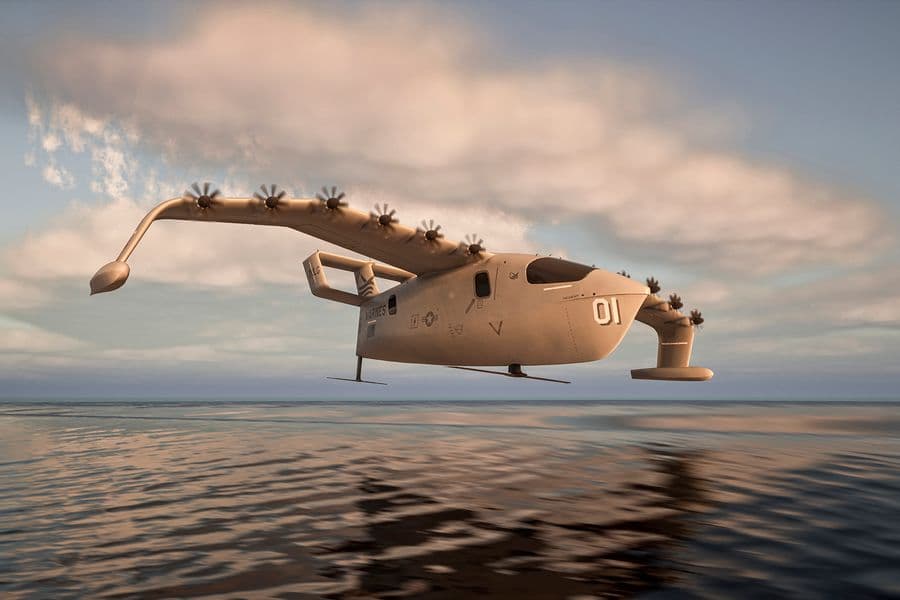
To meet the MLRs’ immediate requirements to achieve rapid and stealthy maneuver options, the Marine Corps should play to its strengths – ingenuity and adaptability – and invest in novel multi-modal means of transportation. By deepening partnerships with industry innovators developing multi-domain platforms available in 2026 instead of 2036, the Corps can hedge against fragile, budget greedy, multi-decade ship-building programs and focus on its own, truly organic mobility formation. Enter the case of wing-in-ground effect (WIGE), where recent technological advancements have transformed a 1960s concept of transportation into commercially viable littoral mobility options. This tech has the Marine Corps attention. Within two years this innovative capability enabled by advanced technologies will provide MLRs with the speed and stealth required to gain time and space advantages in the FIC.
But time is not on the side of the MLR. The needs of the MLR are real time. Iterative, joint exercise life cycles across the Pacific place MLRs, with their partners, into key littoral environments persistently prior to violent conflict. As the Marine Corps waits for its fleet of LSMs, a myriad of credible air and surface mobility options such as Army watercraft, military aircraft, and commercial options are available for use by the Marine Corps.
Modern, safe, and technologically advanced WIGE platforms further enhance MLRs’ persistence in contested environments. Employing state-of-the-art WIGE craft would allow naval, joint, and multinational force commanders the ability to identify and track high-value targets in the surface and subsurface domains. Given the lack of readily available amphibious warships and the likely 2040 delivery of the first LSM squadron, maritime mobility options for larger formations of Marines may continue to be unavailable. However, the Corps must leverage the ingenuity of its Marines and Sailors already operating in the FIC by testing, procuring, and employing its own mobility platforms that enable maritime domain awareness operations.
Force Design 2030 solidified the Corps’ value proposition to the Joint Force. In the FIC, the Corps enhanced this value by establishing and maintaining multi-domain corridors in the Pacific. The Corps requires a reliable means of multi-modal littoral mobility in two years, not ten. Accelerating organic, Joint, and multinational modes of mobility will enable operational units inside the FIC to deter increased aggression, assure partners, and respond to crises.
Maj Brent Jurmu is the 12th Marine Littoral Regiment Future Operations Officer
Maj Benjamin Van Horrick is the 3d Marine Expeditionary Brigade's Current Logistics Operations Officer
The views presented are those of the authors and do not necessarily reflect the policy or position of the U.S. Marine Corps, the U.S. Navy, or the Department of Defense.

Iranian Cyber Operations
By Michael Groen • RealClearDefense
Reflecting on an Epic Horse Campaign in the Mountains of Afghanistan
By Brian Glyn Williams • RealClearDefense
The Godfather of American Foreign Policy Realism Speaks to Today’s World
By Francis P. Sempa • RealClearDefense
In Pursuit of Nuclear Abolition
By Peter Huessy • RealClearDefense
Innovation Alone Won’t Prepare the U.S. for the Future Battlefield
By Joshua Segal • RealClearDefense

26th MEU – U.S. Needs Crisis Response MAGTF
By Marine Corps Compass Points
The Influence of History on a Sea Power
By CDR Salamander
Navy Civilianizes Six Former Flag Billets, Reduces Six to Captains
By Mongilio, USNI N.
Raytheon's $8B Contract for Strategic Comms Terminal Modernization
By M+A El
America’s Maritime Moment Will Not Wait
By CDR Salamander