
The PLA Navy's Marine Corps: China's Expeditionary Force of Choice
Last updated 05:51 AM EDT • Read time: 11m
On 05 May 1980, the People’s Liberation Army Navy (PLAN) Marine Corps was reborn in a ceremony on Hainan Island headed by PLAN Deputy Commander Vice Admiral Liu Daosheng. The resurrection of the PLAN Marine Corps derived from the difficulties the People’s Liberation Army (PLA) encountered conducted an amphibious assault on the Vietnamese coast during the opening months of the Sino-Vietnam War the previous year. The troops who landed remained combat ineffective for several hours due to extreme motion sickness and mishandling of ammunition supplies and key weapons. Fortunately, the Vietnamese did not react. Despite this, the landing achieved little and led key PLA leaders to convince China’s leader Deng Xiaoping that the PLA needed a force specifically trained and equipped for amphibious warfare. That expertise had been lost after Mao dissolved the PLA’s two marine corps regiments in 1957. Now, 46 years after that fateful meeting with Deng, the PLANMC numbers 100,000 personnel across six light mechanized combined arms brigades, one special operations brigade and its first aviation brigade.
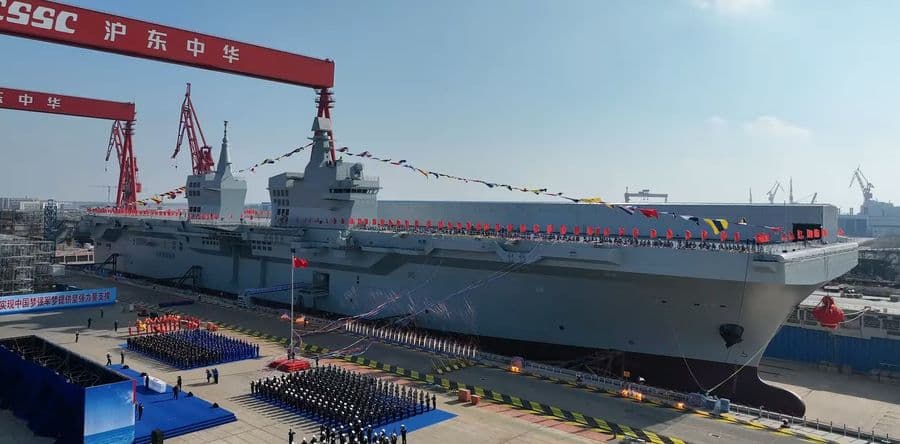
The PLANMC’s mission has expanded in consonance with its expanding force structure and strength. Initially formed as a specialized amphibious assault force, the PLANMC has become Beijing’s expeditionary force of choice. Its Marines can be found conducting overseas training missions in Africa, guarding China’s overseas base in Djibouti and garrisoning Beijing’s disputed island garrisons in the South China Sea. PLAN Marines have also participated in anti-piracy operations and evacuated Chinese citizens from Yemen. Moreover, the PLAN has expanded its amphibious lift four fold since 2000 and nearly doubled it over the last four years. The PLANMC can now rely on four helicopter landing assault ships (LHAs) and as of this writing, one Type 076 Helicopter Landing Dock ship (LHD) that can launch and recovery combat drones and possibly fixed-wing aircraft. It is not yet clear how many Type 076s China intends to construct but most publicized analysts estimate 2-3 will enter service by 2030.
PLAN MC tactics have evolved as a result of that force buildup and China’s doctrinal transition from Mao’s People’s War to a military trained and equipped to fight “High Technology Regional Wars.” Resource limitations precluded that doctrine from fulfillment until this century. Until then, China’s Marine Corps was envisioned as an amphibious assault force that would be the PLA’s masters of all aspects of projecting land power onto a hostile shore. Its doctrine initially was modeled after that of the Soviet Union’s naval infantry with China’s marines securing a beachhead for the landing of follow-on PLA mechanized troops who would exploit the lodgment and press inland. As the 80s advanced, China’s marines began to absorb the lessons learned by their Western counterparts, particularly the US Marine Corps.
They paid particular attention to the need for combat power at the point of landing and the need to advance rapidly past the beach. Infantry in lightly armored personnel carriers lacked the combat power and speed to achieve that requirement due to the PLA prioritizing land and naval air defense well into the 1990s. Amphibious power projection was secondary until Beijing had the financial resources to develop the equipment and systems to take the offensive. In the interim, while the PLAN MC’s two brigades conducted a greater array of amphibious exercises and experimented with ad hoc solutions to suppression of beach defenses, the PLA put its Taiwan invasion plans on hold and assigned the PLAN MC the mission of seizing and protecting disputed island territories in the South China Sea.
Xi Jinping’s Reforms and the PLANMC Upgrades
Carl O. Schuster
By 2000, PLAN MC began to receive amphibious light armored infantry fighting vehicles, artillery, and tanks. By 2014, the brigades had become amphibious light mechanized combined arms units. Xi Jinping’s rise to power brought the Taiwan invasion mission back to the fore and recognition that the PLAN Marine Corps lacked the force structure to lead the assault even if joined by the PLA’s other six amphibious combined arms brigades. China’s Xi Jinping who had risen to power three years earlier, wanted a more powerful invasion force, streamlined PLA command and control structure and a force capable of joint operations. His 2016 reforms, replaced the seven military districts with five theaters of command, reduced the PLA’s General Staff in size and stature, and transitioned the service into force providers subordinate to the theater commands. The PLAN MC became a Navy subcomponent. It also becomes a component of China’s Rapid Reaction Force, along with the PLA Air Force’s Airborne Corps and the PLA’s Special Operations Force. The last, like the PLANMC, owed its existence to the lessons learned from the Sino-Vietnamese War.
The PLA Navy incorporated air cushion vehicles into its landing exercises by 2010, greatly accelerating force delivery rates, particularly of heavy weapons. However, main battle tanks have not yet appeared in PLAN MC Tables of Organization and Equipment (TO &E), possibly awaiting the incorporation of counter-drone units to deal with drone threats. Each combined arms brigade already has a drone unit for reconnaissance and possible tactical strike missions as well.
In 2018, Xi Jinping ordered the PLAN Marine Corps increased to 100,000 personnel and it reached that strength earlier this year. That enabled the Corps to expand its special operations force to brigade strength and add an aviation brigade to its force structure. As of 2023, the PLAN Marine Corps has introduced air mobile assault to its operations and a growing number of PLAN Marines outside its special forces brigade are airborne qualified, although the specific number is unknown. Finally, PLAN MC officers are trained at the same military academy as the PLA’s special operations force officers.
Perhaps more importantly, the PLAN has developed mobile port units that can be emplaced in the assault area to accelerate the force buildup once the amphibious lodgement has been established. Based on preliminary examination of the exercises where that equipment has been employed, those ad hoc ports can disembark up to two PLA combined arms mechanized brigades and related supplies per day. It isn’t clear how long it takes to put one in place but twelve hours seems to be a reasonable estimate.
The PLAN MC’s Expeditionary Mission
Some defense analysts argue that the PLAN MC’s comparatively new expeditionary mission indicates the PLA Ground Forces have assumed the amphibious assault mission in a Taiwan scenario. The PLA Ground Forces have expanded and modernized their six amphibious combined arms brigades. Two are assigned to the Southern Theater Command Ground Component’s 74th Group Army and four are split between the Eastern Theater Command’s 72nd and 73rd Group Armies. The ground force’s amphibious brigades are more heavily equipped than the PLAN Marine Corps with stronger reconnaissance, armor, and air defense elements. But they lack an air mobile assault element, suggesting they will depend on their group army’s aviation brigade for support.
Their sea transport will depend on the PLAN, but the ground component does have access to about 100 Type 271IIIA Utility Landing Craft that can reach Taiwan provided the seas are not heavy. However, that is not enough to lift more than two reinforced battalions across the Strait but would be suitable for an assault on Kinmen or Matsu, both of which are heavily defended. The similarly defended, Penge, which lies halfway between China and Taiwan, may be a more likely objective since its possession would provide a staging base for long-range rocket and missile fire in support of a Taiwan invasion. Although most would argue a smarter strategy would be to isolate these garrisons and starve them out, political leaders often override military considerations. Moreover, an intact Penge garrison could pose a significant threat to any invasion force en route to Taiwan and two of the past successful conquests of Taiwan first seized Taiwan to use as a staging base. In any case, both the PLAN and PLA ground forces can rely on lift augmentation from China’s merchant marine, including Roll-On/Roll-Off ships (RO/ROs) that have been modified to launch amphibious armored vehicles.
PLA writings recognize the need to suppress enemy defenses to get the landing force ashore. Therefore any assault would involve as massive a pre-invasion air, drone, missile, Special Operations Forces, and cyber campaign that Beijing can conduct. The strikes will reach beyond the objective areas itself to isolate the defenders from their chain of command, fire support, logistics and reinforcement. Both the PLA Ground Force and PLA Navy/Marine Corps team have intensified their amphibious training. So far, the PLAN/Marine Corps exercise show a more highly developed capability but the Ground Forces are getting more capable every year.
The command relationships between the PLANMC and PLA Ground Forces have not been delineated clearly in PLA writings but any assault on Taiwan will involve forces drawn from all the PLA’s Theater Commands. China’s Central Military Commission will direct the overall effort with the Eastern Theater Commander assigned as its Executive Agent for conducting the campaign. As such, any assault on Taiwanese territory will be a joint operation with the PLAN commanding the amphibious task force and a PLAGF or PLANMC officer commanding the landing force. The PLAN will be responsible for the equivalent to the Amphibious Operations Area (AOA) until command is transferred ashore. After that, the Eastern Theater Commander or a general designated by him, will direct the ground campaign.
While one can debate which force will lead any assault on Taiwan, it is apparent that China’s Marines are taking on a more expeditionary role. That means the PLAN MC will soon begin deployments of reinforced battalion-sized units equivalent to the USN Amphibious Ready Groups (ARGs) and Marine Expeditionary Units (MEUs). They are en route to become China’s on-call force for contingencies abroad. Whenever local events threaten PRC citizens, Beijing hopes to show its people they can rely on their Marines for rescue.
One mission area that should concern American leaders, particularly the U.S. Marines, is how the PLANMC may be employed against any USMC Littoral Combat Regiments (LCRs) positioned to threaten China’s plans. Those regiments lack an integral air and missile defense capability and will face a potentially devastating strike if their presence is considered a threat to PRC plans. Moreover, PLA leaders may see the PLANMC as a natural follow-on to seize the island hosting the regiment to prevent its regeneration after such strikes. China’s CMC and the Eastern Theater Commander will at least consider that option if they consider the LCRs a serious threat.
However, that does not mean the PLANMC is no longer involved in Taiwan assault planning. The PLAN is constructing the lift to eventually deliver two brigades to an objective and conduct a combined air mobile-amphibious assault. That indicates that China’s Marines will retain their amphibious warfare skills for some time to come. More importantly, they have added vertical penetration of the amphibious operating area as a mission set. Having on-site aviation assets multiplies combat power and the ability to seize key terrain in the enemy’s rear or flanks both demoralizes enemy but enhances the advance. Of course, landing away from hardened defenses and initiating a rapid, deep penetration might decisively impact the campaign. The PLAN Marine Corps may not be there yet, but with it reportedly enjoying a higher retention rate than conventional PLA ground units, it may arrive there soon.
Carl O. Schuster is a retired Navy Captain and former instructor of military studies at Hawaii Pacific University. He finished his naval career as director of operations at then-Pacific Command’s Joint Intelligence Center. He has published four books on naval affairs.
Selected Sources
Blasko, Denis, LTC AUSA-Retired, China Maritime Report No. 20: The PLA Army Amphibious Force, China Maritime Studies Institute, US Naval War College, April 2022
Congressional Research Office, Modernization: Implications for the US Navy Capabilities, 2024, Washington DC, 2024
Dahm, Michael J. & Shugart, Thomas, Bridges Over Troubled Waters: Shuiqiao Landing Barges in PLA Naval Amphibious Operations, China Maritime Studies Institute, Naval War College, 20 March 2025
Department of War, Annual Report to Congress: Military and Security Developments Involving the Peoples Republic of China 2025, Washington DC,
Faxin, Li, et al, The PLA Marines, China Press, Beijing, 2013
Gao, Xiaoxing, et al, The PLA Navy, China Intercontinental Press, Beijing, 2012
Goldstein, Lyle, Understanding China’s Amphibious Warfare: The Yijiangshan Case Study, US Naval Institute Proceedings, July 2025
Inkster, Nigel, China’s Cyber Power, International Institute for Strategic Studies, London, 2016
Pillsbury, Michael, China Debates the Future Security Environment, Barako Books via Kindle, 2020
Roth, N. Luke, PLA Modernizing Combined Arms Brigades for Joint Island Landing Campaign, Army Training and Doctrine Command, G-2, Fort Eustis, July 2025
Stojkovski, Bojan, “China develops next-gen amphibious military vehicle with unmanned turret,”
Interesting Engineering, 5 Mar 2025
Yu -Cheng Chen and Yang Shang-wei, The Type 075’s Operational Integration in Justice Mission- 2025, Jamestown Foundation

In Pursuit of Nuclear Abolition
By Peter Huessy • RealClearDefense
Innovation Alone Won’t Prepare the U.S. for the Future Battlefield
By Joshua Segal • RealClearDefense
The sUAS Tactical Trifecta
By Bryan T. Woody • RealClearDefense
The Revolutionary War: When Strategic Options Share the Same Weakness
By Henry Yep • RealClearDefense
The Houthis Are Testing the Limits of Collective Defense
By Saima Afzal • RealClearDefense

Who Shoots Down the Drone Over the Shipyard?
By John Ferrari & Dillon Prochnicki • RealClearDefense
Northrop Grumman Breaks Out the Big Guns at AUSA
By Daniel Terrill, Defense News
Army Pursuing Diverse Array of New Anti-Air Interceptors
By Trevithick, The WarZoneWho Shoots Down the Drone Over the Shipyard?
By John Ferrari & Dillon Prochnicki, RCD
F-35C Lands for the First Time on a Ford-Class Aircraft Carrier
By The Aviationist