
To Remain Relevant the Marines Must Adapt to a Changing World
Last updated 05:21 AM EDT • Read time: 8m
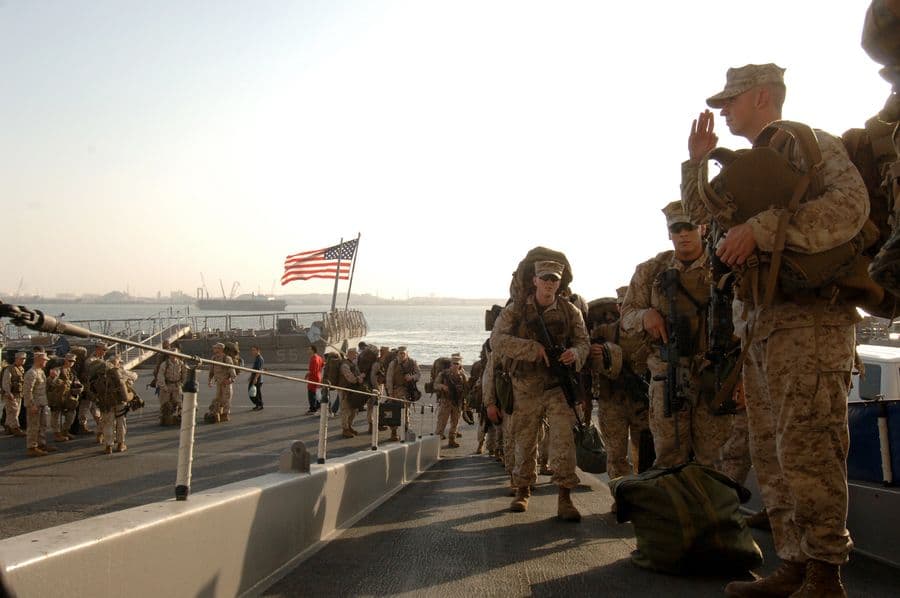
Marines stop and salute the ensign as they embark onto amphibious assault ship USS Wasp in preparation for a crisis response exercise. Coalition forces are conducting a crisis response exercise Nov. 1-7 to enhance their capabilities to respond to a host nation's request for assistance during a time of crisis.
As remarkable as it sounds, the United States Marine Corps is currently organized and equipped for the wrong mission. The Service, once renowned for its offensive mantra as “first to fight”, has become too focused on defending against the highly unlikely scenario in which the Chinese navy projects from the South China Sea to engage U.S. forces and seize control of the Pacific and beyond. To meet this potential threat, the Marines embraced a new operating concept called “Expeditionary Advanced Base Operations” (EABO) and significantly altered Marine Corps force structure and capabilities by implementing a supporting plan called “Force Design 2030” (now called simply “Force Design”).
The intent of Force Design was to convert existing Marine infantry and artillery formations into small, mobile, self-sufficient missile-equipped units spread across the Pacific Ocean’s first island chain through which the Chinese Navy ships must transit on their way to points east, south and north. It must be noted that these dispersed units are themselves unlikely to contribute in any meaningful way to prevent a Chinese invasion of Taiwan, which is considered by planners as both the most likely and most dangerous course of action available to China.
If China elects to strike U.S. bases in Japan, Guam and Hawaii to support the attack against Taiwan, they could use land based missiles fired from Chinese territory and allow the Chinese air force and navy to concentrate on seizing and then defending Taiwan while remaining outside the range of Marine missile batteries.
Before proceeding, it’s worth reviewing why the Marines shifted their main focus from a global, offensive force-in-readiness to a regional, defense force-in-waiting.
The often repeated narrative that the 2018 National Defense Strategy mandated the Marine Corps to radically restructure and reorganize its forces to focus on China is incorrect. The 2018 National Defense Strategy and the current 2022 National Defense Strategy, while recognizing China as a “pacing challenge,” cast their nets more widely, identifying Russia as a second global threat, Iran and North Korea as significant regional threats, and various nonstate actors as inimical to U.S. security and interests. The intent of both strategies was to refocus the U.S. military on the Indo-Pacific region, but not at the expense of responding effectively to other global threats.
The Marines went too far in their shift from counterterrorism to great power competition with China. By divesting too much of their proven combat capabilities to invest in small, dispersed units (termed Stand-in Forces or SIFs), they lost the capability to remain relevant in other regions where U.S. interests are threatened and conflicts are more likely to occur.
Some argue that the Marines 2019 decision to implement Force Design was justified and even laudable. However, the world has since changed dramatically. At that time, Europe was at peace and the Middle East was on the brink of a diplomatic breakthrough (the Abraham Accords), which would begin the process of normalizing relations between Israel and various Arab states.
North Korea had reduced its threatening behavior towards neighboring countries and became more open to western engagement. China was identified as the most likely threat to U.S. national interests and thus, the “pacing challenge” that should directly inform U.S. Defense planning, but not at the expense of reducing agile and lethal general-purpose forces, along with the means to project them quickly to global trouble spots.
Improvements in long-range missiles, precision munitions, and unmanned systems were expected to change the character of war. Some believed that tanks and cannon artillery were on the verge of obsolescence. Like the French Army after WW1, strategists began to sense that defense had replaced offense as the dominant form of warfare.
The strategic and operational environments continue to evolve. In February 2022, Russia invaded Ukraine and combined arms warfare returned to the battlefield. To date, cannon artillery has accounted for at least 80% of the casualties on both sides. Tanks have proven to be combat multipliers, so long as they are properly supported as part of a combined arms team. Though UAVs and precision-guided munitions are widely employed, they no longer attack with impunity—countermeasures develop rapidly and 75% of small drones are lost to electronic warfare. The advantage now enjoyed by small aerial drones will someday be viewed as “a moment in history” and not a “revolution in military affairs” (RMA).
Russian jamming of the guidance systems of modern Western weapons, including Excalibur GPS-guided artillery shells and HIMARS, has diminished Ukraine’s ability to defend its territory. Data shows the success rate for U.S. designed Excalibur shells to strike their intended targets fell to less than 10 percent causing Ukraine’s military to actually abandon them last year. Today, NATO is holding 500,000 troops at high readiness (including significant armored, mechanized and artillery formations) to guard against the looming risk of a larger war with Russia.
In early October 2023, Hamas attacked Israel. In the region’s most significant military engagement since the 1973 Yom Kippur War, the Israeli Defense Forces have interdicted and destroyed thousands of rockets fired by Hamas and Lebanese Hezbollah. Supported by the United States and other countries, Israel interdicted 170 drones and 30 cruise missiles (none of which entered Israeli territory) and at least 110 ballistic missiles (of which a small number reached Israel) fired by Iran in a single attack. Today, Israel remains at war with Hamas in Gaza and on the brink of war with Hezbollah in Lebanon.
In late October 2023, emboldened by Hamas’ attack in southern Israel, the Iran-backed Houthi movement launched cruise missiles and armed drones at Israel. The Houthis conduct regular attacks on merchant and naval vessels in the Red Sea and against Israel, while the U.S. Navy struggles to maintain freedom of navigation using predominately defensive measures that do nothing to deter future attacks. Today, Iran threatens an all-out attack on Israel, which could engulf the region in a wider war.
Among the lessons being learned in the Ukraine, Israel, and the Red Sea is that armed drones, precision guided munitions, and subsonic and ballistic missiles will not themselves be decisive on the battlefield. Infantry, supported by robust and resilient combined arms, will remain the final arbiter of the close and rear battles, where winners and losers will still be determined.
Diplomatic conditions are deteriorating as well.
China and Russia’s “no-limit” partnership formed in February 2022 has only deepened and broadened, to include a military and economic partnership with Iran and North Korea. According to the Commission on the National Defense Strategy, “this new alignment of nations opposed to U.S. interests creates a real risk, if not likelihood, that conflict anywhere could become a multi-theater or global war.” An analysis of the report also states: “The Commission believes the United States needs a force-planning approach that is both global and prioritized. […] An exclusive focus on single adversary or single region, as some have suggested, is a fundamentally flawed response to the global nature of challenges posed by such adversaries as China and Russia and to the growing cooperation between adversaries across regions.”
Major changes have occurred in the security and operational environments that were not foreseen in 2019. DOD and all the Services must reevaluate previous transformation decisions and strive to create a balanced joint force that can meet global, not just regional challenges. Thus far, the changes made to support EABO and Force Design have resulted in a Marine Corps that is less ready and less capable of confronting global threats. The loss of conventional combined arms capabilities at the Marine Expeditionary Brigade and Expeditionary Force levels are serious and will require time and money to redress.
The U.S. Navy received a green light from Marine Corps leadership to reduce the fleet of Amphibious Assault ships by 25% and Maritime Prepositioning ships by over 50%. To make matters worse, Military Sealift Command (MSC) recently announced a plan to de-crew 17 Navy support ships – to include two forward deployed Expeditionary Sea-bases - due to a lack of qualified mariners to operate the vessels across the Navy. Collectively, these platforms are essential to U.S. force projection capabilities and the ability to establish persistent regional presence across the globe during periods of peace and war.
Marines have always adapted to change while retaining their relevance as America’s premier 9-1-1 force across the spectrum of conflict. As it has always done, the Corps must prepare now for future challenges without losing the flexibility to adjust to the uncertain demands of a dangerous world. To that end, Vision 2035 (Global Response in the Age of Precision Munitions), provides a sensible starting point for modifying Force Design to deter and, if necessary, defeat an ever-widening array of global adversaries.
General Walter (Walt) Boomer, USMC (ret.) is a career infantry officer. His last assignment was the 24th Assistant Commandant of the United States Marine Corps.
General James (Jim) Conway, USMC (ret.) is a career infantry officer. His last assignment was the 34th Commandant of the United States Marine Corps.
General Anthony (Tony) Zinni, USMC (ret.) is a career infantry officer. His last assignment was Commander, United States Central Command.

In Pursuit of Nuclear Abolition
By Peter Huessy • RealClearDefense
Innovation Alone Won’t Prepare the U.S. for the Future Battlefield
By Joshua Segal • RealClearDefense
The sUAS Tactical Trifecta
By Bryan T. Woody • RealClearDefense
The Revolutionary War: When Strategic Options Share the Same Weakness
By Henry Yep • RealClearDefense
The Houthis Are Testing the Limits of Collective Defense
By Saima Afzal • RealClearDefense

Who Shoots Down the Drone Over the Shipyard?
By John Ferrari & Dillon Prochnicki • RealClearDefense
Northrop Grumman Breaks Out the Big Guns at AUSA
By Daniel Terrill, Defense News
Army Pursuing Diverse Array of New Anti-Air Interceptors
By Trevithick, The WarZoneWho Shoots Down the Drone Over the Shipyard?
By John Ferrari & Dillon Prochnicki, RCD
F-35C Lands for the First Time on a Ford-Class Aircraft Carrier
By The Aviationist