
Vision 2035: Restoring Marine Corps Capabilities to Fight and Win
Last updated 08:04 PM EDT • Read time: 8m
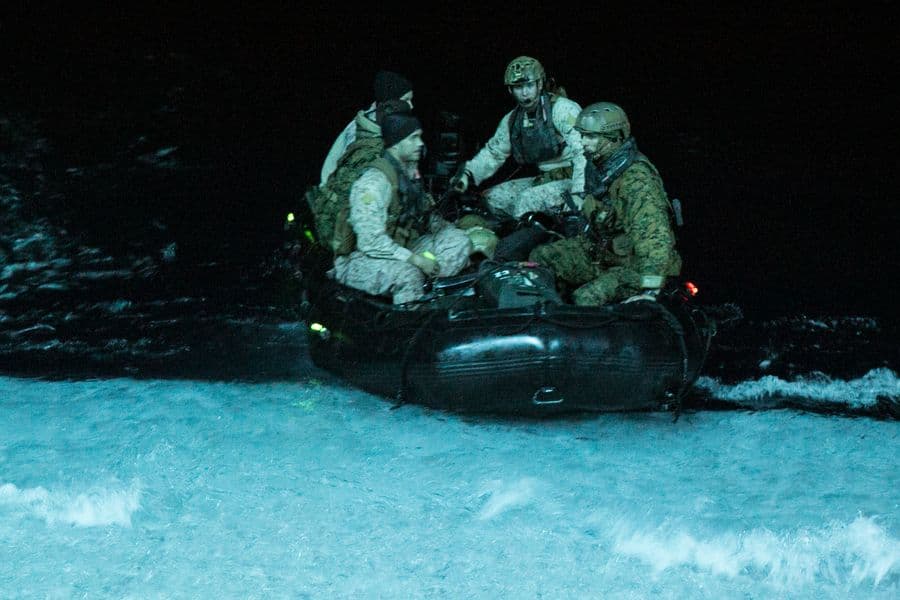
U.S. Marines with the Maritime Raid Force, 13th Marine Expeditionary Unit (MEU) and U.S. Sailors steer their craft from the well deck of the ship before disappearing into the darkness as they execute a night time sea-to-land operation utilizing combat rubber raiding crafts (CRRC) to exit the ship during an exercise being conducted as as part of the Composite Training Unit Exercise (COMPTUEX), aboard the USS Boxer, Oct. 21, 2015. COMPTUEX provides the MEU ARG the opportunity to integrate naval training while also allowing focused, mission-specific training and evaluation for the Marines and their Navy counter parts. (U.S. Marine Corps photo by Cpl. Briauna Birl/UNRELEASED)
The United States Marine Corps’ capability to respond quickly and effectively to a full range of worldwide crises and contingencies is at its lowest ebb in more than 50 years. Why? The adoption of a transformation strategy called Force Design 2030 - - since renamed Force Design.
The Marines require a better and more effective operating concept to guide the development of capabilities needed to deter, respond, and if necessary, defeat the growing number of state and nonstate actors threatening America’s global interests. In response to this need, a group of distinguished retired Marines articulated a framework for restoring Marine Corps capabilities to quickly deploy anywhere, fight any foe, and win. This framework, Vision 2035, emphatically repudiates the underlying tenets of Force Design and calls for the restoration of offensive operations and combined arms capabilities to enable global response across the spectrum of conflict.
Vision 2035 provides the starting point for developing an operating concept to transform the Marine Corps back to its rightful role as the nation’s premier expeditionary force-in-readiness: a 9-1-1 force that is ready, relevant, and capable to persist forward and respond decisively anywhere in the world. The Marines know how to move from a vision to a concept. They have done it many times before. Consider the following.
Coming out of Vietnam, the Marines knew they needed to replace “the institutional and operational dysfunction of the Vietnam experience” with a more modern approach to warfighting. Commencing in the late 70s, the Marines began discussing and debating a new concept, which came to be called Maneuver Warfare. The philosophical underpinnings of this new concept were argued, contested, and revised in the schoolhouses at Quantico, on the pages of the Marine Corps Gazette, in seminars and group discussions throughout the Marine Corps, and in field exercises and wargames. The senior leadership encouraged the discourse, often participating directly in it. The results of this Corps-wide intellectual effort were codified as Marine Corps doctrine in the 1989 publication of Fleet Marine Force Manual 1 (FMFM 1), Warfighting. Maneuver Warfare has stood the test of time and remains Marine Corps doctrine today.
As early as 1948, the Marines recognized the limitations of traditional amphibious operations in the era of nuclear weapons. This and the growing sophistication of mines and precision weapons spurred discussion and debate about new concepts for amphibious operations. Here again, new ideas were encouraged and openly discussed in the schoolhouses, the Gazette, and throughout the Marine Corps. The Marine Corps gradually embraced the concept of Over-the-Horizon (greater than 25 miles offshore) Amphibious Operations, which was officially approved in 1991 after unofficial acceptance years earlier.
Many Marines believed that Over-the-Horizon operations did not go far enough. They advocated “adapting the traditions of maneuver warfare, not merely to amphibious operations, but to all aspects of warfare in, and around coastal areas.” After much discussion and debate, the Over-the-Horizon concept was updated. In 1996, the 31st Commandant approved a new capstone operating concept for the Marine Corps - - Operational Maneuver From the Sea (OMFTS). OMFTS (which was expanded and reinforced by Expeditionary Force 21 in 2014) drove Marine Corps innovation and guided the development of Marine Corps capabilities until it was replaced by Force Design in 2020.
Military innovation and transformation are the products of the marriage of formal and informal processes. The Marine Corps’ formal process is the combat development process, managed by the Marine Corps Combat Development Command in Quantico, Va. The informal process is Corps-wide discussion and debate that helps frame and refine the concepts. The informal process is transparent, inclusive, and encouraged by leaders at all levels. In the words, of 29th Commandant, General Alfred Mason Gray, “if an idea can’t stand up to our own scrutiny, there must be something wrong with it.”
As previously stated, the Marines know how to move from a vision to a clearly articulated and comprehensive operating concept, if they are allowed to do so. To reclaim the Corps congressionally mandated role as the nation’s “shock troops… most ready when the nation is least ready,” the senior leadership needs to:
- Acknowledge the shortcomings of Force Design and commit to developing a more relevant operating concept - - better suited to respond to worldwide threats and contingencies across the full spectrum of conflict. Force Design was implemented to specifically counter China’s People’s Liberation Army Navy in the South China Sea. The divestment of expeditionary and combined arms capabilities mandated by Force Design have reduced the Marine Corps’ capacity and capability - - and relevance - - to meet existing and emerging threats in other strategic regions of the word, such as: the Baltic Sea; NATO’s northern flank; the Arctic; the Red Sea, Gulf of Aden and Persian Gulf; and the Indian Ocean. A 2023 analysis from the Center for Strategic and International Studies assessed that U.S. strategic bombers and submarines would be the most effective platforms for launching anti-ship missiles against Chinese ships; that the utility of small, land-based missile batteries in contested areas would be marginal. In today’s increasingly volatile world, the United States can no longer afford to focus its Marine Corps on a single mission already effectively performed by other elements of the Joint Force. As long as the senior leadership continues to advocate “full steam ahead” with Force Design in congressional testimony and in other official documents, such as the 39th Commandant’s FragOrder 1-24, no one inside the Marine Corps will be willing to step forward with an alternative concept.
- Encourage transparent discussion and debate inside and outside the Marine Corps and in the pages of the Marine Corps Gazette on an alternative concept. The Commandant should lead the effort by ensuring the Quantico schoolhouses invite those with different views to speak with the faculty and students. Many Marines remember the often painful, but insightful role that outside observer and critic Bill Lind played in the debates and development of Maneuver Warfare. Likewise, leaders at all levels should inspire active-duty Marines of all ranks to voice their concerns about Force Design and the supporting concepts and propose alternatives. Retired Marines who speak out should be listened to instead of discredited as “old men who are out of touch.” And the Gazette, which has previously refused to publish some controversial articles that did not follow the “party line” by embracing Force Design, should actively solicit articles and opinion pieces with alternative views.
- Return control of all elements of the combat development process - - doctrine, force structure, training and education, equipment, and facilities and support - - to a single commander (Commanding General, Combat Development Command). The Corps’ once highly effective and well-respected combat development process has been recently divided between two separate commands, neither of which have the authority and responsibility for the entire process.
- Use Vision 2035 to begin the process of developing a forward looking, relevant operating concept to replace Force Design, which was essentially developed outside the combat development process by a small group of officers behind closed doors. The new concept can then be vetted through a truly integrated combat development process to determine and ultimately field the capabilities needed to meet the global security challenges of the 21st-Century.
The time to start is now. The Congress, the Department of Defense, and the American people will applaud the Marines for having the foresight and moral courage to change course to better meet the growing and diverse number of national security threats facing the nation.
Brigadier General Jerry McAbee (USMC, ret.) is a career artillery officer. He served as the Chief of Staff for the Marine Corps Combat Development Command. His last assignment was Deputy Commander United States Marine Corps Forces Central Command during Operation Iraqi Freedom and Operation Enduring Freedom.
Colonel Stephen (Steve) Baird (USMC, ret.) is a career artillery officer. He served as the Chief of Staff for the 1st Marine Division followed by his last assignment as the Chief of Staff for U.S Marine Corps Forces Command during Operation Iraqi Freedom and Operation Enduring Freedom.
Colonel Michael (Mike) Marletto (USMC, ret.) is a career artillery officer. He served a wide variety of operational assignments, including command of a direct support artillery battalion, command of an artillery regiment (11th Marines) during the attack to Baghdad, and Assistant Chief of Staff G-3 Operations for I Marine Expeditionary Force (Forward) in Iraq.
Colonel Timothy (Tim) Wells (USMC, ret.) is a career infantry officer. He served as G-3 Operations for United States Marine Corps Forces Central Command during Operation Iraqi Freedom and Operation Enduring Freedom. His last assignment was Commanding Officer, Marine Corps Mountain Warfare Training Center.

In Pursuit of Nuclear Abolition
By Peter Huessy • RealClearDefense
Innovation Alone Won’t Prepare the U.S. for the Future Battlefield
By Joshua Segal • RealClearDefense
The sUAS Tactical Trifecta
By Bryan T. Woody • RealClearDefense
The Revolutionary War: When Strategic Options Share the Same Weakness
By Henry Yep • RealClearDefense
The Houthis Are Testing the Limits of Collective Defense
By Saima Afzal • RealClearDefense

Who Shoots Down the Drone Over the Shipyard?
By John Ferrari & Dillon Prochnicki • RealClearDefense
Northrop Grumman Breaks Out the Big Guns at AUSA
By Daniel Terrill, Defense News
Army Pursuing Diverse Array of New Anti-Air Interceptors
By Trevithick, The WarZoneWho Shoots Down the Drone Over the Shipyard?
By John Ferrari & Dillon Prochnicki, RCD
F-35C Lands for the First Time on a Ford-Class Aircraft Carrier
By The Aviationist