
The Space Force Needs New Space-Based Systems to Defend America
Last updated 04:47 PM EDT • Read time: 5m
What is happening to our Air Force? Once the technology leader among U.S. military services, the Air Force is now honored to be the home of our first Space Force, which needs new space-based systems to defend America. Incredibly, however, the Air Force is embarked on looking backward with a huge expenditure, apparently to keep open a Boeing production line for past-generation F-15s that have been cleverly renamed F-15EXs.
July 20 Investor’s Business Daily put it this way. “More Boeing orders canceled. Boeing reported just one order in June … delivered just 20 commercial jets in Q2, the fewest for a quarter since 1977. On the defense side, Boeing received the first order for eight F-15EX jets for the Air Force in what could be a $23 billion contract to build 144 of the updated fourth-generation jets." Even worse, news reports show that this order could grow to 200 of the non-stealthy F-15EXs, likely increasing the $23 billion. [1] The F-15EX has life expectancy into the 2050s. [2]
How would this $23 billion (or more) venture help America? Not in fights where years ahead non-stealthy fighters would need to operate in contested airspace (China, Russia, Iran, North Korea) or against fifth-generation fighters (Russia, China), nor, like other Air Force fighters, where close-in airbases would be sitting ducks against attacks by cruise missiles and ballistic missiles (China, Russia, North Korea, Iran) and new hypersonic missiles (China, Russia).
What about against terrorists or unsophisticated adversaries? F-15EXs could be useful, but the Air Force does not need to spend new money for that kind of fight.
Experts have decried this F-15EX buy! “It is perhaps the most un-cost-effective expenditure ever made by DOD,” said retired Air Force Lt. Gen. David A. Deptula, head of AFA’s Mitchell Institute for Aerospace Studies. [2] Retired Air Force General Mike Loh, former Air Force Vice Chief and Commander of the Air Combat Command, said, “Buying new F-15X fighters for the U.S. Air Force is unsolicited and unwise.” [3] Loh also criticized the F-15EX buy on the grounds that, "In its haste, the Air Force is buying the engines, two per F-15EX, on a sole-source contract from General Electric rather than on a competitive basis, despite the availability of Pratt & Whitney engines already flying on nearly all its F-15Es. The GE engines will be provided to Boeing from the Air Force as government-furnished equipment.” [4]
What else could be done with that $23 billion (or more)? It could buy many more modern F-35s or new B-21s than funds now permit. But with this F-15EX decision, the Air Force has decided that more of those advanced stealthy fighters and bombers have a lower priority for available dollars.
To really help America, that $23 billion (or more) could buy new space planes and 1,000 space-based interceptors to defend GLOBALLY against attacks on U.S. satellites and against ballistic and hypersonic missile attacks on U.S. interests!
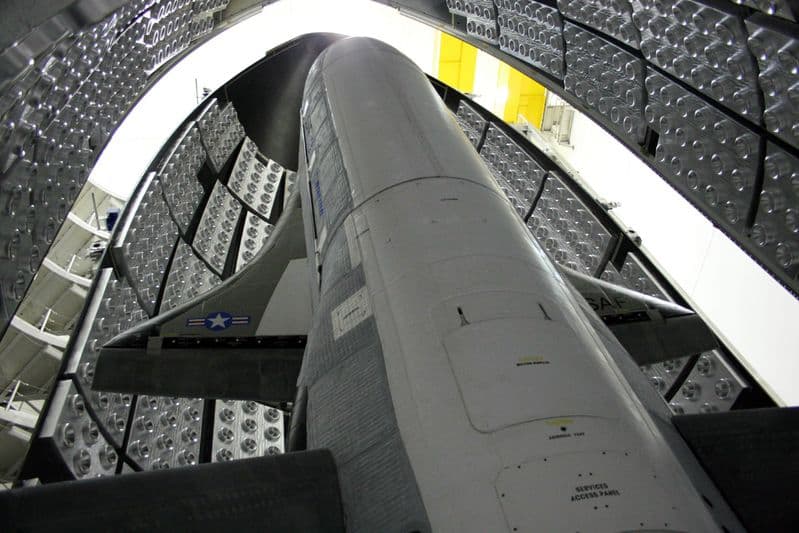
Vividly illustrating the current threat, Russia just flexed its anti-satellite (ASAT) muscles again when one of its military satellites “launched a mysterious projectile into orbit at high speed.” [5] U.S. X-37C space planes, upgrades of Boeing’s current two X-37Bs, could be built and made operational within a couple of years to help counter anti-satellite attacks. Spaceplanes could also be used to perform close reconnaissance against Russian, Chinese, and North Korean satellites to ascertain if they are ASATs, or even clandestinely and illegally nuclear-armed for an EMP attack. For example, the Congressional EMP Commission warned that two North Korean satellites that regularly orbit over the U.S. might be a clandestine EMP threat. [6]
In addition, the small space-plane fleet could assist in testing new U.S. low-earth-orbit satellites in conjunction with the space-based interceptors, all 1,000 of which could be in place within five years to defend against ballistic and hypersonic missile attacks, including attacks on Air Force bases.
Two retired Air Force generals (Kevin Chilton and William Shelton) recently joined the experts' chorus, urging attention to America's space-based deterrent. "Successful deterrence in space requires the development of both offensive and defensive capabilities that will force adversaries to question the wisdom of interfering with U.S. space systems.” [7]
National Defense leaders in Washington D.C. should reverse the F-15EX mistake and put the $23 billion (or more) into much-needed space-based systems to defend America!
Norm Haller has led and assisted analyses, planning, and preparing reports for DoD and Congress on nuclear and non-nuclear forces for deterrence and defense against missile attacks; now a consultant, he served in the Air Force, Office of the Secretary of Defense, and Nuclear Regulatory Commission as the Chairman’s Executive Assistant.
Dr. Peter Vincent Pry is executive director of the Task Force on National and Homeland Security. He served on the Congressional EMP Commission as chief of staff, the Congressional Strategic Posture Commission, the House Armed Services Committee, and the CIA. He is author of "Blackout Wars," and also of "The Power and the Light," available on Amazon.com.
Notes:
- https://www.airforcemag.com/air-force-now-wants-up-to-200-f-15exs/
- https://www.airforcemag.com/air-force-awards-1-2-billion-contract-for-first-lot-of-f-15exs/
- https://www.defensenews.com/opinion/commentary/2019/03/04/buying-new-f-15x-fighters-for-the-us-air-force-is-unsolicited-and-unwise/
- https://www.defensenews.com/opinion/commentary/2020/03/02/dear-us-air-force-speed-is-good-but-competition-is-better/
- https://spaceflightnow.com/2020/07/23/u-s-officials-say-russia-tested-a-new-anti-satellite-weapon/
- EMP Commission, Chairman’s Report (July 2017) www.firstempcommission.org. Dr. Peter Vincent Pry, “Have Russia and China Already ‘Militarized’ Space?” Real Clear Defense (July 16, 2020).
- https://www.c4isrnet.com/opinion/commentary/2020/07/21/the-us-needs-to-take-action-to-deter-near-peer-rivals-in-space/

The First Test of Peace Lies in Ukraine's Borderlands
By Dennis T. Cosgrove • RealClearDefense
The VFW’s Gambling Addiction Victimizes Veterans
By Jack Yoest • RealClearDefense
Superintelligence Exposes a Gap in the Law of Delegated Authority
By Sue Ghosh Stricklett • RealClearDefense
When the Network Goes Dark, Who Controls the Battlefield?
By Jonathan K. Corrado • RealClearDefense
We Cannot Build Tomorrow's Weapons With Yesterday's Alloys
By Joseph F. Krause • RealClearDefense
When the Network Goes Dark, Who Controls the Battlefield?
By Jonathan K. Corrado • RealClearDefense
Air Force Should Buy 250 Blended-Wing Tankers, as 2027 Demo Looms
By A&SF Mag.
Long Deployments to Be Navy Standard For Next Couple Years
By Mongilio, USNI NewsWhen the Network Goes Dark, Who Controls the Battlefield?
By Jonathan Corrado, RCD
Marines Deploy Neros Archer Drone in Live Fire Exercise for First Time
By USNI News