
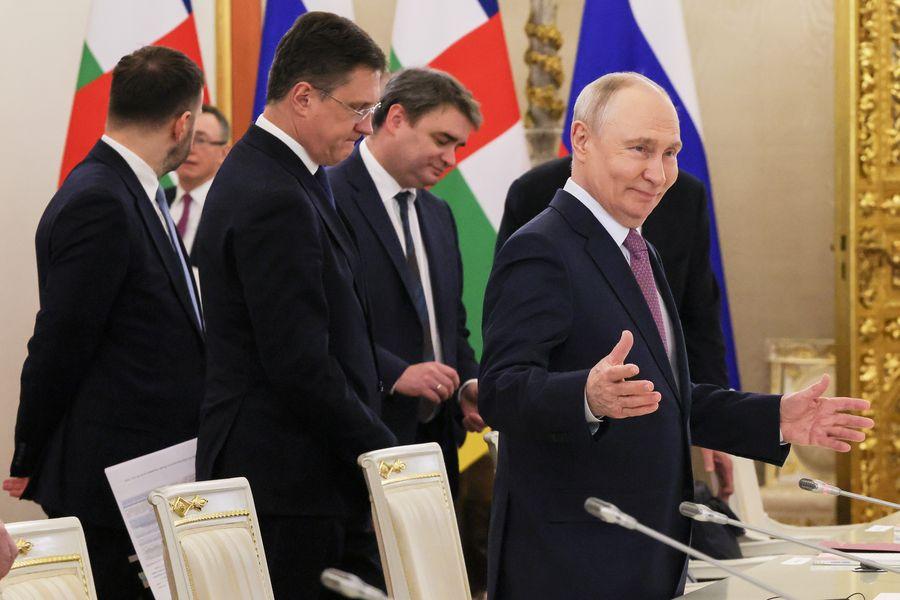
Russian President Vladimir Putin, right, greets Central African Republic's President Faustin-Archange Touadera suring their meeting on the sidelines of the Russia-Africa Summit at the Grand Kremlin Palace in Moscow, Friday, Oct. 30, 2026.
The Summit as Mirror
What Moscow’s Africa Showcase Reveals About Russia Itself
Published Nov. 17, 2026 • Read time: 7m
Join the Conversation
0Diplomatic summits work like theatre. The communiqués matter less than the stage, the guest list, and the story the host tells about himself. On that measure, the third Russia–Africa Summit, which took place in Moscow on October 28-29, merits close attention not because it will change much in Africa but because it highlights the gap between Russia’s goals and the means at its disposal.
Vladimir Putin opened the gathering by announcing that "we are witnessing a multipolar world becoming a reality, a trend that is both objective and irreversible," and that "the era when the destinies of entire continents were determined by a narrow bloc of states is coming to an irreversible end". He told delegates that Russia was their best partner, accused a "colonial West" of using debt to hold Africa back, and offered grain, fertilizer, infrastructure, and support for a bigger African voice at the IMF and World Bank. None of this is new. What is new is how badly Russia needs it to work.
A summit about legitimacy
Look past the panels on artificial intelligence and youth exchange and the summit's main purpose is to show that Russia is not isolated. Since 2022, Moscow has been excluded from Western capitals, heavily sanctioned, and charged with war crimes. A hall full of African heads of state is the strongest visual argument Putin has that the world disagrees with the West. Each handshake in the Grand Kremlin Palace is meant to say that sanctions failed, and the "international community" is a Western fiction.
Therefore, the Kremlin cares so much about attendance, and observers count heads. Officials say 48 delegations came, but only 22 were led by heads of state. Moscow will call that progress since it increased from 17 in St Petersburg in 2023. It is still about half of the 43 leaders who came to Sochi in 2019. China's 2024 Africa summit drew more than 50.
Who stayed home matters even more. The heads of state of South Africa, Nigeria, and Algeria sent delegations but did not come themselves. Those are Africa’s largest economies, and Algeria is Russia's biggest African arms customer. The leaders who came include those who most need Moscow: Mali's Assimi Goïta, whose government relies on Russian paramilitaries against a jihadist offensive, and Sudan's Abdel Fattah al-Burhan. The guest list reflects dependence, not realignment. Even the venue says something. The summit was first announced for Libya and then moved to Moscow. Holding it in Africa would have shown real reach. Holding it at home shows Russia playing it safe.
The gap between story and delivery
Russia's approach to Africa has always rested on a trade: offer a story that appeals to Africans and hope it substitutes for resources Russia lacks. The story looks strong. Russia never held African colonies, backed liberation movements during the Soviet era, and can denounce Western hypocrisy with some credibility. In Moscow, Burkina Faso's prime minister said cooperation with Russia was transparent and that Moscow was not trying to "erase African languages and cultures." That line was aimed at Paris, and it resonates.
Ultimately, however, that story must be backed up. In 2019, Putin set a goal of $40 billion in Russia–Africa trade. Last year it was about $27 billion compared to roughly $348 billion for China and $93 billion for India. About a third of Russia’s total comes from Egypt alone, mostly wheat. Russia has signed nuclear cooperation agreements with at least 15 African states, but Egypt’s El Dabaa plant is still under construction and Ethiopia’s planned reactor remains a plan.
Moscow knows this. Russia's foreign ministry admitted at a forum in June that earlier summits had produced "more declaration than deals" and promised this one would be different. The Kremlin says 33 documents will be signed, alongside a joint declaration, an AI declaration, and an action plan for 2027–2029. That is a lot of paper. Whether it produces something real is a separate question.
Force as Russia's main offer
That leads to the uncomfortable center of Russia's Africa policy. Where the economic offer falls short, security fills the gap. Since 2023, Afrika Corps, the state-controlled successor to Wagner, has spread beyond Mali, the Central African Republic and Libya into Burkina Faso and Niger, and probably Togo. Moscow is expected to use the summit to sell more air-defense systems and military support.
This is the most direct and revealing form of Russian force projection. Russia cannot outspend China or match European trade. But it can protect governments, especially anti-Western military governments that need external support to stay in power. Russia often receives payment in access, including gold-mine revenues that the US Treasury says have helped Russia evade sanctions and fund its war.
This is a cheap, effective model for influence and keeping clients in place. But it is also fragile. The record on actual security is poor. Annual deaths from violent extremism in the Sahel rose from an average of 927 in 2016–2019 to 10,470 in 2022–2025. In April, Tuareg separatists and al-Qaeda-linked fighters killed Mali's defense minister and forced Afrika Corps out of Kidal, which Russian-backed forces only retook in October. A security guarantor that loses a major northern city has a credibility problem that no summit can fix.
The war follows Russia to the table
Russia's Africa campaign has also encountered realities contrary to its narrative: Africans dying in Ukraine. An estimated 3,000 Africans, from countries including Kenya, Ghana and South Africa, are fighting for Russia, many of them lured by promises of factory or hospitality jobs and then mobilized. Families are asking whether their sons are alive and when the dead will come home. A Nigerian editorial asked what "security" means when young Nigerians end up on a front line they never chose.
This damages Russia's core message. The anti-colonial story depends on Russia being the partner that does not exploit Africa. Recruiting young Africans to fight a European war under false pretenses is exploitation at its worst. The longer the war lasts, the harder it gets to disentangle the two stories.
What the summit says about Russia
So, what are Moscow’s objectives? Three things, in order of importance. It wants evidence that it is not isolated, which is essential for domestic and foreign audiences. It wants economic workarounds, e.g., new payment systems, reform of global financial institutions and opposition to unilateral sanctions, along with grain markets and mineral access. And it wants to lock in its security clients before a ceasefire in Ukraine, or Western re-engagement, gives them other choices.
Taken together, these aims describe a power that is simultaneously ambitious and constrained. Russia remains good at narrative, opportunism, and quick security deployments to fragile regimes. It is not a power that can build things. Its influence in Africa reaches far but not deep. It is strongest where states are weakest and weakest where states are strong.
That should not comfort Western governments. Russia's limits are real, but so are the grievances it exploits, and many of those grievances started in Western capitals. African leaders are not choosing between Moscow and Washington. Rather they are shopping, and Russia is one supplier among many. When the declarations are signed, most of them will return with some agreements, photos, and leverage to use against everyone else.
Before 2022, Russia went to Africa to show it was a great power. Now it brings Africa to Moscow to show that it remains one. The difference between those two goals is a fair measure of where Russia stands today.
Stephen Blank is a senior fellow at Foreign Policy Research Institute (FPRI).
Why Iran Cannot Simply Surrender
By Eric Garland • RealClearDefense
The Formation Left Us Behind
By Mark W. Castillon • RealClearDefense
Can Commanders Tell When Artificial Intelligence Is Wrong?
By Jonathan K. Corrado • RealClearDefense
The Summit as Mirror
By Stephen Blank • RealClearDefense
The False Choice That Could Get Us Killed
By Adam Strickland • RealClearDefense
Why Iran Cannot Simply Surrender
By Eric Garland • RealClearDefense
U.S. Navy Cuts Submarine Maintenance Delays by 40%
By Ethan Gossrow, Naval News
Air Force Bets on Hybrid-Electric Aircraft for Transport
By L.C. Williams, Defense One
Roosevelt Joins 2 Other Carriers in Mideast As Pressure on Iran Rises
By Stars & Stripes
Fight Now? Time to beef up III MEF
By Marine Corps Compass Points