
Drone Warfare Is Breaking the Economics of the Tank
Last updated 06:51 AM EDT • Read time: 4m
Join the Conversation
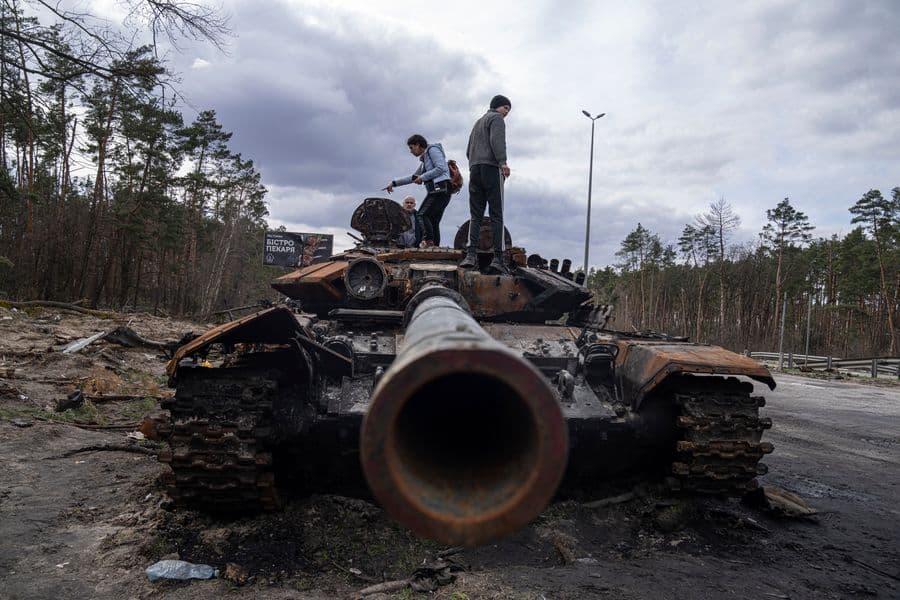
0The footage has been running for years now on battlefields across the globe. Drones that cost $1000 on average are flying and hitting armor platforms like tanks. It takes on several drones to soften the target and finish it off leaving an asset costing millions destroyed. Now the lives of a tank crew seem more like a liability than an asset. Russian FPV drones costing around $400 to $1,000 have repeatedly destroyed M1 Abrams tanks valued between eight and ten million dollars a unit. This is a modern economics inverse on the battlefield; one is deployable rapidly fire and forget tool that cost nothing. While the other is a long-term investment in supply chain, crews and life cycle.
The Marine Corps already ran those numbers. In 2020 Commandant General David Berger eliminated every tank in the Marine Corps inventory. All 452 of them. They did not reduce their inventory; they totally eliminated it from their strategic fighting structure. The tanks were transferred to the Army, while the Marines replaced them with rockets and drones. Berger looked at the future operating environment and made a clean call. Tanks are targets. Expensive targets with logistics chains, fuel requirements, maintenance crews, and support vehicles that are themselves targets. The institutional blowback was immediate. Retired generals wrote op-eds. Congress asked questions. Then Ukraine happened and Berger looked like the smartest man in the room.
The Army did not get the memo. The Abrams modernization program continues under new war doctrine as of 2026. The response to the M10 Booker cancellation was not to stop building tanks, it was to redesign the Abrams with a remote turret and better drone protection. Which may seem like a solution, but in reality, it is just pushing off the inevitable. All the modifications to modern tanks do is increase costs and deepen supply chain constraints. The cost ratio does not change. The exchange asymmetry does not change. A $1000 drone destroying a $10 million platform is still a $1000 drone destroying a $10 million platform regardless of what cage you weld onto the turret. Even if it takes ten cheap drones to destroy one tank, that ratio is still 1:1000. One batch of ten drones at $10,000 to one platform at $10,000,000.
The front lines of today have already given the answer between Drone vs Tank. News spoiler, drone wins. A Ukrainian lieutenant operating at zero point said it plainly. Russian drones swarm armored vehicles the moment they approach the front. The days of the tank, his words, are truly over. That is not an analyst. That is a field commander describing the reality of modern conflict. The Royal United Services Institute found that tactical drones account for sixty to seventy percent of damaged and destroyed Russian systems in Ukraine, consistent across multiple independent assessments. The tank in past was the fortress to push a column forward, now today it is struggling to get through a mine field before being hit by a drone.
The institutional resistance follows a familiar pattern. Procurement pipelines have constituencies. Military officers built careers on armored doctrine. The contractors who build tanks lobby. The congressional delegations that represent tank-producing districts vote. Nobody walks into Fort Hood and tells the armored branch their primary platform is a liability. That conversation costs careers. So instead, billions keep moving toward modernization programs that the battlefield has already rendered obsolete, and the soldiers who crew those vehicles in the next war are the ones who should worry most, because modern frontlines increasingly treat armored platforms as detectable and expendable targets.
Nations serious about defense modernization, including U.S. allies, should look beyond legacy platform conventions and procurement models built for another era. The evidence from Ukraine is clear. Battlefield leverage increasingly belongs to forces that can produce and deploy consumable systems at scale across air, land, and sea. A nation that can produce ten thousand drones a month may have more operational relevance than one built around a handful of frigates it cannot afford to lose. A force that can saturate a battlespace with expendable autonomous systems no longer needs to anchor its doctrine around tank columns.
War is a numbers game. The question is how much force you can deploy before your adversary can replace what you destroy. Drones and AI make that equation dramatically cheaper for the side willing to build accordingly.
Michael Aaron Cody is an independent researcher published in the European Physical Journal Plus, AI & Society (Springer Nature), Philosophy & Cosmology, and the Journal of Modern Physics. His work spans physics, systems theory, and defense policy.

The Dual Threat: Why Beijing’s Collapse Is Just As Dangerous as Its Rise
By Efraín Vázquez-Vera • RealClearDefense
Optimizing Trump’s Strategy to ‘Rot Iran’s Economy’
By Brian G. Chow • RealClearDefense
The AI Scare Is the New Y2K: A Veteran’s Perspective on Hype, Risk, and the Discipline Needed to Modernize Safely
By Kenneth Smith • RealClearDefense
The Pentagon’s AI Rush Needs Adult Supervision
By Michael Aaron Cody • RealClearDefense
ICE Is Not a Four-Letter Word
By Meda Parameswara Reddy • RealClearDefense

Marine Died of Injuries Suffered During Fast-Rope Training on Okinawa
By Brian McElhiney, Stars and Stripes
Drones Built To Look Like Birds Evaded Detection at Air Force Tech Exercise
By T&P
Navy Unfairly Evaluated Saildrone Musv Proposal, Court Finds
By D. Stancy, BrDefense
HII and Thales Demonstrate UUV with End-to-End Autonomous MCM
By Naval News
General Atomics Joins Army-Navy Hypersonic Glide Body Production
By Defence Blog