
Optimizing Trump’s Strategy to ‘Rot Iran’s Economy’
Last updated 06:21 AM EST • Read time: 6m
Join the Conversation
0Now that the 2026 midterm ballots have been cast, national security pundits are locked in a debate over whether America’s foreign policy will shift depending on which party controls Congress. In reality, this is a red herring. Foreign policy and naval enforcement remain squarely under executive authority, meaning President Donald Trump will continue to dictate terms over the next two years regardless of Capitol Hill balances. The real question is not who wins the midterms, but how the administration can optimize its baseline posture—Trump’s ultimatum that Iran must “make a deal, rot economically or be wiped out"—to make it maximally efficient. To compel a fair, durable settlement without open-ended military entanglements, Washington must execute a high-leverage, low-cost strategy that systematically seals Tehran’s remaining economic escape hatches while conserving U.S. resources. Moreover, because successful diplomacy requires two willing parties, this strategy must force Tehran to realize that returning to the negotiating table to secure a fair agreement is far preferable to watching its economy collapse and being forced to negotiate later from a vastly eroded bargaining position.
Beyond the Midterm Red Herring
The obsession with Congressional midterm outcomes ignores the fundamental nature of presidential power in national security affairs. Sanctions enforcement, maritime interdiction, and military targeting options are driven from the Oval Office, not committee rooms on Capitol Hill. Whether Republicans or Democrats gain seats, President Trump retains executive authority to direct U.S. strategy toward Iran over his remaining two years in office.
However, allowing Tehran’s economy to "rot" through passive sanctions alone is an incomplete strategy. Sanctions without active, surgical enforcement allow Iran to limp along by relying on shadow tankers, dark ship-to-ship crude transfers, and covert financial pipelines. On the other hand, an all-out military campaign or broad campaign involving American boots on the ground runs counter to President Trump’s long-standing commitment to avoid costly, open-ended entanglements in the Middle East. The administration needs a strategy that avoids both passive stagnation and military overreach: a posture that minimizes U.S. financial expenditure and troop risk while maximizing the immediate economic pain inflicted on the regime.
The Missing Operational Engine: Step-by-Step Escalation Against Kharg Island
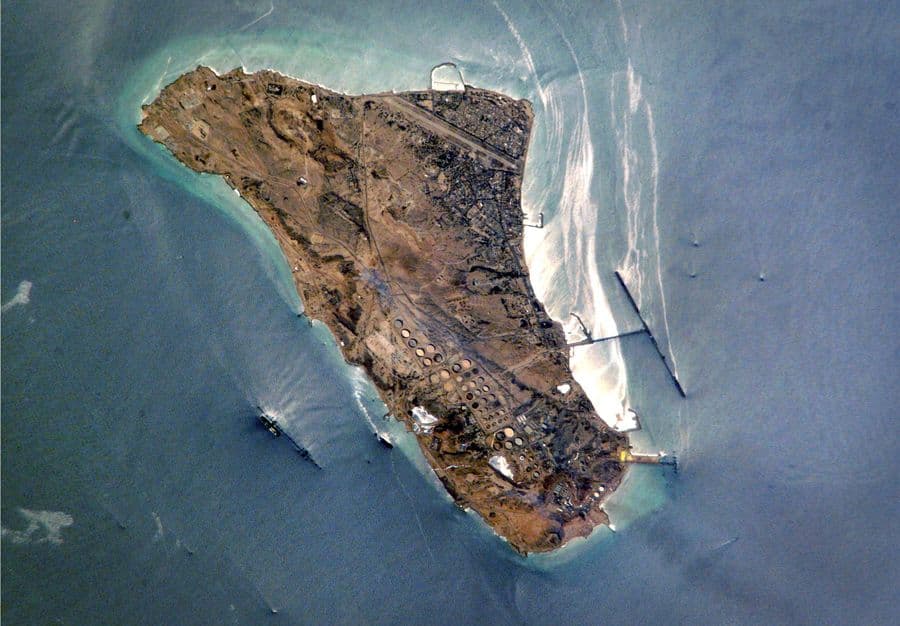
To operationalize this high-leverage, low-cost approach, Washington must focus its target set on Tehran’s single point of extreme vulnerability: Kharg Island. In a previous analysis, I demonstrated that Kharg Island serves as the central artery of Iran’s economic survival, handling roughly 90 percent of the regime’s crude oil exports. Without the revenue flowing through Kharg Island's loading berths and storage tanks, Tehran cannot fund its domestic state apparatus, pay its security forces, or subsidize its regional proxy network. Indeed, U.S. Central Command recently confirmed that the naval blockade has cost Iran over $25 billion in lost oil revenue. But clearly that is not enough to compel Tehran to genuinely return to negotiation. Instead, as a condition for returning to negotiation, Tehran wants the U.S. to lift the blockade even temporarily so that they can take crude out their storages in Iran to replenish their dozens of floating oil supertankers off Malaysia, which in turn can sell crude to China and other buyers.
As the threat of all-out war or wiping out Iran has not lessened Tehran’s will to fight, we must propose a step-by-step strategy that President Trump would accept for the next two years and allow plenty of offramps for Tehran to choose genuine negotiation and fair agreement, instead of forcing both sides fighting to death, killing untold number of military personnel and innocent bystanders along the way. That is a nonpartisan goal that both the United States and its allies would agree and support. President Trump can adopt a controlled, step-by-step target framework against Kharg Island. Under this calibrated posture, Washington establishes a clear, explicit escalation ladder: any Iranian provocation, escalation, or non-compliance with maritime sanctions triggers the next precise, stand-off strike against specific, vital components of Kharg Island’s export infrastructure, such as specific offloading jetties, pumping stations, crude metering facilities, and crude storage tanks.
This approach offers distinct operational advantages for the White House:
- Zero Boots on the Ground: Strikes can be delivered entirely through stand-off air- and sea-launched precision munitions, eliminating troop exposure and long-term deployment costs.
- Low Cost, Maximum Economic Impact: The U.S. expends minimal military resources to destroy critical infrastructure facilities that cost Tehran tens of billions of dollars in lost oil revenue and take months or years to repair.
- Stoppable Escalation Dial: By taking out infrastructure incrementally rather than all at once, Washington keeps Tehran on notice while preserving the remaining crude export capacity to convince Tehran to return to negotiation, limiting further losses to these indispensable resources at Kharg Island that Iran’s economy cannot survive without.
Fulfilling Guiding Principles and Enforcing a Fair Settlement
This step-by-step target framework seamlessly reinforces the core principles of an effective Iran strategy outlined in my previous discussion. A successful policy must maintain an unbroken, continuous posture of pressure that deprives Tehran of economic breathing room while keeping the door open for a comprehensive, permanent settlement.
If the regime believes Washington will eventually lose focus or that Congressional shifts will dilute executive resolve, it will simply attempt to outlast U.S. sanctions. A step-by-step targeting protocol on Kharg Island shatters that illusion. It demonstrates to Iranian leadership that waiting only guarantees the progressive, irreversible destruction of their primary revenue source.
Conclusion: Optimizing the Next Two Years
Over the next two years, the administration’s goal must be to make Iran’s economic rot rapid, inevitable, and surgically precise. By implementing a high-leverage, step-by-step escalation framework against Kharg Island, President Trump forces Tehran to face a stark mathematical reality: the sooner it returns to the negotiating table to secure a fair settlement, the more of its indispensable economic infrastructure it preserves. Signaling that President Trump is openly committed to a sustained, stoppable strategy of economic destruction—and publicly announcing this posture to the world and to Tehran as soon as possible so that all parties can act accordingly—is ultimately the fastest way to compel a peaceful and lasting settlement.
Brian G. Brian G. Chow is an independent policy analyst with more than 200 publications on national security issues. He holds a Ph.D. in physics from Case Western Reserve University and an MBA with distinction and a Ph.D. in finance from the University of Michigan. He can be reached on X at @briangchow.
The Dual Threat: Why Beijing’s Collapse Is Just As Dangerous as Its Rise
By Efraín Vázquez-Vera • RealClearDefense
Optimizing Trump’s Strategy to ‘Rot Iran’s Economy’
By Brian G. Chow • RealClearDefense
The AI Scare Is the New Y2K: A Veteran’s Perspective on Hype, Risk, and the Discipline Needed to Modernize Safely
By Kenneth Smith • RealClearDefense
The Pentagon’s AI Rush Needs Adult Supervision
By Michael Aaron Cody • RealClearDefense
ICE Is Not a Four-Letter Word
By Meda Parameswara Reddy • RealClearDefense

Marine Died of Injuries Suffered During Fast-Rope Training on Okinawa
By Brian McElhiney, Stars and Stripes
Drones Built To Look Like Birds Evaded Detection at Air Force Tech Exercise
By T&P
Navy Unfairly Evaluated Saildrone Musv Proposal, Court Finds
By D. Stancy, BrDefense
HII and Thales Demonstrate UUV with End-to-End Autonomous MCM
By Naval News
General Atomics Joins Army-Navy Hypersonic Glide Body Production
By Defence Blog