
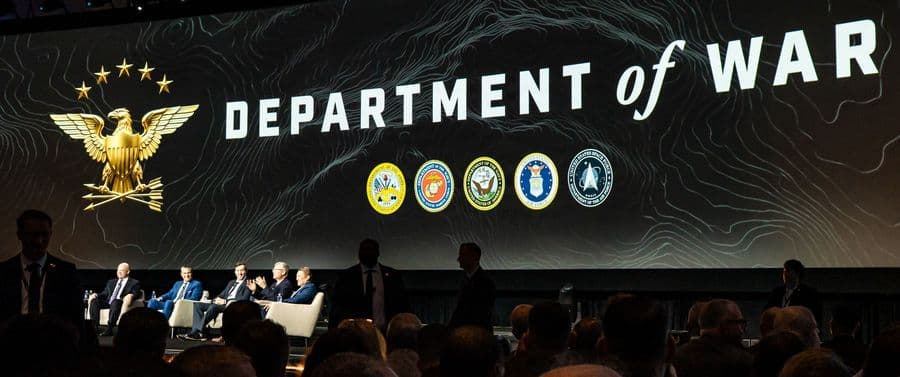
Secretaries of the Military Departments discuss Project Agincourt at the 2026 Association of the United States Army in Washington, D.C., Oct.14, 2026. Defense leaders outlined plans for a new four-star Autonomous Warfare Command designed to unify unmanned systems, artificial intelligence, and drone capabilities across the Joint Force. The initiative reflects a broader effort to build a faster, more agile military by accelerating innovation, streamlining acquisition, and strengthening partnerships with industry. Leaders emphasized rapidly delivering capabilities to Soldiers, enhancing deterrence, and preparing the force for future conflicts. (U.S. Army photo by Sgt. Chase Murray)
The AI Scare Is the New Y2K: A Veteran’s Perspective on Hype, Risk, and the Discipline Needed to Modernize Safely
Last updated 06:20 AM EST • Read time: 4m
For months, the national conversation around artificial intelligence has been dominated by fear existential risk, runaway systems, and predictions of societal collapse. It’s a familiar pattern. As a former United States Marine and a federal modernization leader, I’ve seen this cycle before. In fact, the current AI panic mirrors the atmosphere leading up to Y2K: loud predictions of catastrophe, sweeping claims of imminent failure, and a public narrative shaped more by anxiety than by disciplined technical assessment.
The truth is simpler. AI is not an extinction level threat. It is a powerful tool one that demands structured governance, rigorous engineering, and mission‑focused integration. What we are experiencing today is not a technological emergency. It is a modernization challenge, and modernization challenges are solved through disciplined execution, not fear.
This is especially clear when you consider the threats that rise to the level of existential risk. We face strategic adversaries accelerating nuclear modernization. We face biological threats capable of global disruption. We face cyber actors probing critical infrastructure every day. We face supply chain vulnerabilities that could cripple national readiness. These are real, tangible, and historically validated risks yet none of them generate the level of public panic that AI does.
So why is AI moving the doomsday clock? Because AI is unfamiliar, poorly understood, and easy to dramatize. It is far simpler to imagine a runaway algorithm than to confront the slow, grinding realities of nuclear proliferation, biothreat evolution, or critical‑infrastructure fragility. Fear fills the gaps where understanding is missing. But national security cannot be built on fear. It must be built on discipline remember that there is nothing to fear accept fear itself!
During Y2K, the problem was never that computers were going to destroy society. The problem was that systems had been built without long term lifecycle planning. The fix required methodical inventory, remediation, testing, and verification. The same is true now. AI systems are only as dangerous as the environments they are deployed into. Poorly governed systems fail. Well governed systems scale.
The defense community understands this better than most. We do not treat new technology as magic, nor do we treat it as a monster. We treat it as capability something that must be evaluated, hardened, integrated, and monitored. The Marine Corps taught me that discipline is an antidote to chaos. In modernization, discipline is the antidote to all the hype.
The real risk today is not AI itself. It is mismanaged modernization, rushed deployments, unclear authorities, fragmented governance, and the belief that AI can replace human judgment. No algorithm can substitute for accountability. No model can replace leadership. And no system, no matter how advanced, can operate safely without a clear chain of responsibility.
Federal agencies should approach AI the same way they approached Y2K remediation:
- inventory systems
- identify vulnerabilities
- establish governance
- test relentlessly
- verify continuously
- and integrate only when mission‑ready
This is not panic based thinking. It is disciplined in modernization.
The public conversation needs to be shifted. Instead of debating whether AI will take over, we should be asking whether our modernization pipelines are structured, whether our data governance is mature, and whether our acquisition strategies reflect the realities of integrating complex systems at scale. These are not existential questions. They are engineering questions that have answers if properly socialized.
AI is not the end of the world, complacency is. The Y2K scare taught us that fear is a poor substitute for preparation. The AI scare is teaching us the same lesson. If we apply disciplined modernization principles that kept critical systems stable during Y2K we will not only mitigate risk, but we will also strengthen national security.
As a Marine, I learned that readiness is not a slogan. It is a process. As a modernization leader, I’ve learned that technology is not dangerous when governed well. The danger comes when we allow hype to drive decisions instead of discipline.
AI will not destroy the world. But if we fail to modernize with rigor, we might break our systems ourselves.
The solution is clear: treat AI not as a crisis, but as a modernization mission. Missions are successful through structure, accountability, discipline, and execution. If you’re still not convinced, just remember that duct tape is for quick fixes. Modernization is not.
Kenneth Smith is a former United States Marine and CEO of Lykirk Technologies Consulting Group, an SDVOSB specializing in federal IT modernization, enterprise integration, and mission-critical systems support.

The Dual Threat: Why Beijing’s Collapse Is Just As Dangerous as Its Rise
By Efraín Vázquez-Vera • RealClearDefense
Optimizing Trump’s Strategy to ‘Rot Iran’s Economy’
By Brian G. Chow • RealClearDefense
The AI Scare Is the New Y2K: A Veteran’s Perspective on Hype, Risk, and the Discipline Needed to Modernize Safely
By Kenneth Smith • RealClearDefense
The Pentagon’s AI Rush Needs Adult Supervision
By Michael Aaron Cody • RealClearDefense
ICE Is Not a Four-Letter Word
By Meda Parameswara Reddy • RealClearDefense

Marine Died of Injuries Suffered During Fast-Rope Training on Okinawa
By Brian McElhiney, Stars and Stripes
Drones Built To Look Like Birds Evaded Detection at Air Force Tech Exercise
By T&P
Navy Unfairly Evaluated Saildrone Musv Proposal, Court Finds
By D. Stancy, BrDefense
HII and Thales Demonstrate UUV with End-to-End Autonomous MCM
By Naval News
General Atomics Joins Army-Navy Hypersonic Glide Body Production
By Defence Blog