
Fully Autonomous Air Combat Is Coming
Last updated 07:34 AM EST • Read time: 4m
Top Gun: Maverick begins with Rear Admiral Cain alluding to how Maverick and human pilots in general will have no place in the future of air combat. Maverick’s response is calm but defiant: ‘Maybe so, sir, but not today.’ The scene may be fictional, but it reflects current developments in military aviation as technological advances in increasingly autonomous uncrewed aircraft are disrupting long-standing doctrines developed around manned aircraft.
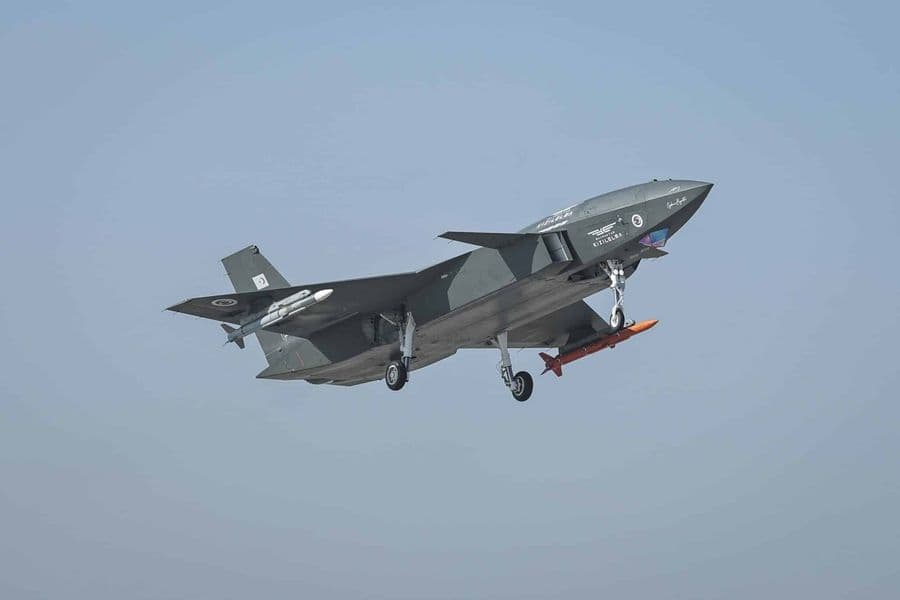
The future that Maverick dismissed may be coming sooner than many thought, and in some respects may already have arrived. Two collaborative combat aircraft (CCAs, fighter-like drones) made pioneering shots of air-to-air missiles late last year.
There were differences between the level of autonomy that was achieved. And, when CCA’s are operational, there will probably be enduring differences between the level of autonomy that’s allowed.
On 30 November, a Baykar Kizilelma was the first to blur the line between Hollywood and reality, or at least the first to do so publicly. The CCA detected, tracked and shot down a jet-powered aerial target. No uncrewed aircraft is known to have previously fired an air-to-air missile.
Notably, the Kizilelma’s own radar guided the weapon, a medium-range Gokdogan somewhat equivalent to the Raytheon AIM-120 Amraam and made by Turkey’s Tubitak Sage.
Baykar is aiming for Kizilelmas to decide on their own what to do, including launching missiles: it says that aircraft of the type will eventually perform patrol and interception missions autonomously. They’ll do this in designated airspace, it says—perhaps meaning free-fire zones, those in which anything in the air is an allowable target.
In a further step towards such missions, Baykar demonstrated two Kizilelma prototypes autonomously flying in close formation on 27 December. The design has since undergone more tests.
Western CCA programmes generally prioritise human supervision of aircraft autonomy. For instance, Eric Trappier, chief executive of Dassault Aviation, has stressed the integration of controlled and monitored AI into the development of the Rafale F5 and its accompanying CCAs.
An air-to-air missile test by the MQ-28 Ghost Bat CCA, developed in Australia, was conducted comfortably within the concept of human supervision. In the test, an E-7A Wedgetail, F/A-18F Super Hornet and the Ghost Bat (all Boeing aircraft) took off from separate locations, says Boeing. An operator on the Wedgetail took ‘custodianship’ of the Ghost Bat, with which the Super Hornet flew in combat formation, providing sensor coverage.
The Super Hornet crew detected, identified and tracked the fighter-class target drone and passed the data to the other two aircraft. With this, the Ghost Bat manoeuvred for the shot and, when given permission from its operator on the Wedgetail, fired. Its Amraam hit.
From the published information, the definitely identifiable difference between the tests is that the Australian aircraft relied on targeting data from another aircraft (the Super Hornet). This is itself an important operational advantage but for the moment may reflect a lack of an onboard radar for the Ghost Bat.
A possible but most unlikely difference is that the Kizilelma fired without human permission. It’s not likely because this was an initial test: Baykar and the Turkish air force almost certainly wanted to maintain tight control. Mostly likely, a crew member of one of the accompanying F-16s authorised the drone to shoot.
US officials, such as former US Air Force secretary Frank Kendall have acknowledged that adversaries employing totally autonomous uncrewed combat aircraft would challenge the West’s ability to maintain human supervision over such machines. Still, for now, it seems that when European countries deploy CCAs, they will probably allow them to shoot only with human permission.
Yet the West’s rivals may not be the only other countries that are less picky. The Baykar Kizilelma may be an attractive product for them.
Success of initial tests conducted in controlled environments hardly means that combat effectiveness has been achieved, with or without human supervision. Air combat is unpredictable and unforgiving, so CCAs would be confronted with many of the same challenges as crewed fighters.
Even so, the tests by the Kizilelma and the Ghost Bat demonstrate that a disruptive transition is well underway in military aviation. In many cases, full autonomy won’t be wanted all the time even by non-Western forces: a common mode of operation will be CCAs working with crewed fighters that act as their command nodes. So, the crewed fighters will still have their place.
Still, fully robotic execution of air-to-air missions is also coming—maybe not today, but soon.
Mustafa Bilal is a researcher at the Centre for Aerospace & Security Studies, Islamabad.
AI contributed no ideas to this article—Mustafa Bilal.
This article appeared originally at The Strategist (ASPI).

ICE Is Not a Four-Letter Word
By Meda Parameswara Reddy • RealClearDefense
The U.S. Can Draw Down in the Middle East Without Going Blind
By Cudi Zerey • RealClearDefense
America Needs a Joseph Directive
By Jeff Ballabon • RealClearDefense
Partnering Decides Whether Flexible Military Construction Can Work
By Matt Russell • RealClearDefense
Eight Months of Epic Fury and Still No Internal Alternative
By Stephen D. Cook • RealClearDefense

GE Aerospace to Supply Engines for Two US Navy Flight III Destroyers
By Defense Post
U.S. Air Force Asks Industry for New Cruise Missile for Ukraine
By Michael Peck, DNews
First Flight II San Antonio-class Amphib Completes Builder’s Trials
By Mongilio, USNI N.
LGM-35 Sentinel ICBM on Track for 2030
By Kris Osborn, Warrior Maven
On American Destroyers, Avoid a Self-Inflicted Wound in Spain
By Defense News