
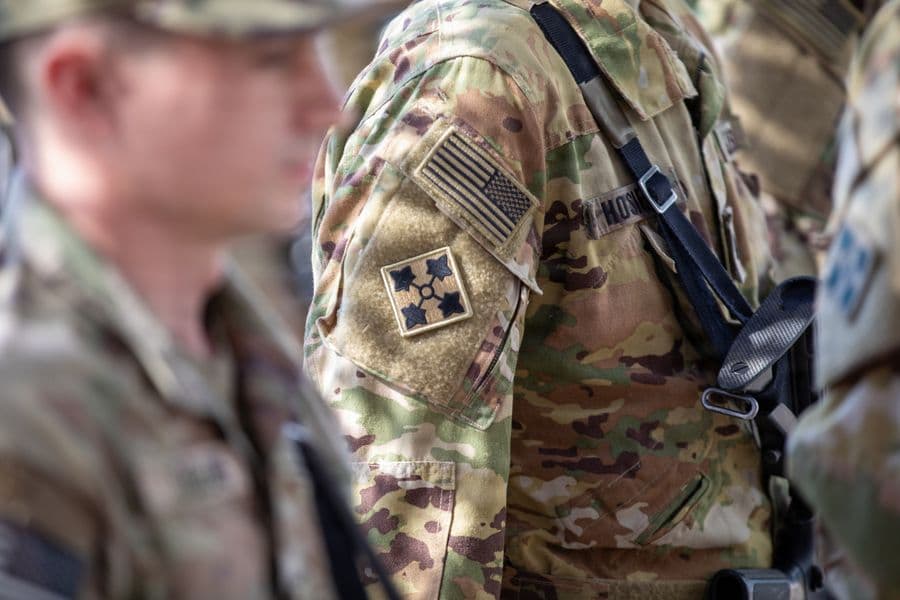
U.S. Army Soldiers assigned to Task Force Nighthawk, 4th Combat Aviation Brigade, 4th Infantry Division receive their Shoulder Sleeve Insignia – Military Operations in Hostile Conditions (SSI-MOHC) during a patching ceremony at Erbil Air Base, Iraq on Oct. 23, 2025. The SSI-MOHC, commonly known as the “combat patch,” is worn on the right shoulder sleeve of the Army Combat Uniform to indicate a Soldier’s deployment and service in a combat zone. (U.S. Army photo by Capt. Bernard Jenkins)
The U.S. Can Draw Down in the Middle East Without Going Blind
Last updated 06:47 AM EST • Read time: 6m
Washington has good reasons to direct more attention and resources toward China and the Indo-Pacific. But treating the campaign against ISIS as finished business would be a mistake. The group no longer controls cities or large stretches of territory, yet the conditions that helped it rise have not disappeared.
The immediate danger is not another ISIS army sweeping across Iraq or Syria. It is slower deterioration: local forces that remain dependent on outside support, detention facilities that cannot be secured indefinitely, and international attention moving elsewhere. Recent UN assessments continue to describe ISIS as resilient and adaptive. A future resurgence would probably begin at the margins, not with another dramatic march on Mosul.
Preventing that outcome does not require another large American deployment. It does require Washington to decide what it cannot afford to lose as its footprint shrinks. Intelligence, regional access, capable local partners and the ability to respond quickly matter more than preserving yesterday's troop numbers.
That distinction should guide any further U.S. drawdown. Fewer American troops do not automatically mean less security. Losing the intelligence, surveillance and advisory capabilities that allow Washington and its partners to see threats developing is another matter.
A smaller U.S. presence should preserve intelligence sharing, regional access, special operations partnerships and a limited ability to reinforce local forces when necessary. The purpose would not be to sustain another open-ended ground campaign. It would be to identify a threat early enough that it never reaches that point.
The choice is not between permanent deployment and walking away. There is considerable room between those positions. The danger comes when reducing the footprint also reduces situational awareness. As the Congressional Research Service has noted in its overview of the Islamic State and U.S. policy, withdrawals and changes in coalition support affect the conditions under which local partners operate. Once Washington loses the ability to recognize a deteriorating security environment, a manageable threat can become far more expensive to contain.
A smaller American role also makes the quality of local partners more important. Operation Inherent Resolve reporting shows how U.S. strategy in Iraq and Syria increasingly relies on local forces rather than large American formations. But that model only works if those forces become less dependent on U.S. intelligence, logistics, maintenance and operational planning.
Washington therefore needs a better way to judge whether its assistance is working. Counting raids, missions or trained personnel says little about whether a partner force will continue to function when American support declines.
The harder test is whether partner forces can plan their own operations, keep equipment running, move supplies, retain trained personnel and maintain secure detention facilities. These achievements are less visible than battlefield victories, but they are better indicators of whether a reduced U.S. role will be sustainable. U.S. defense and security-assistance officials should make those capabilities central to partnership reviews and future support.
Military self-sufficiency, however, is not enough. RAND research has stressed that long-term stability also depends on governance and development alongside immediate security requirements. Local forces cannot permanently compensate for political institutions that fail to provide basic order or retain public legitimacy.
That is why stabilization should not be treated as an activity that begins after the security mission ends. In areas where ISIS has operated, targeted stabilization is part of preventing the next crisis. ISIS benefited from places where governments could not reliably provide security, resolve disputes or convince communities that state institutions were working for them. Military pressure could remove fighters from the battlefield, but it could not repair those weaknesses on its own.
Those problems have not disappeared. The International Crisis Group has documented continuing governance and institutional weaknesses in parts of Syria, while UNDP has linked exclusion, limited opportunity and weak governance to vulnerability to violent extremism. The implication for U.S. strategy is straightforward: counterterrorism assistance that ignores these conditions will repeatedly be asked to solve problems it cannot solve on its own.
Washington does not need to fund every local problem or return to a broad nation-building agenda. It should concentrate limited stabilization resources where failures in basic services, local governance or security institutions are most likely to create openings that ISIS can exploit.
Nowhere is the cost of leaving a problem unresolved clearer than in northeastern Syria's detention facilities and displacement camps. The Congressional Research Service identifies the detention of ISIS-linked individuals and conditions in northeastern Syria as continuing policy issues. Thousands of detainees and family members remain there, leaving local authorities and their international partners with a security challenge that has outlasted the territorial caliphate.
These facilities are not simply a humanitarian concern. Weak security creates opportunities for recruitment and radicalization, while prisons remain obvious targets for operations intended to free experienced fighters. Every year the underlying arrangements remain unresolved, another year in which local partners must take that risk.
The responsibility cannot sit with local forces alone. The State Department should press governments to repatriate their nationals, while the United States and coalition partners continue helping local authorities improve detention security. Governments receiving returnees will also need the legal and institutional capacity to prosecute, rehabilitate, reintegrate or monitor them as appropriately.
Leaving thousands of people indefinite legal and physical uncertainty is not a strategy. It means accepting a vulnerability that ISIS has every reason to exploit.
None of this requires a return to the large deployments of the previous decade. It requires clarity about what a smaller American commitment must still accomplish.
As Washington adjusts its posture in Iraq and Syria, the Pentagon and State Department should judge further reductions against three questions: Will the United States retain enough intelligence to recognize an ISIS recovery? Can local forces increasingly operate without American support? And are detention and stabilization problems becoming more manageable rather than merely being left behind?
The territorial caliphate was defeated because the United States and its partners sustained military pressure, built local partnerships and supported stabilization. Drawing down does not require abandoning those lessons. The real test of a smaller U.S. presence will not be how many troops leave the Middle East, but whether Washington can reduce its footprint without recreating the conditions that force it to return.
Cudi Zerey is a management consultant specialising in defence and public-sector transformation. He is also a doctoral researcher whose work focuses on sustainable armed forces and security policy.

ICE Is Not a Four-Letter Word
By Meda Parameswara Reddy • RealClearDefense
The U.S. Can Draw Down in the Middle East Without Going Blind
By Cudi Zerey • RealClearDefense
America Needs a Joseph Directive
By Jeff Ballabon • RealClearDefense
Partnering Decides Whether Flexible Military Construction Can Work
By Matt Russell • RealClearDefense
Eight Months of Epic Fury and Still No Internal Alternative
By Stephen D. Cook • RealClearDefense

GE Aerospace to Supply Engines for Two US Navy Flight III Destroyers
By Defense Post
U.S. Air Force Asks Industry for New Cruise Missile for Ukraine
By Michael Peck, DNews
First Flight II San Antonio-class Amphib Completes Builder’s Trials
By Mongilio, USNI N.
LGM-35 Sentinel ICBM on Track for 2030
By Kris Osborn, Warrior Maven
On American Destroyers, Avoid a Self-Inflicted Wound in Spain
By Defense News