
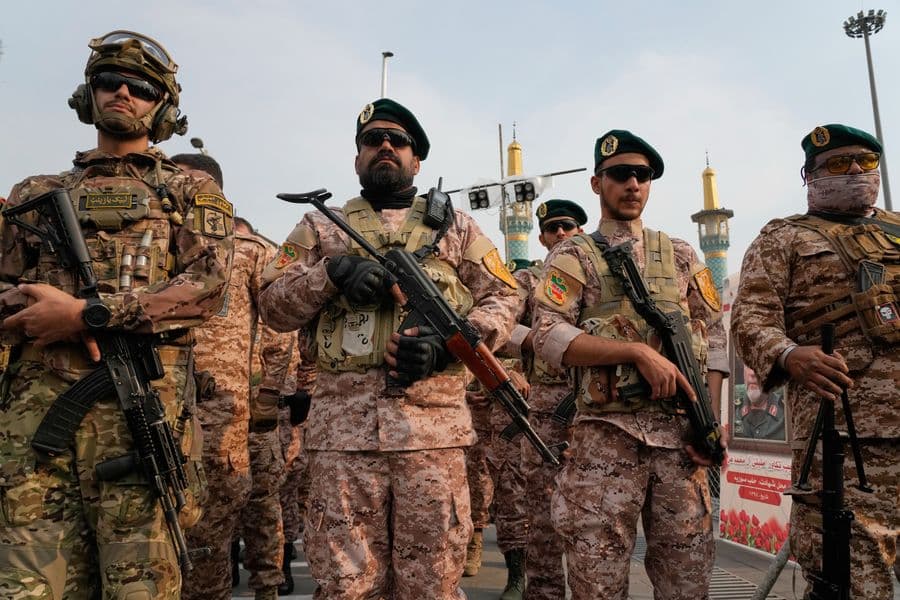
Members of the Basij paramilitary force affiliated with the Revolutionary Guard, attend the inauguration of a military training center for civilian volunteers near the Imamzadeh Saleh shrine in Tajrish Square in Tehran, Iran, Monday, Nov. 2, 2026. (AP Photo/Vahid Salemi)
Eight Months of Epic Fury and Still No Internal Alternative
Last updated 06:33 AM EST • Read time: 6m
Eight months into Operation Epic Fury, the White House continues to promise a swift conclusion to the conflict. We have seen this playbook before: Washington degrades Iranian military capabilities through intense airstrikes, tightens economic sanctions, and then waits for a battered regime to petition for peace. Yet Tehran’s theocracy is absorbing these material losses while keeping an iron grip on power. U.S. strategists are ignoring a glaring parallel: our own failure in Afghanistan.
Long before their 2021 return to power, the Taliban cultivated a functional shadow government, guerrilla cells, and an underground intelligence apparatus. Pakistan’s Inter-Services Intelligence provided the critical sanctuary and logistics to sustain them, supplemented by arms and intelligence support from Russia and the Islamic Revolutionary Guard Corps (IRGC) Quds Force. While the United States propped up the Afghan government with a substantial force presence, Washington fatally underestimated both the Taliban's deep local insurgent roots and the durability of their ideology. When U.S. diplomats negotiated from a perceived position of strength, they secured an agreement that evaporated the moment American troops withdrew. Because Washington left no sustained ground counterweight, the insurgent structures American forces failed to dismantle simply took over.
Iran presents a related, yet distinct, challenge. Unlike the Taliban, who had to build their insurgency from the outside in, the Iranian regime already possesses the ultimate tools of internal control. The IRGC and its Basij paramilitary, alongside the national police (NAJA), operate a dense, neighborhood-level surveillance and suppression machine. Operating from tens of thousands of bases embedded in mosques and schools, the Basij weaponizes ideological indoctrination, patronage, and the constant threat of localized violence to paralyze dissent.
Furthermore, Beijing and Moscow are actively reinforcing Tehran’s resilience. China buys the vast majority of Iran’s smuggled oil—providing a vital financial lifeline—while supplying dual-use technology. Russia, drawing on lessons from Ukraine, shares targeting intelligence and helps replenish Iran's drone fleet. Both powers carefully calibrate this support to bleed U.S. resources without triggering a direct war. They are perfectly content to watch America bog down in another endless Middle Eastern commitment.
To be sure, U.S. forces have delivered devastating tactical blows during Operation Epic Fury. American strikes have obliterated Iran’s ballistic missile production, neutralized its navy, and essentially grounded its air force. The opening salvos killed Ayatollah Ali Khamenei, forcing his successor into hiding. Yet these tactical victories have not translated into a decisive strategic outcome. For Tehran, endurance is victory. The regime frames its economic hardship and shattered military as badges of resistance, willing to absorb casualties that would break a conventional adversary. Whenever Iranian diplomats do agree to negotiate, they offer only hollow commitments they fully intend to break once Washington relieves the military or economic pressure.
The critical shortcoming in U.S. strategy is the absence of a viable internal alternative. Today, no nationwide Iranian organization possesses the guerrilla skillset, underground networks, auxiliary support, or shadow governance required to contest the Basij and NAJA at the street level. Scattered resistance units associated with the People’s Mojahedin Organization of Iran (MEK) offer little more than symbolic propaganda, while Baloch insurgents and Jaish al-Adl remain geographically isolated, lacking the organizational depth that fueled the Taliban. A viable alternative cannot rely on these exiled factions or isolated border insurgents. On the night Operation Epic Fury began, the Commander in Chief told the Iranian people that ‘the hour of your freedom is at hand’ and urged them to ‘take over your government’ once the strikes ended; he returned to the same theme months later, asking when Iranians would ‘rise up and fight.’ Yet neither the United States nor Israel has invested in the organizational capability that would make such an uprising viable against the Basij and NAJA. Precision munitions cannot build local networks. B-2 bombers cannot hold territory or govern a neighborhood once the dust settles. Sanctions may drain the regime’s coffers, but they leave Tehran’s coercive apparatus intact. To build the networks that bombs cannot, one plausible possibility would fuse the urban networks that emerged during the Mahsa Amini protests with disaffected junior and mid-level officers from the Artesh, Iran’s regular military, which has long been sidelined by the IRGC. Pairing the demographic weight of urban youth with the tactical literacy of those officers could produce an internal force capable of contesting the regime at the neighborhood level.
If Washington refuses to foster a credible internal resistance, Operation Epic Fury risks repeating the Afghan disaster in reverse. U.S. military pressure might force temporary Iranian concessions, but Beijing and Moscow will ensure the regime eventually reconstitutes. When the current U.S. administration leaves office, its successor will inherit an Iranian theocracy that weathered the storm, protected its ideological core, and maintained its chokehold on the Iranian people. The Taliban proved that deep local roots and external sanctuary can outlast conventional military superiority if no local counterweight exists. Iran’s theocracy already owns those roots. Bombs and sanctions impose costs, but they cannot replace an organized alternative capable of fighting for control on the ground.
A strategy built for lasting victory requires Washington to systematically arm, train, and equip Iranian elements willing to build a genuine insurgency. The U.S. must help forge mechanisms to foster intelligence, logistics, and alternative governance to support a resistance movement. In the 21st century, sanctuary is both physical and digital. Covert logistical pipelines through neighboring states such as Azerbaijan and Iraqi Kurdistan, combined with low-earth orbit connectivity, encrypted mesh networks, and shadow financial channels, would let an Iranian underground coordinate, and sustain itself despite regime internet blackouts and surveillance.
This is not a call for another multi-trillion-dollar U.S. ground occupation or the deployment of American combat formations. It is a call for limited external support—arms, training, intelligence, and funding—to help Iranians build the local capacity required to contest the regime on the ground. Airstrikes and embargoes alone cannot collapse a system engineered to survive them. Unless America backs an internal resistance, we will continue pouring resources into a war against a system that defines victory as sheer survival, while our great-power rivals gleefully sustain the enemy. The upcoming midterm elections will not solve this standoff, and neither will another round of airstrikes masquerading as the final phase of a war that has long outlived its original timeline.
Stephen D. Cook is a retired U.S. Army Special Forces lieutenant colonel with 25 years of service. A combat veteran decorated for both heroism and valor, he is the author of the field manuals “When We’re Finished” and “Choose the Heavier Ruck,” and the techno-thriller precision-strike trilogy leading with “In the Shadows of the Sky.” His work explores the intersection of elite military decision-making, intuition, and disruptive leadership. He is based in St. Augustine, Florida

Eight Months of Epic Fury and Still No Internal Alternative
By Stephen D. Cook • RealClearDefense
The Readiness Cliff: Pacific Lessons Drawn from the Middle East
By Brian McSorley • RealClearDefense
The Pentagon’s Real Modernization Problem Is Time, Not Technology
By Bruce Allen Lubbering • RealClearDefense
The World His Mother Opened
By Carlo J.V. Caro • RealClearDefense
Wake Island Lessons for Expeditionary Advanced Base Operations
By Brian J. Dunn • RealClearDefense
Wake Island Lessons for Expeditionary Advanced Base Operations
By Brian J. Dunn • RealClearDefense
U.S. Navy Expands Unmanned Mine Hunting
By Global Defense News
MRF-SEA Will Maintain Continuous Presence in the Philippines
By Mahadzir, USNI News
Space Force Weighs Proliferated Cislunar Satellite Constellation
By C. Albon, A&SF
America-Class Amphibs Enable New Ship-to-Shore Attack Strategies
By Warrior M.