
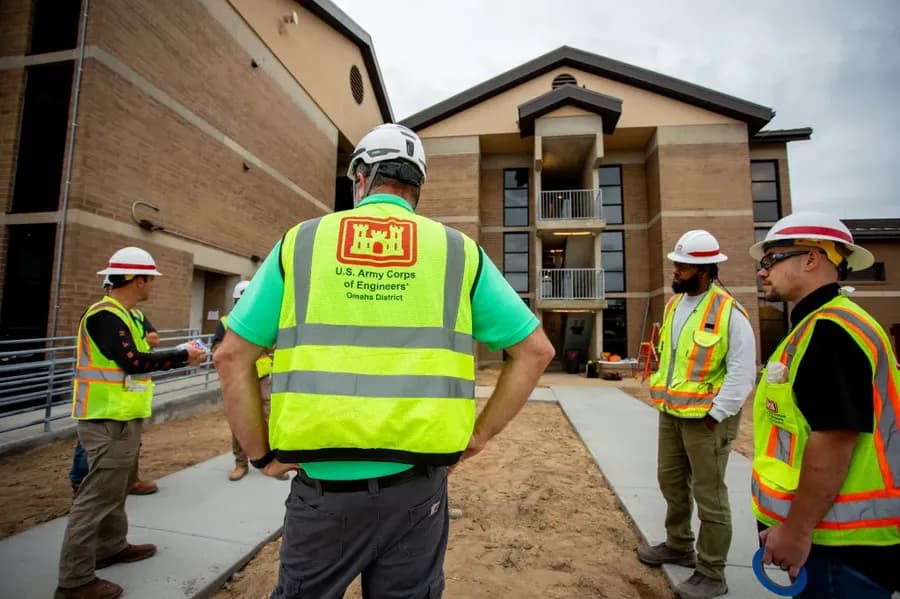
Members of the U.S. Army Corps of Engineers conduct an inspection at Fort Bragg, North Carolina. (Samuel Weldin/Army)
Partnering Decides Whether Flexible Military Construction Can Work
Last updated 06:45 AM EST • Read time: 7m
Join the Conversation
0The U.S. Army Corps of Engineers (USACE) is preparing to ask a design-build team to begin work before anyone knows the final price. Progressive design-build (PDB) with other transaction authority (OTA) can deliver a usable facility sooner, but only if government and industry build a working partnership before design and price are settled.
The planned Multi-Domain Cyber and Intel Operations Center at Joint Base San Antonio-Lackland shows the method in practice. The Corps programmed about $986 million for the project and plans to select one design-builder based on qualifications and experience. That team will refine the design and develop costs in an open-book process before the parties agree on a construction price.
The Rulebook Has Changed
Congress gave the department a new contracting path. Congress added section 2808a to title 10 of the U.S. Code in the fiscal 2026 National Defense Authorization Act, enacted in December 2025. It lets the Secretary concerned enter into transactions instead of the contracts, cooperative agreements, or grants that usually govern construction. The authority covers planning, design, engineering, prototyping, and execution of facility repair and construction.
Congress also set conditions on the path. A project must already be authorized and funded under other law before you use the authority. You must notify the congressional defense committees at least 14 days before entering a transaction. The notice must state the estimated cost, the funding source, and why you chose this authority over the traditional military construction process.
The Federal Acquisition Regulation normally sets pricing, change, and dispute terms in a construction contract. Under the new authority, your agreement must write those terms itself. The statute leaves partnering, open-book cost development, end-user roles, and exit rights to the parties, so your legal team must draft them before negotiations begin.
Appropriations law sets a boundary the agreement cannot cross. Section 8150 of the fiscal 2026 Consolidated Appropriations Act restricts certain fund transfers under the new authority. Confirm each project’s funding source before you negotiate a price.
Where the Partnership Could Break Down
The partnership is most likely to fail at the decision table, where the Army, the designer, and the builder disagree and no one holds final authority. Each party shapes the project, so the agreement must name who decides when they disagree. Without firm deadlines, the team waits on approvals the right official has not yet given.
Changing requirements can break the partnership during design. End users refine what they need as the design takes shape. GAO found that changing customer requirements contributed to military construction delays in the five fiscal years it reviewed. A change made after the team sets a price can reopen cost, schedule, and trust at once. Require end-user sign-off at each design milestone and set a cutoff date for new requirements.
Open-book cost development can turn into a contest of positions when each side treats shared information as a bargaining chip. The builder shares cost assumptions, subcontractor input, and contingency estimates early. USACE's partnering playbook calls for resolving issues at the lowest level, which lets the team settle estimate differences before they harden into positions.
Early design work can outrun the government’s ability to judge cost. Progressive design-build asks the team to develop the design before the price is final, so the government must test estimates as the design grows. GAO has reported that DoD construction cost estimates did not consistently follow best practices, and that gaps between early estimates and final costs forced budget and schedule changes. Independent government estimates and design maturity gates let you test each decision against a credible budget before the team commits to it.
The Agreement Is the Vehicle
The agreement must do the work a standard contract does by default. Without the regulation’s familiar terms, the parties must write down how they will decide, share cost information, resolve disputes, and exit. Those terms show the team how the partnership will function under pressure.
Decision rights come first. The agreement should name the official who approves each design milestone, the official who approves a price, and the official who can change the scope. It should set a deadline for each decision so the team never waits on an approval that no one can give.
Cost-sharing rules come next. The parties need written terms for open-book estimates: who may see the information, how the builder’s fee will be treated, and whether the government can audit subcontractor costs. USACE's partnering playbook recommends a standing issue-resolution ladder. Build that ladder into the cost process so estimate disputes reach the right level on a set schedule.
The off-ramp needs the same care. The Lackland solicitation protects the government if negotiations fail: if the parties cannot agree on a construction price, the government may take the completed design and procure construction another way. Before talks begin, both sides should know what the government keeps, how the builder is paid for its design work, and when either side may walk away. Clear exit terms let the team leave cleanly and give both sides a reason to solve problems before exit becomes the only option.
Build the Team Before the Price
The team must exist, with named people, before anyone fixes the design or the price. The people who will design, build, approve, and occupy the facility must work together before anyone signs a construction agreement. That early period lets you confirm shared goals and fix problems while they remain cheap to fix.
The core team includes more than the contracting officer. It needs the district program lead who owns the project, the agreements officer who signs the transaction, the end user who will occupy the building, the designer, and the builder. Each role needs a named person and a written list of the decisions that person controls. A vacant role leaves the team without the authority it needs to act.
Early partnering sessions must produce decisions, not just agreement. A kickoff that ends with friendly remarks and no decision list leaves the team with the problems it started with. USACE's partnering playbook describes partnering as an active process with a recurring structure. Each session should end with an issue log, an escalation path, and a date for the next review.
The first 90 days often shape the rest of the project. In that window, the team should confirm end-user requirements, set the decision calendar, agree on the open-book cost structure, and test the independent government estimate against early design. Commit the people and time for that work, even though it slows the start of design. The effort in month one can prevent costly rework later.
Conclusion
If Army leaders treat the agreement as the team’s working system, PDB-OTA can deliver a usable facility sooner and share risk fairly. If they treat it as a formality, the method will risk repeating the planning and requirements failures GAO has documented, with less oversight. The choice belongs to the leaders who write the terms and staff the team in the first ninety days.
Matt Russell and Michael Carvelli are co-founders and managing partners of Attain Leadership Solutions, a consulting firm that helps organizations reduce project delivery friction. Their work draws on their experience leading complex organizations and planning operations in demanding environments. Russell is an experienced Army strategist and infantry officer. Carvelli is an experienced Army engineer officer, operational planner, and organizational leader.
The views expressed are their own and do not represent those of the U.S. Army, the Department of Defense, or any part of the U.S. government.

ICE Is Not a Four-Letter Word
By Meda Parameswara Reddy • RealClearDefense
The U.S. Can Draw Down in the Middle East Without Going Blind
By Cudi Zerey • RealClearDefense
America Needs a Joseph Directive
By Jeff Ballabon • RealClearDefense
Partnering Decides Whether Flexible Military Construction Can Work
By Matt Russell • RealClearDefense
Eight Months of Epic Fury and Still No Internal Alternative
By Stephen D. Cook • RealClearDefense

GE Aerospace to Supply Engines for Two US Navy Flight III Destroyers
By Defense Post
U.S. Air Force Asks Industry for New Cruise Missile for Ukraine
By Michael Peck, DNews
First Flight II San Antonio-class Amphib Completes Builder’s Trials
By Mongilio, USNI N.
LGM-35 Sentinel ICBM on Track for 2030
By Kris Osborn, Warrior Maven
On American Destroyers, Avoid a Self-Inflicted Wound in Spain
By Defense News