
Penny Wise and Pound Foolish with American Airpower
Published June 28, 2024 • Read time: 4m
Washington Should Not be Penny Wise and Pound Foolish with American Airpower
In modern warfare, airpower serves as a critical component of power projection, which is why maintaining air superiority has become one of the most critical issues that military planners grapple with today.
A recent report from the Five Eyes – an intelligence alliance comprising of the U.S., Canada, Australia, New Zealand and the U.K. – has put the issue into sharp contrast by specifically highlighting how the People’s Republic of China is using private companies to recruit current and former Western military personnel, and former fighter pilots in particular, “to train PLA Air Force and Navy aviators.” The report concludes that the “PLA wants the skills and expertise of these individuals to make its own military air operations more capable while gaining insight into Western air tactics, techniques, and procedures” and that the insights the PLA gains from Western military talent “threatens the safety of the targeted recruits, their fellow service members, and U.S. and allied security.”
Such damning evidence shows how it is hard to overstate the risks that China poses to the United States and its closest allies. Policymakers in America are waking up to the threat, and polls show that public sentiment in the country regarding China acknowledges this reality. Yet at the same time, there are some here in the United States pushing to sharply limit investments in key defense systems such as the next-generation air dominance program and development of a sixth-generation fighter plane – purportedly to help combat the higher deficits the country faces. This approach is penny wise and pound foolish and would dramatically increase national security risks without providing any meaningful budgetary benefits. It must be reconsidered.
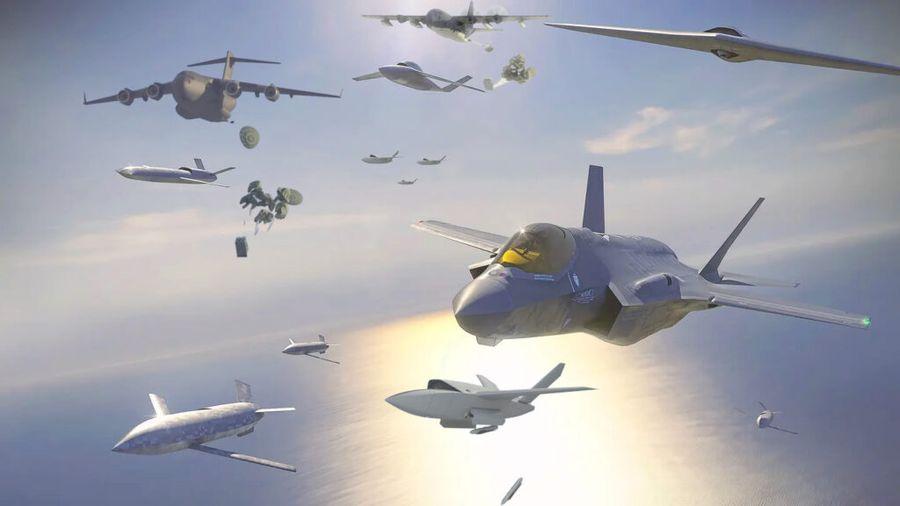
History teaches us that a nation must employ a series of tools and tactics to counter military threats and ensure victory. In the case of fighter jets, America needs a variety of systems in production that each excel at a specific task. Some policymakers within the U.S. Air Force have pushed for the Collaborative Combat Aircraft (CCA) program, for example, a multi-pronged initiative to test, develop and implement new autonomous and manned-unmanned aircraft teaming concepts that would supplement America’s F-35 arsenal. This is a promising development, but some have gone a step further and concerningly suggested that it could also be a potential substitute for designing and producing a sixth-generation fighter. This is not the case.
Others have similarly argued that upgrading the F-35 alone could suffice. But there are drawbacks. The upgrade effort alone could cost $20 billion, negating much in the way of savings, and could take more than a decade to implement at a moment when time is of the essence. It is also important to remember that the F-35 first took flight nearly 20 years ago and American adversaries have had plenty of time to uncover its flaws and develop weapons to defeat it. Additionally, this approach locks the Navy and Air Force into an existing fighter capacity when it has become clear that America would be better served by pushing the technological envelope and providing the different services more fighter diversity.
The fact remains that both systems will be needed, especially as conflict in the Pacific looms. With a sixth-generation fighter, America will get next generation range, payload, survivability, and upgradeability that it doesn’t presently have. The CCA, meanwhile, is seen as a cost-effective and pragmatic solution to maintain a formidable airpower capacity in response to proliferating hostile stealth fighters. Fielded together, they would provide an absolute advantage to the U.S. and its partners in the region.
Leaders at the Pentagon recognize this strategic value of this pairing which is why Air Force Secretary Frank Kendall announced two years ago that the Air Force was ready to transition to the engineering, manufacture and design phase of development for a sixth generation fighter. Unfortunately, budgetary constraints and existing operational challenges have delayed that timeline and at present, the soonest that the sixth-generation fighter could be deployed is at the start of 2030. That’s nearly six years away and counting and risks leaving the United States unprepared to counter the next threat.
While there is a broad consensus that policymakers must find a way to capture control of our federal government’s expenditures, the clock is ticking for next generation fighter development. Just as a household on a tight budget wouldn’t fail to replace its front door if it collapsed or was no longer capable of operating properly, America shouldn’t risk its national security as it works to tackle the large deficits facing the country. If the Pentagon delays production until a new platform is desperately needed, it will already be too late, and Americans of all stripes will pay the price.
Tanner Tharp is a senior fellow with Americans for Liberty and Security

Iran’s Nuclear and Chemical Weapons Threat
By Ben Ollerenshaw • RealClearDefense
Europe’s Rearmament Paradox
By Daniel Darling • RealClearDefense
Pentagon’s Pursuit of Faster Acquisition
By Ben Harris • RealClearDefense
The Army’s AI Cyber Defenders Need a Proven Stand-Down Order
By Gleb Tsipursky • RealClearDefense
After the Silence
By Chase Skylar DeMayo • RealClearDefense
The First Surface Drone-v-Drone Fight
By CDR Salamander, CDR Salamander
Air Force Strengthens F-22 Raptor Combat Readiness in the Pacific
By Global DefenseAfter the Silence
By Chase Skylar DeMayo • RealClearDefense
Underwater Arms Race Puts U.S. Naval Supremacy at Risk
By Tom O'Connor, Newsweek
New Facilities To Pump Out Upgraded F/A-18E/F Super Hornets
By Trevithick, WarZone