
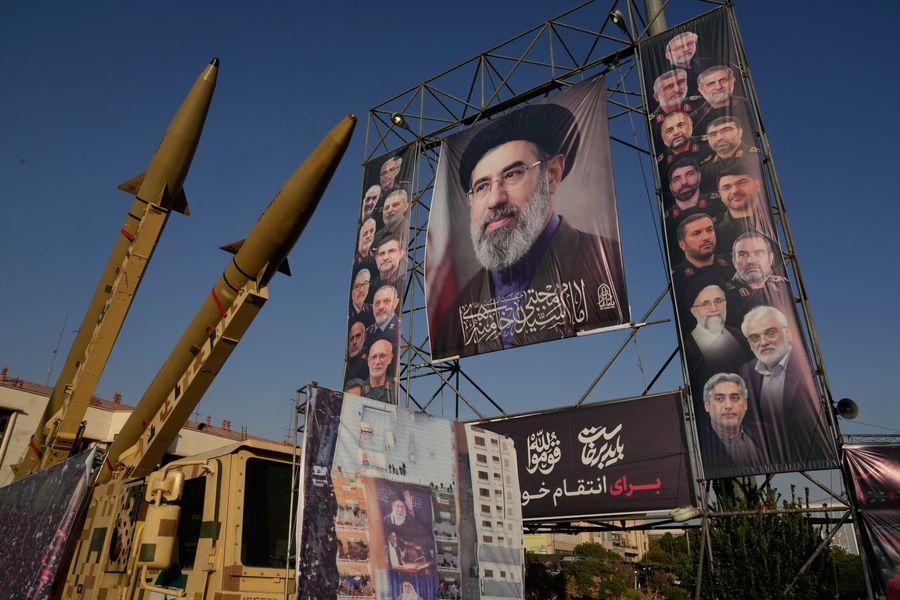
Iranian missiles and banners showing portraits of the Iranian Supreme Leader Ayatollah Mojtaba Khamenei, center, and the late armed forces commanders and nuclear scientists, who were killed in Israel and U.S. strikes, are displayed in a military exhibition commemorating the anniversary of the start of the 1980-88 Iraq-Iran war at Baharestan Square, in Tehran, Monday, Sept. 28, 2026.
Iran’s Nuclear and Chemical Weapons Threat
Published Nov. 14, 2026 • Read time: 16m
Join the Conversation
0On November 12, Iran’s Assembly of Experts, the country’s highest clerical body, urged the Government to consider withdrawing from the Non Proliferation Treaty, (NPT) which prohibits Iran and other non-nuclear signatories from acquiring nuclear weapons, and also prohibits existing nuclear powers from transferring nuclear weapons to other parties.
This statement represents a significant potential shift in official Iranian policy, which until now has generally been to deny that Iran intends to acquire nuclear weapons, and to claim that its current stockpile exists for civilian use only.
A little further back, on October 22, Mohammad-Saleh Jokar, chairman of Parliament's Internal Affairs and Councils Committee, publicly urged the Iranian government to permit the use of nuclear weapons against the US in the event of a US attack on Iran. Jokar’s statement has the probable distinction of being the most explicit and public suggestion of nuclear use by an Iranian public official of some standing so far in this war.
Meanwhile, recent media reports have cited Israeli intelligence that Iran may be considering chemical weapons employment if and when the recent skirmishes with US forces escalate to something more serious.
The obvious question is: what are Iran’s current and near - term capabilities for employing nuclear and chemical weapons?
Of the two, Iranian nuclear capabilities are much better attested in open sources, though much uncertainty remains. When the last IAEA (International Atomic Energy Agency) inspections of the nuclear material took place in June 2025, inspectors were aware of 440kg of 60% highly enriched uranium (HEU) in the Iranian stockpile, which was sufficient to produce up to around five 15 kiloton weapons (roughly equivalent to the bombs dropped on Japan) at the then - current level of enrichment, or up to about 14 weapons if further enriched to 93% concentration.
One May 2026 article states that estimates of the time required to assemble a completed weapon from stockpiled materials range from one month to one year. Either way, there has been more than enough time since the last inspections in June 2025 for the pre - war stockpile, or whatever remains of it, to be converted into completed weapons, assuming that the nuclear material could be physically accessed.
By contrast, there is little public information on current Iranian chemical (and biological) warfare capabilities, and recent media reports have not changed this.
Iranian Nuclear Capabilities
One common misconception about Iran’s nuclear program concerns the term “weapon-grade.” Usually, media reports state that while Iran’s June 2025 stockpile was not “weapons-grade,” it could be rapidly enriched to 90% concentration, allowing for a so - called nuclear “breakout.” Furthermore, it is sometimes added that the 60% enriched Highly Enriched Uranium (HEU) which Iran possessed in June 2025 is “insufficient” to produce nuclear weapons. This is misleading.
In fact, it is entirely possible to produce a relatively powerful nuclear weapon with only the 60% enriched uranium which Iran had already stockpiled prior to US strikes on Iranian nuclear facilities in June 2025. These HEU weapons may be called “devices” or “explosives” rather than “weapons,” but they explode just the same. Enrichment to higher levels provides a greater yield for the same weight, (allowing the weapon to be more easily mounted on a missile,) and provides more weapons per kilogram of fissile material, which would allow Iran to produce more weapons in total. From Iran’s perspective, therefore, enrichment beyond June 2025 levels would have been desirable, but not necessary to obtain a useful nuclear capability.
Similarly, there is no particular need for Iran to use any advanced technology; weapons no more sophisticated than those produced by the US eighty years ago would be minimally sufficient. Given the relatively small size of the known Iranian stockpile, the most effective way for Iran to leverage it in the near - term may be to conduct nuclear blackmail by threatening mass - casualty attacks on civilian targets, rather than attempting to fight and win a nuclear war. In that case, the weapons could be infiltrated to their targets by boat or truck, and even very large and inefficient weapons using 60% enriched HEU would be adequate.
In fact, for the purpose of attacking or threatening the US with a very small arsenal, infiltration is clearly preferable to missile attack. Iran is not known to possess any operational ICBM - range missile which could strike the Continental United States, but even if it did, fourteen ICBMs fired from Iran may well all be intercepted by US missile defenses. By contrast, it is far more likely that, out of five covertly infiltrated weapons, some would reach their targets.
Besides the level of enrichment, the next important variable is the current location and status of the stockpile. On one hand, Iran has had a long interval since the last strikes in April within which to access any material which may have been buried by US attacks; but none of the sources cited above provide any definitive information on this problem.
President Trump, for his part, has consistently maintained that the stockpile has remained buried in place since the initial US strikes in June 2025, and is therefore inaccessible.
“Nobody’s going to get that for a long time unless we want to get it. We’ll get it but we’re the only ones who can,” Mr. Trump said in June 2026.
On November 6, a US CENTCOM post on X advertised a $20 million reward for information pertaining to Iran’s nuclear program, including “facilities, equipment, personnel…or movement of any of the above.”
The final unknown variable is whether or not Iran’s stockpile has been processed into completed weapons. Unfortunately for the US, this part of the process is difficult to detect or prevent – assuming that the stockpile could first be accessed. Unlike uranium enrichment, the fabrication of weapons from already stockpiled uranium can be conducted at a “laboratory scale,” and therefore does not necessarily require large and clearly visible production facilities which may already have been destroyed in earlier US - Israeli strikes. Fabrication may therefore have taken place without US knowledge.
On balance, then, there is sufficient evidence to suggest that Iran might potentially possess somewhere in the region of five to fourteen nuclear weapons, if some or all of the nuclear material has been accessed; or at least the ability to procure them in a relatively short period of time, if not. With that said, the possibility of additional material which was never detected by IAEA inspectors cannot be ruled out.
Implications of Iran’s nuclear capabilities
Neither five or fourteen 15 kiloton weapons would provide Iran with a highly effective warfighting capability against the US or even against Israel alone, (though they could certainly do a lot of damage to important military targets and raise the stakes,) but one weapon of comparable yield detonated in Manhattan might cause something in the neighborhood of 90,000 fatalities and 400,000 injuries, according to one source.
With that in mind, it is easy to see why Iran appears so determined to retain even a small nuclear capability. On November 11, Mohsen Rezaei, Secretary of Iran’s Supreme National Security Council, reiterated Iran’s hard line on its nuclear stockpile, which regime officials have generally maintained over the past several months:
“We will not remove even a particle of enriched uranium from Iran,” he said.
Short of convincing Iran to change that position, there is probably little the US can do about the pre-existing stockpile. Whether enriched to 60%, 90%, or already assembled into completed weapons, it could be buried in any number of holes in the desert; and, even if the entire known pre-war stockpile were handed over, there would be no assurance that there was not more.
Regardless of the status of the pre-existing stockpile, what the US could have reasonably hoped to achieve with a high degree of assurance as of February 2026 was to preclude Iran from attaining a much larger arsenal, capable of threatening massive civilian casualties against the US; or, alternatively, of inflicting such a heavy military cost in a limited war that the US and Israel would be dissuaded from opposing future Iranian expansion. Whether or not this goal is feasible today depends to a large extent on Pickaxe Mountain, the only known major Iranian nuclear site which has not yet been struck.
Pickaxe Mountain
The Pickaxe Mountain complex was still under construction at the start of the war and is now assessed as being partially completed. Whether or not the site is currently capable of enriching uranium, or how long it will take until it is fully operational, is unknown. In July 2026, it was reported that Israeli intelligence believed centrifuges and other equipment had been moved to the site.
In the past, President Trump has signaled that the US may strike the complex, but more recently he has downplayed the possibility. In a November 8 interview, the President told CBS that strikes were unnecessary for the moment, but left the door open for future action.
“If we needed to do Pickaxe, which we don't at this moment, we would have that done in one hour, it would be taken care of,” Mr. Trump said.
"There's been very little activity there. They have other problems. They're not lookin' at Pickaxe Mountain."
Although these statements imply that the US has not attempted to strike Pickaxe Mountain because it does not need to, another potential explanation is the great difficulty of damaging the complex, which is buried deep underground.
There is no reliable unclassified source for exactly how deep the complex is buried: media reports range from about 100m to 600m. In both cases, attacks by non - nuclear weapons could perhaps seal exits, damage ventilation, and generally exploit weaknesses in the facility, but would probably not put the facility out of commission for a very long period of time (i.e. months or years,) assuming vigorous repair efforts. In order to more permanently disable the complex, the US would likely need to use its own nuclear weapons.
If the depth of the complex is closer to 100m, then even a relatively small nuclear burst by an Earth Penetrating Weapon (EPW, or “bunker - buster”), yielding around ten kilotons may be sufficient to severely damage it. If, on the other hand, the complex is 600m (2,000ft) deep, then even America’s most effective nuclear weapons may not be enough.
The only US EPW currently in service, the B-61-11, would likely not be sufficient to collapse hardened tunnels at a depth of 600m even at its maximum yield of 300+ kilotons, although sensitive machinery inside the tunnels might conceivably be affected. In the early 2000s, the US attempted to develop more effective EPWs under the Robust Nuclear Earth Penetrator program (with precisely this kind of operation in mind,) but the program fizzled out due to Congressional opposition.
Either way, given the high priority which the US and Israel have attached to the disruption of the Iranian nuclear program, it seems reasonable to assume that anything which the Allies could hope to achieve against Iran’s known nuclear production facilities using non - nuclear weapons would have already been attempted in previous rounds of fighting. Since Pickaxe Mountain has not yet been struck, it is reasonable to conjecture that non- nuclear strikes would not achieve very decisive results.
Nevertheless, the US has not threatened to use its own nuclear weapons at any time in this war so far. On several occasions, President Trump has explicitly ruled out a nuclear strike against Pickaxe Mountain.
“I wouldn’t use nuclear. We don’t have to,” the President told Newsmax on October 15.
Trump has previously expressed his blanket opposition to any nuclear use; an unusually strong position for a US President to take.
“A nuclear weapon should never be allowed to be used by anybody,” he said in April.
Nevertheless, the Iranians do not appear to be taking him at his word. On November 6 it was reported in the Times that Iranian authorities were distributing iodine tablets and survival advice, though both of these measures would also be useful precautions against contamination which might result from non - nuclear strikes on nuclear facilities.
“If America does not use a nuclear weapon against Pickaxe Mountain, it will be a miracle,” one anonymous Iranian source said.
A nuclear strike against Pickaxe would cause some fallout in the vicinity of populated areas, which would likely lead to significant civilian casualties, depending heavily on the wind. One recent source using the standard WSEG - 10 model provides a very approximate range of 3,500 (typical) to 11,200 (worst - case) fatalities for a single 360 kiloton (maximum yield) burst in November, compared with 400 to 10,900 fatalities for a single 10 kiloton burst. Worst case injuries (i.e., nonlethal radiation sickness, which may range from very mild to severe) are estimated at 27,000 for a ten kiloton or 155,000 for a 360 kiloton burst.
These should probably be considered high - end estimates, as they ignore the effects of sheltering and / or postattack evacuation. In reality, fallout takes some time to arrive, and during this time people can either evacuate or shelter in place. One source suggests that sheltering in place may reduce casualties by around two to eight times for comparable targets.
By comparison, total civilian casualties in the war so far total around 3,400 dead and ~33,000 wounded, according to Iranian authorities; most open sources approximately agree with the fatality count, although this agreement might be due these sources relying in turn on Iranian government sources.
Chemical and Biological Weapons
There is no solid information in public sources on current Iranian chemical and biological warfare (CBW) capabilities. Prior to the present war, US intelligence assessed that Iran “very likely” intended to continue research and development of chemical and biological weapons for offensive purposes, but, unlike the nuclear stockpile, nothing substantial is publicly known about Iran’s already existing stockpile of CBW agents.
Recent reporting suggests that Israeli intelligence considers Iranian chemical capabilities to be a major concern; the New York Times, for instance, has reported that Israeli officials have “portrayed the chemical weapon threat as more urgent than Iran’s ambitions to develop a nuclear weapon.”
However, Israeli intelligence’s corresponding assessment of the status of Iran’s nuclear program was not reported, and neither were any details of the underlying intelligence concerning Iranian chemical capabilities.
It has also been reported that some US and Arab officials were skeptical of the Israeli assessment, although the justifications for their skepticism are, again, unclear.
The last time Iran is thought to have used chemical weapons in combat is the Iran - Iraq War of 1980 - 88, when Iran first developed infrastructure for the production of these weapons.
Ilan Berman, Senior Vice President of the American Foreign Policy Council and an Iran expert, said that Iran likely retains both the capabilities and the production capacity developed during the Iran - Iraq War.
“The assessment is that they still have the chemical weapon agents,” Berman said.
“So it’s everything from blister agents, choking agents, nerve agents, what have you; and the means to weaponize them.”
Moreover, according to Berman, US and Israeli strikes have largely overlooked dual - use facilities which form the basis of Iranian research and production infrastructure for both chemical and biological weapons.
“The Iranian chem-bio infrastructure is very much dual-use,” he said.
“What you have is pharmaceutical companies that can then essentially create dual use precursors that can then be used for bio and chem.”
“That infrastructure is mostly [still] in place.”
According to the US State Department, Iran has not complied with the Chemical Weapons Convention since at least 2018.
Iran has in the past publicly denied having any chemical weapons. This is, however, only the official party line. For context, Iran has also long officially maintained that its nuclear program is intended for civilian purposes only, while simultaneously permitting IAEA inspections which verified that its nuclear stockpile was enriched to a level useful only for nuclear weapons. Similar statements with regards to non-possession of chemical weapons should therefore not be taken at face value.
Recent media reports have cited claims by Israeli intelligence that Iran may now be considering the employment of chemical weapons in the next round of fighting. However, unlike Jokar’s October 22 nuclear quote, as yet there have been no official statements from regime sources suggesting or threatening chemical weapons employment.
Two anonymous sources, one current and one current former Iranian official, told the NYT that Iran would not use chemical weapons unless it was first attacked by nuclear weapons.
As with nuclear weapons, using chemical / biological weapons to simply kill (or threaten to kill) civilians is much easier than using them to effectively fight a war. If Iran possesses any militarily significant CBW stockpile – even a small residual one – that stockpile could probably be employed for terror attacks on civilian populations, but whether or not it could be used effectively against military targets depends on the size of the stockpile and availability of delivery systems, all of which are unknown in open sources.
Bottom Line
Until recently, Iran maintained a policy of deliberate ambiguity regarding its nuclear program; the November 12 statement by the Assembly of Experts marks a potential shift in this policy. The current status of Iran’s nuclear stockpile – whether enriched to 60%, 90%, or assembled into completed weapons – remains unknown, and essentially nothing concrete is known in open sources about current Iranian CBW capabilities.
However, this does not mean that the present situation is comparable to the Iraq War of 2003, when pre-war claims as to Iraq’s nuclear and other WMD capabilities turned out to be unfounded. Unlike Iraq in 2003, the existence of Iran’s pre-war nuclear stockpile is not disputed, either by Iran itself or by independent sources. Though its current status is unknown, that stockpile required no further enrichment beyond June 2025 levels to produce several relatively high - yield nuclear weapons, which could at least be delivered against civilian targets by covert infiltration, if not by missiles.
The interval in high - intensity combat operations since April 2026 has provided Iran with a substantial window within which to access any accessible nuclear material, conduct further enrichment (if possible,) and assemble completed weapons. However, there is no proof that any of these steps have actually been completed; and we are not likely to see conclusive proof unless and until Iran tests a completed weapon. Threats of Iranian nuclear use therefore appear fairly credible, if unsubstantiated. Iranian chemical and biological capabilities, by contrast, remain a mystery for now.
Ben Ollerenshaw is a journalist specializing in defense matters. He may be contacted at [email protected]
Iran’s Nuclear and Chemical Weapons Threat
By Ben Ollerenshaw • RealClearDefense
Europe’s Rearmament Paradox
By Daniel Darling • RealClearDefense
Pentagon’s Pursuit of Faster Acquisition
By Ben Harris • RealClearDefense
The Army’s AI Cyber Defenders Need a Proven Stand-Down Order
By Gleb Tsipursky • RealClearDefense
After the Silence
By Chase Skylar DeMayo • RealClearDefense
The First Surface Drone-v-Drone Fight
By CDR Salamander, CDR Salamander
Air Force Strengthens F-22 Raptor Combat Readiness in the Pacific
By Global DefenseAfter the Silence
By Chase Skylar DeMayo • RealClearDefense
Underwater Arms Race Puts U.S. Naval Supremacy at Risk
By Tom O'Connor, Newsweek
New Facilities To Pump Out Upgraded F/A-18E/F Super Hornets
By Trevithick, WarZone