
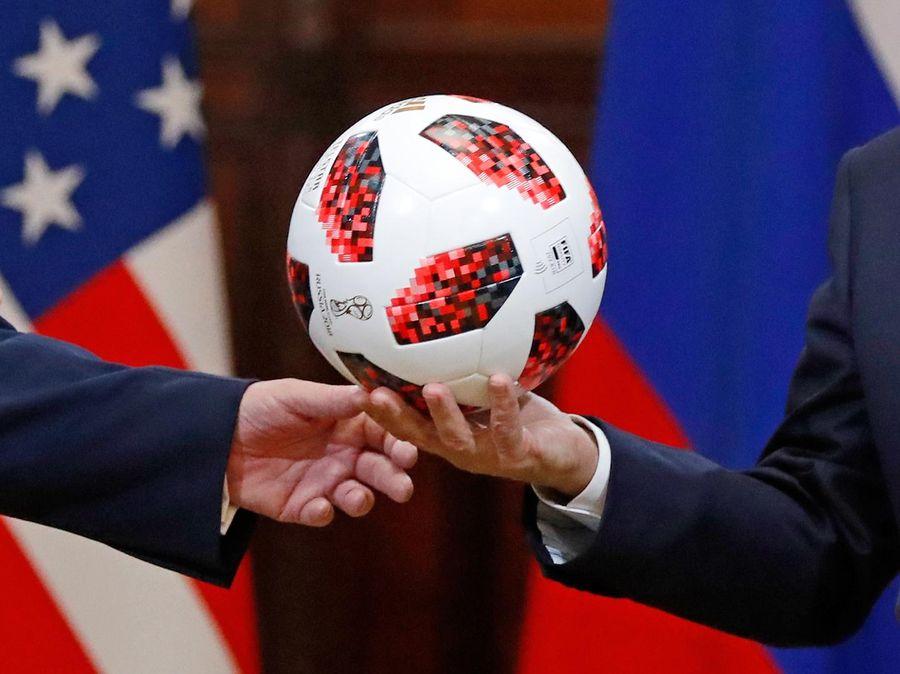
Both Parties Stuck in the Cold War
Published July 17, 2018 • Read time: 6m
Why Trump and Obama Have the Same Russia Policy
"1980s are now calling to ask for their foreign policy back..." – Barack Obama 2012
President Obama’s snotty swipe at Mitt Romney was his way of saying that he did not think that Russia was our enemy. What he did not consider was that his Russia policy was simply the flip side of the same coin as Romney’s. Both over-assessed Russian relevance. And now President Trump is doing the same.
Of course, the Trump administration insists their Russia reset is not a reset because Trump called for raising NATO defense spending targets to 4%.
It is a distinction without a difference. Both lend undue relevance to what in reality is a third world dump. Both policies are predicated upon Cold War assumptions of Russian strength.
Yes, Russia information warfare is a real and serious threat. The U.S. needs to respond. The same applies to the shameful part that Russia played in the downing of MH17 (the anniversary of which is Tuesday). But that kind of behavior makes Russia a threat and a menace, not a superpower deserving of presidential attention or additional carrier strike groups.
Nonetheless, Obama and Trump have simply taken Putin at his word that Russia is back. But let’s take a look under Russia’s hood.
The Russian military contractor Wagner’s attempted ambush of U.S. forces in Syria in February is a good place to start. Moscow claims that Wagner is Russia’s Blackwater analog--a company of retired soldiers. Yet, Wagner is not just comprised of retired soldiers. Its cadre is “retired” Spetsnaz GRU, Russia’s most highly-trained soldiers. They were the “little green men” in Crimea; they fought with the “separatists” in the Donbas, and they had thousands of soldiers in Syria. They are not Blackwater but the point of the Russian spear.
Preventing Foreign Cultivation
China Is Building an AI System for Tailoring Its Foreign Propaganda
Open Models Are Becoming a Tool of Chinese Statecraft
Maduro Is Gone, but His Surveillance State Has a Chinese AI Upgrade on Order
Putin wanted Wagner to announce Russia’s return to the world stage, but we wiped out 100 to 300 of them in four hours.
Consider Wagner’s background: It is run by a former hot dog stand purveyor who is now a billionaire largely because he is from Putin’s St. Petersburg. Wagner, which trains on at a government-run GRU base, was uncovered by reporters who snuck into Wagner’s training cycle with a video camera.
This slaphappy nonsense is not an outlier.
The Russian Navy’s capital ship–a navy’s most important ship–the aircraft carrier Admiral Kuznetsov, smokes like it is on fire, must be accompanied by a tugboat and lost multiple jets during a PR stunt deployment to Syria. Still, the U.S. reactivated the Second Fleet to defend against this supposed threat.
Russia’s 5th generation stealth fighter has been panned as “an overpriced 4th generation fighter.” It is so bad, codeveloper India refused to buy any.
However, Russia’s military weakness is not what defines its Lilliputian status, e Everything else does. Its GDP is $1.3 trillion, similar to Spain’s, a country with 98 million fewer people and no oil.
Russia’s banking sector groans under the weight of Putin’s corruption. Three of its top ten banks have recently collapsed because they were corrupt pocket banks for Russia’s oligarchs.
After the Trump administration sanctioned Oleg Deripaska, a strong Russia would have responded accordingly. Russia’s Duma threatened to ban foreign-made pharmaceuticals, which mainly hurts Russians. Russia is a net pharmaceutical importer, with only 2% of Russians inflicted with drug-resistant TB having access to modern treatment.
Russia’s birth rate is not high enough to replace its aging population, “aging” not “elderly” because the latter rarely applies. Russian men only have a 66-year expected lifespan, a figure topped by North Korean males’ 67-year lifespan.
But, apparently, Russia the great power is back.
Pyotr Stolypin supposedly said, “In Russia, everything can change in a decade, but nothing will change over the course of 200 years.” After the Soviet Union collapsed, U.S. officials realized that the Iron Curtain had been camouflaging a bag of bones version of the Russian empire. It was not the fearsome foe we had thought.
That bag of bones then suffered 30 years of economic torment on top of 70 years of Communist maladministration.
It beggars belief that U.S. policymakers leap to the conclusion that the “Upper Volga with Rockets” is again a great power, even though it is a vodka-soaked basket case. Putin and his cronies have stripped the country bare. 75% of Russian wealth is offshore. Russia is just our 30th largest trade partner, but, today in Helsinki, Trump set aside time to discuss the U.S.-Russian economic and trade relationship. Obama did the same thing.
It is no accident that Potemkin was Russian. Both Trump and Obama fell for it, and the policies are kissing cousins, as a result.
Russia is a country so feeble that we should question its viability. Russia analysts should be preparing for when Putin’s mafia lieutenants take him out, or when China pushes on an open door to claim a little Siberian lebensraum.
Instead of reactivating the Second Fleet, we should build up our information warfare capabilities, which, heretofore, we have mainly addressed by shoveling money at the State Department.
If Trump wants the NATO allies to “pay more,” then threat perception is the coin of the realm. Russia’s information warfare is clearly a major threat. NATO should unequivocally defend against it. Trump, nevertheless, downplays the threat.
We should not be stroking Putin’s ego. If he demands a meeting, he should not get a meeting with the president, and he certainly should not be allowed to hold court over U.S. Senators on July Fourth. And under no circumstances should he be given a 1980s throwback summit in Helsinki that recalls the Soviet Union’s salad days. That is just embarrassing.
A weak Russia offers us nothing, and there is nothing–nothing–we want from it. So why do presidents keep offering these resets (the fundamental principle of which is Blame America First)? When Russia misbehaves, the proper response is a swift kick in the teeth, not a presidential summit where Putin can soak in the concessions that gullible U.S. presidents thrust in his face.
The 1980s would never call to inquire about today’s Russia. Thinking otherwise is either shockingly poor analysis or partisan hackery dressed in analytical drag. Either way, Putin is pleased.
Kristofer Harrison was a senior official for Defense Secretary Donald Rumsfeld and Secretary of State Condoleezza Rice and was a foreign policy adviser to Sen. Ted Cruz’s presidential campaign.

Batteries Can Power a Win for America in Super Intelligence
By Manisha Singh • RealClearDefense
Poland’s Fighter Fleet Is Growing: Can Its Training System Keep Up?
By Bruce Allen Lubbering • RealClearDefense
Why Iran is Not Vietnam
By Kevin Brown • RealClearDefense
Closing the Missile (Defense) Gap
By Jason Camilletti • RealClearDefense
Part of a Larger Secret, Hidden World
RealClearDefense

Sign of the Times: CCAs Dominate a Major Fighter Conference
By Bill Sweetman • The Strategist (ASPI)Closing the Missile (Defense) Gap
By Jason Camilletti • RealClearDefense
U.S. Navy Prepares for Third Zumwalt Hypersonic Upgrade
By C. Johnston, Naval N.
Pearl Harbor Hero Doris Miller Will Stay Namesake of CVN-81
By Mongilio, USNI News
Navy CCA Plans Will Not Wait For F/A-XX Next Generation Fighter
By The WarZone