
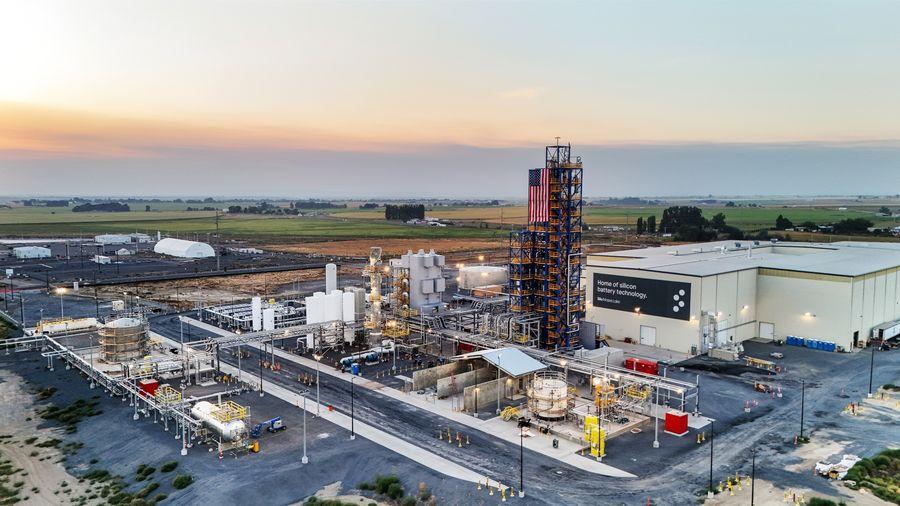
Sila, a leading battery technology and materials company, announced a commercial offtake agreement with Panasonic Energy Corporation of North America.
Batteries Can Power a Win for America in Super Intelligence
Published Nov. 23, 2026 • Read time: 5m
America’s ability to stay ahead of China in the deployment of Super Intelligence (SI) will be centered around having cost-efficient energy sources to power SI data centers. One of the leading sources increasingly utilized by data center developers and operators are batteries capable of providing flexible and fast electricity. A recent report by energy consultancy Wood Mackenzie found that, across all 43 markets studied, batteries capable of supplying four hours of electricity are the lowest-cost form of new dispatchable power.
This report is the latest sign that batteries should be considered part of the solution to the challenge of reliable, stable electricity sources needed in the SI race. Electricity is stored when there is excess electricity on the power grid and released when demand spikes and power supply is scarce. Therefore, existing power sources are effectively utilized while new sources are explored and built. By reducing strain during peak demand, batteries can also limit the need for costly infrastructure built to handle just a few hours of extreme demand each year. They won’t replace the need for new power generation, but they can help existing resources go further.
Batteries also work well with all types of power generation, including natural gas. While gas plants supply power for long stretches, batteries respond quickly to swings in demand, including the sudden changes in electricity use that increased demand can create. Used together, they can help make the grid more flexible and reliable.
The World Cup Is Over. The Drone Threat Isn’t.
ICE Is Not a Four-Letter Word
America Needs a Joseph Directive
The Underground Cloud
Some data center developers are already utilizing these principles. In Michigan, DTE is building six battery storage projects to better utilize its entire fleet of power plants and ensure reliable, affordable electricity despite a 25% jump in demand for power from just one data center project. The energy storage projects are using batteries manufactured in Michigan from LG Energy Solution, and are key to delivering a rate freeze for Michigan ratepayers.
In addition to providing cheap, reliable power, the battery storage industry is helping drive one of the fastest and largest manufacturing growth stories in America today. Historically, China has controlled the vast majority of the world’s battery-making capacity, but that’s quickly changing. As America builds the power it needs to fuel new large infrastructure, we need to continue to build our domestic battery supply chain -- we cannot afford to depend on China.
While progress is rapidly being made, there are still key chokepoints that require smart industrial policy and government reform. China refines more than 90 percent of the graphite used in battery anodes. In late 2025, Beijing began requiring export licenses for advanced battery cells, cathode materials, synthetic graphite anodes, and the machinery used to make them. That followed an earlier round of graphite export restrictions in 2023. Though this requirement has been suspended, it demonstrates the sword of Damocles held by Beijing in this area.
Right now, the largest impediments to bringing battery material refining capacity on shore are the U.S. federal government’s lengthy and outdated permitting processes and red tape. If enacted, the Bipartisan American Affordability and Jobs Act of 2026 (BAAJA) would make sweeping changes to streamline permitting that could enable the build out of this critical domestic capacity.
These reforms would come on top of the many steps the Trump Administration has taken to address the potential risk that is posed by dependence on China. The One Big Beautiful Bill Act ties certain storage tax credits to restrictions on Chinese-controlled suppliers. And manufacturers are converting idle electric-vehicle cell lines into battery-storage production, an encouraging step toward building domestic capacity. The battery industry’s trade group says that much of the U.S. battery storage supply chain could be manufactured domestically within the next several years.
Battery and storage installations keep climbing too. The first quarter of 2026 set a record at 3.3 gigawatts, beating the previous first-quarter high by 54 percent. The second quarter set another record in energy terms, and new systems are now built to discharge for longer. Meanwhile, the price of grid-scale systems continues to fall.
Washington can keep this momentum going by taking three key steps. First, it should provide clear and predictable implementation of the sourcing rules because factories take years to build and investors need a degree of certainty. Next, it should move grid-relieving storage projects to the front of the line for permits and connections. It should expand investment in domestic graphite processing, an area where America is currently very exposed, and ensure storage can compete fairly with other technologies in providing grid reliability services. Lastly, Congress should rally to pass BAAJA, legislation that would dramatically improve how we build all infrastructure in the U.S. -- including the battery supply chain.
SI development is a race America can’t afford to lose, especially to China. Batteries can help get more out of existing electricity supply while new infrastructure is built. This advantage, however, will always be fragile and at risk if Beijing controls the supply chain. The Trump Administration has taken important steps to reduce America’s dependence on Chinese battery suppliers. The next challenge is ensuring that those steps are matched by the necessary regulatory reform, investment, and industrial policy needed to build a competitive domestic industry.
Manisha Singh served as assistant secretary for Economic and Business Affairs at the U.S. State Department (2017-2021) and as acting undersecretary for Economic Growth, Energy, and the Environment during President Trump’s first term.
Batteries Can Power a Win for America in Super Intelligence
By Manisha Singh • RealClearDefense
Poland’s Fighter Fleet Is Growing: Can Its Training System Keep Up?
By Bruce Allen Lubbering • RealClearDefense
Why Iran is Not Vietnam
By Kevin Brown • RealClearDefense
Closing the Missile (Defense) Gap
By Jason Camilletti • RealClearDefense
Iron Raven: Remembering Colonel Joseph B. Conmy, Jr.
By Louis Marano • RealClearDefense
Closing the Missile (Defense) Gap
By Jason Camilletti • RealClearDefense
Marine Corps Hero Under Federal Investigation
By Laporta, Burnham & Watson, CBS
A Postmortem of Maneuver Warfare in the U.S. Marine Corps
By Donald Vandergriff
U.S. Putting Weapons in Space: A Strategic Blunder?
By Ajey Lele • RealClearDefense
U.S. Senate Seeks to Exchange Shipbuilding Funds for More Munitions
By Naval News