
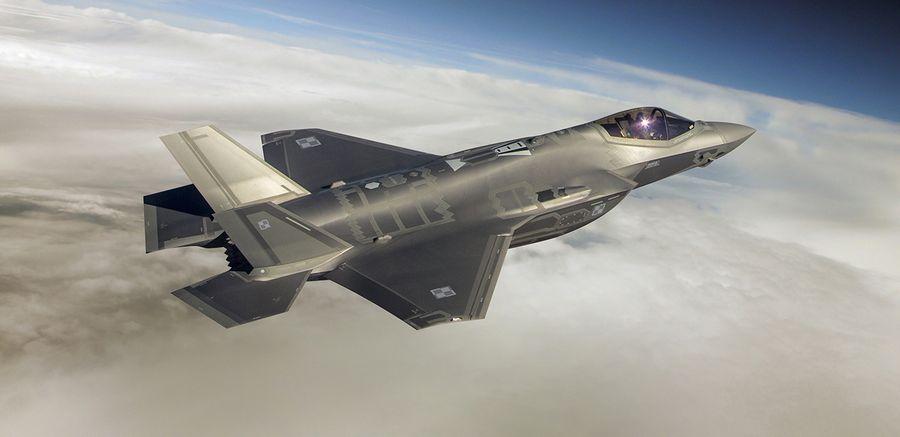
Poland's first F-35A "Husarz" was revealed during a rollout ceremony at our Lockheed Martin Aeronautics facility in Fort Worth, Texas, on Aug. 28, 2024.
Poland’s Fighter Fleet Is Growing: Can Its Training System Keep Up?
Published Nov. 23, 2026 • Read time: 6m
Poland is in the middle of a major air force rebuild. Its first F-35s arrived at Łask Air Base in May 2026, and ten aircraft of the 32 on order were in the country by late October. Warsaw has also purchased 48 Korean FA-50 light combat aircraft. But a growing question surrounds these investments: Can Poland train enough pilots to turn its expanding fleet into operational squadrons?
Poland has a training plan built around its M-346 Bielik advanced trainer, the FA-50GF Light Fighter/Trainer and F-35 conversion training in the United States. It is also preparing changes to its military aviation education system. The challenge is whether these efforts can produce enough qualified pilots to keep pace with the aircraft arriving over the next several years.
A Fleet Arriving on a Tight Schedule
The FA-50 purchase of 48 includes 12 FA-50GF Light Fighter/Trainer aircraft which are already serving in an operational role, and 36 more capable FA-50PLs. Deliveries of the PL version have slipped due to licensing issues with advanced missiles. With those issues resolved, an amended contract moved the first deliveries to mid-2027, with completion expected in early 2029. Operational Commander General Ireneusz Nowak said nine aircraft should arrive between July and December 2027.
These schedules matter because receiving aircraft and establishing combat-ready squadrons are two different milestones. Pilots need time to become familiar with new equipment, weapons, and operating procedures. Poland must also maintain its existing F-16 force while preparing crews for two new fighter types.
Europe’s Rearmament Paradox
The Gulf of Finland’s Forgotten Islands
Seoul's Defence Pivot to Europe
Why Europe Cannot Defend Itself
How Many Pilots Does Poland Need?
There is no publicly verified figure establishing Poland's total fighter-pilot requirement. The number depends on squadron organization, aircraft availability, readiness goals, and the number of experienced pilots remaining in service.
A recent report by Rzeczpospolita raised concerns about the F-16 fleet, claiming Poland had approximately 40 qualified pilots for 47 aircraft. The newspaper suggested that at least 70 would be needed.
However, Poland's Ministry of National Defence disputed those figures on October 29. The ministry said the country had more F-16-qualified pilots than the newspaper reported, but declined to publish an alternative number, citing the sensitivity of personnel information.
The disagreement illustrates the difficulty of assessing Poland's actual pilot strength. Neither the unofficial estimate nor the government's response provides a complete picture of how many pilots are available for operational assignments.
The broader challenge remains. Poland must staff its expanding Western-equipped fleet while replacing pilots who retire, leave military service or transfer to new aircraft. Moving an experienced F-16 pilot to the F-35 program helps establish a new capability but does not necessarily increase the air force's overall pilot strength.
Dęblin: Poland Is Changing Its Training System
Poland's advanced jet-training system centers on the Leonardo M-346 Bielik, operated through the Polish Air Force Academy at Dęblin.
The system has received U.S. Air Force certification for preparing pilots for fourth- and fifth-generation fighters. Poland has invested in simulators and advanced instruction to reduce its dependence on foreign training.
But officials increasingly recognize that the training process itself needs improvement.
In 2026, the academy began implementing changes intended to make flying instruction more continuous and efficient. A broader reform is planned for 2028, when students are expected to complete a more concentrated period of academic instruction followed by continuous practical flying.
The objective is to reduce interruptions between training phases, eliminate unnecessary duplication and make better use of available flying time. The reforms also emphasize practical military aviation skills rather than simply accumulating flight hours.
Operational pilots are expected to contribute more directly as instructors and mentors, bringing experience from frontline units into the training system.
These changes could improve the number of students moving through the pipeline, but their actual results remain to be demonstrated.
Warsaw Evaluates Two Turboprops to Modernize Pilot Training
Another important development involves the aircraft used before students reach advanced jet training.
Poland is evaluating replacements for its aging PZL-130 Orlik turboprop trainers. The two candidates identified by General Nowak are the Swiss Pilatus PC-21 and Brazil's Embraer A-29 Super Tucano.
The military has conducted demonstration flights and evaluated the aircraft and their training systems. The objective is to find a platform better suited to preparing pilots for modern fighters, including the F-35 and upgraded F-16. No final selection or purchase contract has been announced.
This is significant because the training bottleneck may begin well before a student reaches the M-346. Improving the basic and intermediate stages could help Poland move more candidates into advanced jet training.
The United States Provides an Important Training Link
Poland’s F-35 training program is taking place in the United States and covers 24 Polish pilots and about 90 ground personnel. Eight Polish F-35s have been assigned to Ebbing Air National Guard Base in Arkansas, where the pilots are learning to fly the aircraft. Some are also receiving instructor training, a key step toward building Poland’s own F-35 training capability.
Ebbing is not a Polish facility. It is an international training center that serves several F-35 customers, and Poland was its first foreign user. The base was originally planned to host 24 F-35s from various nations, along with 12 Singapore Air Force F-16s. As more countries bought the F-35, that plan grew. The Air Force finished an environmental review clearing the base for a total of 36 F-35s and 12 F-16s, and it formally approved the expansion in June 2026. The extra twelve jets come with new infrastructure and training facilities, including 600 additional personnel by 2029 and a vertical landing pad for the F-35B.
The expansion does not mean Poland receives all the added capacity. Ebbing serves many customers, and part of the growth exists to make room for newer F-35 buyers. Even so, the larger center gives every participating country more room to train.
Developing Polish instructors is particularly important. Eventually, Poland will need to run more of its own conversion and continuation training rather than rely on overseas instruction.
The FA-50PL and the Next F-35 Squadrons
The FA-50PL should improve Poland's light fighter capabilities, through its planned PhantomStrike active electronically scanned array radar and expanded weapons options.
As these aircraft enter service, they could reduce some operational demands on the FA-50GF fleet. However, their arrival will not immediately solve training shortages. Pilots and maintenance personnel must first become familiar with the new configuration.
The longer-term challenge could become larger.
In June 2026, Defense Minister Władysław Kosiniak-Kamysz announced that Poland's military development program through 2039 includes plans for two additional F-35 squadrons. If implemented, the proposal would increase the planned fleet from 32 to 64 aircraft.
The Real Measure Is Pilot Production
Poland did not purchase its new fighters without planning for pilot training. Its certified Bielik system, American F-35 instruction and planned reforms provide a substantial foundation.
It is also addressing weaknesses earlier in the training pipeline by examining new trainer aircraft and changing how students receive instruction.
But the central question remains unanswered: How many qualified fighter pilots can Poland produce each year, and how many will remain in service?
Poland is investing heavily in modernizing its air force. Its next challenge is ensuring that enough trained pilots are available to fly the aircraft it is buying.
Bruce Allen Lubbering held several management positions with aerospace manufacturing companies in a career that lasted over 30 years.

Batteries Can Power a Win for America in Super Intelligence
By Manisha Singh • RealClearDefense
Poland’s Fighter Fleet Is Growing: Can Its Training System Keep Up?
By Bruce Allen Lubbering • RealClearDefense
Why Iran is Not Vietnam
By Kevin Brown • RealClearDefense
Closing the Missile (Defense) Gap
By Jason Camilletti • RealClearDefense
Part of a Larger Secret, Hidden World
RealClearDefense
Closing the Missile (Defense) Gap
By Jason Camilletti • RealClearDefense
Marine Corps Hero Under Federal Investigation
By Laporta, Burnham & Watson, CBS
A Postmortem of Maneuver Warfare in the U.S. Marine Corps
By Donald Vandergriff
U.S. Putting Weapons in Space: A Strategic Blunder?
By Ajey Lele • RealClearDefense
U.S. Senate Seeks to Exchange Shipbuilding Funds for More Munitions
By Naval News