
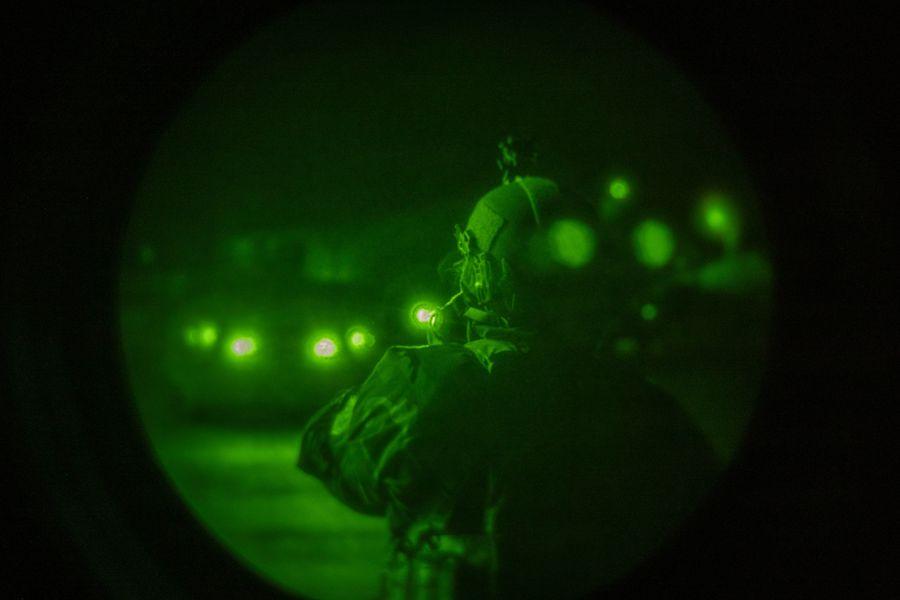
A U.S. Air Force Airman assigned to the 8th Fighter Wing, directs a Humvee during a security sweep amid a simulated small unmanned aerial system and ground attack scenario as part of exercise Beverly Sentinel 27-1 at Kunsan Air Base, Republic of Korea. Training scenarios are focused on defensive maneuvers and infrastructure protection to reinforce the capacity to safeguard personnel and assets against potential threats in a simulated wartime environment. (U.S. Air Force photo by Staff Sgt. Tabatha Chapman)
Closing the Missile (Defense) Gap
Published Nov. 23, 2026 • Read time: 5m
Join the Conversation
0The past year has seen the Air Force conduct one of its most comprehensive air campaigns in recent memory. Throughout the 38 days of Operation Epic Fury, it sustained an average of 250 sorties per day, enabling it to strike thousands of Iranian targets.
But beneath the surface of these successes lies a disquieting record of destructive Iranian strikes against Air Force bases across the Middle East.
Using a mix of cruise missiles, ballistic missiles, and drones, Iran has repeatedly penetrated the Army’s air-defense systems meant to shield American airbases from incoming fire. These attacks have inflicted widespread damage on the infrastructure and facilities of air bases throughout the region.
And the reach of Iranian attacks has not been limited to static targets. More than a dozen Air Force aircraft have been damaged by Iranian strikes while stationed on the ground at airbases.
The vulnerability of U.S. airbases to Iranian fire is, unfortunately, a core feature of modern combat. The proliferation of precision munitions has allowed America’s adversaries to stockpile missiles and drones in volumes large enough to overwhelm the Army’s current air-defense capabilities.
This can’t continue. To ensure American air bases can keep generating combat airpower in the face of these threats, Congress must fully fund the Air Force’s $1.4 billion FY2027 budget request for air base air defenses.
The damage inflicted upon U.S. air bases during the conflict with Iran can’t compare with the much greater scope of destruction that a potential future war with China might bring. The PLA has devoted considerable attention and investment toward constructing a robust anti-access/area denial (A2/AD) network that envelops the first island chain. Upon the outbreak of conflict with the U.S., Chinese forces could attack American air bases across the Western Pacific with their expansive stockpiles of ballistic missiles, cruise missiles, and drones.
The Clearance Myth Is a Readiness Problem
U.S. and Venezuela Sign a Deal To Reestablish Military Ties
Defense Acquisition and Construction Must Move Together
Prediction Markets Are Becoming a New Frontline for Military Operational Security
Such a mass of coordinated fire would pose a significant problem for Air Force assets stationed along the first island chain. The network of air bases that may be used in a conflict against China occupy an expansive geographical footprint encompassing large swaths of the Western Pacific. This dispersion, paired with China’s intense targeting, demands substantial air defense coverage exceeding that required during operations against Iran or any other adversary the United States has confronted in recent decades.
If the Air Force enters a war in the Western Pacific still solely reliant upon Army-provided air defense, its bases may be battered by China’s intense long-range targeting campaign.
The Air Force’s air bases in the Western Pacific may be subjected to barrages of missile and drone attacks that could impose crippling infrastructure and airframe attrition upon the installations. These successful A2/AD efforts may starve the Air Force of refuges to generate combat sorties from.
Despite past agreements, the Army has been reluctant or unable in recent decades to dedicate the resources necessary for air base defense against an adversary the magnitude of China. This track record, comprising shortfalls in interservice commitments and program cancellations in favor of redirecting funding toward higher-priority items, was forged in an era devoid of high-intensity conflict. A war against China in the Pacific will further exacerbate the divergence between Air Force and Army priorities and stress the existing air defense capability shortfall.
The result of these institutional dynamics will be a network of Air Force bases and combat aircraft dangerously exposed to incessant Chinese fires at the outset of conflict in the Pacific. Consequently, the Air Force must be given the resources needed to stand up independent air defense capabilities for its bases while not having to sacrifice other priorities.
The Air Force provides the U.S. with a potent ability to rapidly mass and project combat power against adversaries around the world. This Air Force capability will be essential in the early stages of a conflict with China, a time when the bulk of Marine, Navy, and Army forces will still be staging in or in transit to the region.
However, Chinese long-range strikes on underdefended air bases may successfully paralyze U.S. combat air operations along the first island chain for an extended period. Such a failure to sustain adequate combat sortie generation rates may cripple the initial U.S. response to Chinese aggression in the Pacific, putting in jeopardy the success of the larger campaign across the region.
A lost ability to operate from forward air bases within the first island chain cannot easily be replaced. Using tankers to ferry combat aircraft from far-flung bases to the first island chain, while not unprecedented, would tie up a prohibitive portion of the Air Force’s tanker fleet. It would also hamstring sortie generation rates by forcing strike packages to transit vast distances to and from the combat zone before returning to base.
The Air Force has requested $1.4 billion as part of its FY2027 budget to develop new Air Base Air Defense Systems (ABADS). This topline will provide funding for defensive capabilities that can defeat threats spanning from small enemy drones to missiles.
Such a mission set will be essential to addressing the gaps left by the U.S.’ overstretched and overburdened air defense network. While the Army grapples with depleted munitions reserves and competing priorities, the Air Force must be able to ensure its air bases are protected by resilient defenses in the face of large-scale attacks by precision munitions.
Winning a future war in the Pacific will depend heavily on the Air Force’s ability to sustain combat operations within the first island chain. Guaranteeing this capability requires providing the Air Force with the resources to stand up independent air defense systems. Fully funding its $1.4 billion ABADS budget request for FY2027 is a critical first step in attaining that goal.
Jason Camilletti is a Visiting Fellow in the Allison Center for National Security at the Heritage Foundation. Chase Ouellette is a member of Heritage’s Young Leaders Program.
Why Iran is Not Vietnam
By Kevin Brown • RealClearDefense
Closing the Missile (Defense) Gap
By Jason Camilletti • RealClearDefense
Iron Raven: Remembering Colonel Joseph B. Conmy, Jr.
By Louis Marano • RealClearDefense
Stand Proud of the Force
By Jay Rogers • RealClearDefense
How a Dying Agency Turned Fentanyl Into a Weapon of Mass Destruction
By Barry Angeline • RealClearDefense
Closing the Missile (Defense) Gap
By Jason Camilletti • RealClearDefense
Marine Corps Hero Under Federal Investigation
By Laporta, Burnham & Watson, CBS
A Postmortem of Maneuver Warfare in the U.S. Marine Corps
By Donald Vandergriff
U.S. Putting Weapons in Space: A Strategic Blunder?
By Ajey Lele • RealClearDefense
U.S. Senate Seeks to Exchange Shipbuilding Funds for More Munitions
By Naval News