
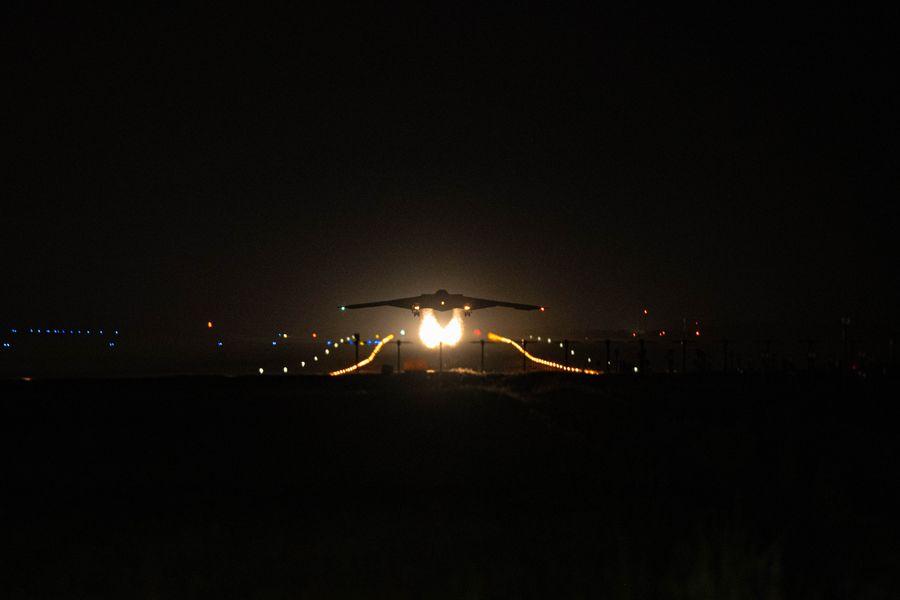
A U.S. Air Force B-2 Spirit takes off to support Operation MIDNIGHT HAMMER at Whiteman Air Force Base, Missouri, June 2025.
Why Iran is Not Vietnam
Published Nov. 23, 2026 • Read time: 5m
The current phase of U.S. military actions against Iran has now lasted seven months without a clear resolution. Trump’s inconsistent negotiation approach toward Iran has drawn comparisons to Lyndon B. Johnson during the Vietnam War. Iran is using asymmetric warfare to pressure Trump. But the Vietnam comparison overlooks several key differences that limit its usefulness: domestic legitimacy, economic vulnerability, and foreign alliances.
North Vietnamese leader Ho Chi Minh had built decades of goodwill among the country’s rural peasantry, dating back to his leading role in resisting Japanese occupation during World War II. In its war against the French and later the Americans and Washington’s southern clients, the North benefited from war weariness, the urban-rural divide, and the enemy’s lack of legitimacy. Likewise, this same establishment of domestic legitimacy, which proved to be a winning formula for the Taliban during its 2001-2021 wilderness years, also worked against an American-supported secular government in Kabul.
None of these conditions apply to Iran today, where the regime that came into power in 1979 has ruled an urbanizing country without interruption for nearly fifty years. Today, the Revolutionary Islamic government is highly unpopular among the population it governs. Decades of sanctions, censorship, and corruption have created a society that seeks change, and pre-conflict polling in Iran showed that “opposition to the continuation of the Islamic Republic” stood at over 70 percent. These numbers were even higher among urbanites, the educated, and the young.
The Pressure Is the Message: What Xi and Putin Faced in Shenzhen
Previewing The Shenzen Summit: A Critical View
What the 2026 Midterm Results Mean for U.S. Strategic Competition with Rivals
The Six Strategic Mistakes That Led to U, S, Defeat in Afghanistan
Support for the current regime was higher among more conservative Iranians, but this does not mean that most of these groups support the government in Tehran. Opinion polls showed that only 28% of rural Iranians supported the Islamic government in its current form. This suggests that the regime’s legitimacy is weak even among religiously conservative Iranians, the post-1979 government’s main political base.
Iran’s current popular support problems also stem from economics, while Hanoi had comparatively little economic activity. In contrast, Iran has a fully functioning above-ground economy, dependent on market whims, foreign powers, and the global mood.
North Vietnam, despite central planning, was agrarian and decentralized before the 1976 reunification, which is another key difference between the two countries. Its limited development and reliance on socialist partner countries like the Soviet Union and Eastern Bloc for trade made it less vulnerable to American bombing campaigns. Operation Rolling Thunder, for example, had little overall impact on North Vietnam’s ability to wage war.
The ongoing conflict with the United States has only worsened daily conditions for the average Iranian. Since the war began in February, the Iranian economy has contracted sharply, shrinking by more than 10% according to some estimates. As a result, inflation has left even upper-middle-class households struggling to afford basic goods such as food.
The clearest sign that Washington has more leverage than the popular media often portrays is Iran's recent appeal for a seven-day cease-fire to reopen the Strait of Hormuz. Iran needs the Strait open, at least temporarily, because the halt in oil exports is crippling Tehran’s economy. Fewer exports mean less funding for the Iranian Revolutionary Guard Corps (IRGC) and more hardship for ordinary Iranians. The government appears to recognize that its support is weak in Iranian society due to mismanagement, and it needs the Strait open again to ease its economic problems.
Beyond domestic troubles and economic isolation, Tehran's international alliances are also far more fragile than Hanoi's ever were. From Caracas to Beijing, Iran finds a world of mutual benefactors in sharp retreat. North Vietnam shared socialist alliances with the Soviet Union and other Eastern Bloc members.
Tehran’s two biggest great-power patrons, Russia and China, have their own problems, and the latter has reasons to be skeptical of Iran. Anti-Americanism isn’t proving as strong a bond with the outside world as socialism was, especially given that both powers have strong political and economic reasons to cut deals with the United States.
Russia’s influence in the Middle East has declined since the botched invasion of Ukraine. This is a far cry from Moscow’s role as a historic power and a patron of anti-Western forces across the region. However, the war has been a humiliating blow to Russia’s military prowess. With the collapse of Bashar al-Assad’s regime in Syria, both Moscow and Tehran have lost a key ally and a host for military bases. At the same time, Moscow has little political, economic, or military capital to spare for Tehran.
China has its own reasons to be skeptical of underwriting Tehran's asymmetric campaign. Beijing’s manufacturing-driven economy has seen reduced export demand and supply chain disruptions since the war began in February. The Iran War was surely on the agenda during President Trump’s recent meetings with Xi Jinping at the White House. Xi acknowledged that, despite public differences with the United States, it is in China’s interest for the Iran conflict to end.
China’s willingness to negotiate with the United States over Iran does not excuse Washington’s strategic miscalculations, unlike the Vietnam War. Washington clearly has the long-term upper hand because of America’s financial and military power. That matters more than short-term political speculation. Even if it’s hurtful to the Trump Administration, the continuation of the war leaves Iran as the only loser.
The Iranian state, in its current form, lacks the popular support, economic capacity, and diplomatic prestige to sustain a long-term war against the United States. This war, still largely conventional, poses the greatest challenge to the current Iranian regime’s survival since 1979.
Kevin Brown holds an MSc. in International History from LSE and has previously published in The National Interest, The American Conservative, Real Clear Defense, and The Diplomat, among other outlets.

Batteries Can Power a Win for America in Super Intelligence
By Manisha Singh • RealClearDefense
Poland’s Fighter Fleet Is Growing: Can Its Training System Keep Up?
By Bruce Allen Lubbering • RealClearDefense
Why Iran is Not Vietnam
By Kevin Brown • RealClearDefense
Closing the Missile (Defense) Gap
By Jason Camilletti • RealClearDefense
Iron Raven: Remembering Colonel Joseph B. Conmy, Jr.
By Louis Marano • RealClearDefense
Closing the Missile (Defense) Gap
By Jason Camilletti • RealClearDefense
Marine Corps Hero Under Federal Investigation
By Laporta, Burnham & Watson, CBS
A Postmortem of Maneuver Warfare in the U.S. Marine Corps
By Donald Vandergriff
U.S. Putting Weapons in Space: A Strategic Blunder?
By Ajey Lele • RealClearDefense
U.S. Senate Seeks to Exchange Shipbuilding Funds for More Munitions
By Naval News