
GBSD: An Imperative Without Delay
Last updated 04:58 PM EDT • Read time: 6m
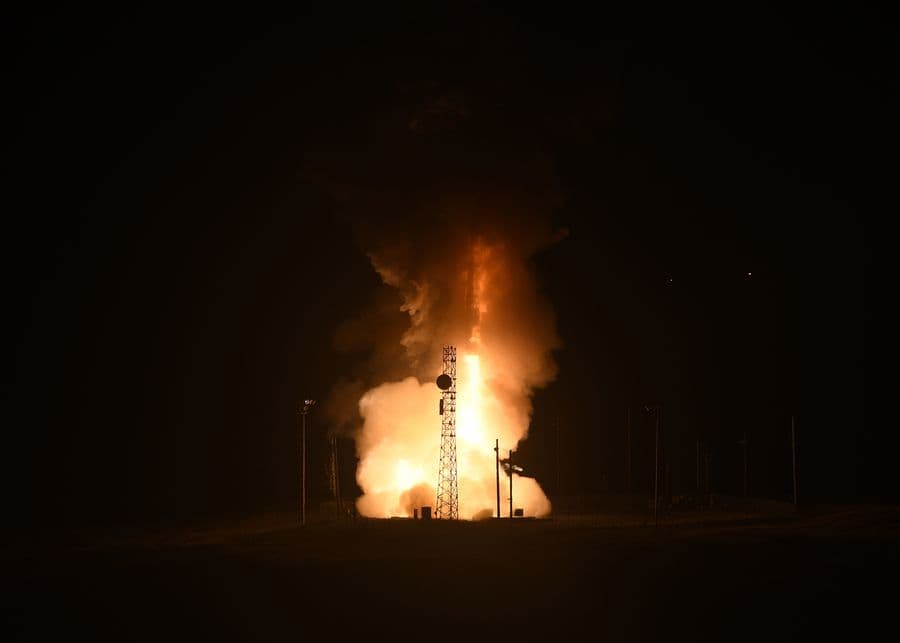
The Air Force has been working for some seven years to replace the Minuteman III ICBM, which is rapidly approaching the end of its sustainable life through the Ground-Based Strategic Deterrence (GBSD) program. After delaying the recapitalization and modernization of the legacy Minuteman III missile force for well over a decade, the Air Force is running out of time to develop and field new replacement missiles.[i] There is a debate about the merits of the Air Force acquisition strategy following Boeing's intention to depart from the competition. There are clear dangers of revising that acquisition strategy given tight timelines that outweigh the drawbacks of sole sourcing. A single [competitive] offer, while not ideal, can and has worked in the past and is different from sole source.[ii]
The Minuteman III force needs to be replaced and cannot be extended further.[iii] In an era of renewed great power competition, nuclear deterrence systems should receive top priority. It will be especially important in an increasingly competitive global threat environment to maintain a credible strategic deterrent that underpins the defense of the United States as well as our extended nuclear deterrence guarantees to our allies.[iv]
The Air Force launched an industry competition for GBSD over three years ago and has invested in reducing some technical risk through Technology Maturation and Risk Reduction (TMRR) contracts with industry. Until recently, two strong industry teams, one by Northrop Grumman and the other by Boeing, were bidding for this program.[v] Boeing then announced in July that it did not plan to submit a bid. However, Boeing is not officially out unless they do not turn in a bid by the December 2019 deadline. Of late, some in the defense community have begun calling for a national team to design and build the GBSD. In addition, some that are advocating the Air Force adopt a “national team” are also those that have denied the importance of the land-based triad altogether or believe that the land-based ICBM modernization should be deferred.[vi]
National teams do best when a single industry team cannot offer a technical solution—where there is no alternative, even if it ultimately costs more, and the path is problematic. Historically, the U.S. had used national teams out of necessity when there was no way to develop unknown technologies, and there was no industrial base. Past examples come to mind that includes atomic weapons, the first ICBMs, and NASA's mission to land a man on the moon. The GBSD program does not fall into this category.
Competitive awards do best when multiple industry teams can offer credible and competitive bids. Competition is the bedrock of American values, and it works. There are few exceptions, but as much as feasible, competition should be the foundation of U.S. acquisition. It encourages bids from industry teams that have the right mix of experience, talent, and capacity as well as a history of working together to solve very complex technical and supply chain challenges yielding lower costs and better solutions.
Nevertheless, single offers resulting from a competitive process provide the government with the benefits from competition and the ability to obtain certified cost and pricing data to ensure a fair price for the goods or services provided. There are also recent examples when the government launched an industry competition and received only one bid: GPS III, VH92A Presidential Helicopter, Armored Multi-Purpose Vehicle, and the Combat Rescue Helicopter, et al.
For GBSD to be effective and on-time, the Air Force should continue to follow the best practices of executing a major defense acquisition program, which means following the processes in place. This includes a disciplined focus on managing requirements, reducing risk, and holding contractors responsible for on-time, on-cost deliveries that meet requirements. The Air Force launched the formal competition for this program in 2016 with a strategy to deliberately develop GBSD so the system could field in the late 2020s. All indications are that the program is on track.[vii]
Changing the acquisition approach at this point would likely delay the program significantly since the Pentagon and Congressional approval process would take a considerable amount of time. It could set the GBSD program up for a "graveyard spiral" of schedule slips and cost growth. It would likely give critics of a strong nuclear deterrence an opening to either move to a dyad-only strategy that would forego the GBSD altogether or defer it.
The Air Force should be commended for pursuing a focused and disciplined acquisition strategy since 2014 with the intent to competitively award a development contract in 2020. Let us hope that our defense priorities concentrate on the most effective way to achieve the Air Force’s goal for a GBSD program that is on cost and schedule. The Air Force should be free to choose the team most qualified to safely, securely, and affordably provide the nation this critical deterrence capability in the most expeditious manner possible.
Dr. Carl Rehberg is a Non-Resident Senior Fellow at the Center for Strategic and Budgetary Assessments. He is a retired Air Force colonel and former Chief, Air Force Long Range Plans on the Air Staff.
Notes:
[i] Mark Gunzinger, Carl Rehberg and Gillian Evans, Sustaining the U.S. Nuclear Deterrent: The LRSO and GBSD, (Washington, DC: Center for Strategic and Budgetary Assessments) pp. ix-xi, 39-54, available at https://csbaonline.org/research/publications/sustaining-the-u.s.-nuclear-deterrent-the-lrso-and-gbsd. See also General C. Robert Kehler, USAF (ret.), “The U.S. Needs a New ICBM Now,“ National Institute for Public Policy, Issue No. 444, August 16, 2019, available at https://www.nipp.org/2019/08/16/kehler-c-robert-the-u-s-needs-a-new-icbm-now/
[ii] For sole source acquisition, the government typically enters into a sole source acquisition contract because there is only one company that can meet the government’s requirements and timelines without a substantial duplication of costs. For a single [competitive] offer, the government initiates a competition that may culminate in only one offer. It is not unusual for the government to receive only one proposal for some competitive programs.
[iii] Office of Secretary of Defense, Nuclear Posture Review 2018, (Washington DC: DoD, February 2018), pp. 45-46.
[iv] Mark Gunzinger, Carl Rehberg and Gillian Evans, “American’s Endangered Nuclear Deterrent: The Case for Funding Two Critical Capabilities,” War on the Rocks, April 23, 2018, available at https://warontherocks.com/2018/04/americas-endangered-nuclear-deterrent-the-case-for-funding-two-critical-capabilities/
[v] Robin Rand and Michael Fortney, “Boeing Revives Push for GBSD Teams with Northrop,” Breaking Defense, November 1, 2019, available at https://breakingdefense.com/2019/11/boeing-revives-push-for-gbsd-team-with-northrop/
[vi] Jon Harper, “Nuclear Missile Replacement Program at a Crossroads,” National Defense, August 23, 2019, available at https://www.nationaldefensemagazine.org/articles/2019/8/23/nuclear-missile-replacement-program-at-a-crossroads
[vii] Sara Sirota, “ICBM Replacement Program Moving Toward Interim Design Review This Fall,” Inside Defense, September 25, 2019, available at
https://insidedefense.com/daily-news/icbm-replacement-program-moving-toward-interim-design-review-fall

The First Test of Peace Lies in Ukraine's Borderlands
By Dennis T. Cosgrove • RealClearDefense
The VFW’s Gambling Addiction Victimizes Veterans
By Jack Yoest • RealClearDefense
Superintelligence Exposes a Gap in the Law of Delegated Authority
By Sue Ghosh Stricklett • RealClearDefense
When the Network Goes Dark, Who Controls the Battlefield?
By Jonathan K. Corrado • RealClearDefense
We Cannot Build Tomorrow's Weapons With Yesterday's Alloys
By Joseph F. Krause • RealClearDefense
When the Network Goes Dark, Who Controls the Battlefield?
By Jonathan K. Corrado • RealClearDefense
Air Force Should Buy 250 Blended-Wing Tankers, as 2027 Demo Looms
By A&SF Mag.
Long Deployments to Be Navy Standard For Next Couple Years
By Mongilio, USNI NewsWhen the Network Goes Dark, Who Controls the Battlefield?
By Jonathan Corrado, RCD
Marines Deploy Neros Archer Drone in Live Fire Exercise for First Time
By USNI News