
A Millennial's Retort: ICBMs are Essential
Last updated 12:38 AM EDT • Read time: 6m
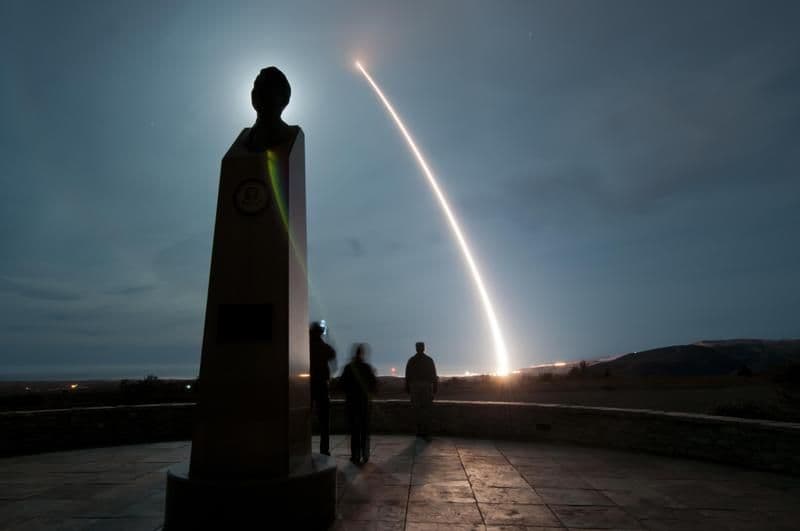
Noah Mayhew’s article titled, "A millennial's view: ICBMs are ridiculous," includes three misleading claims about intercontinental ballistic missiles: they are dangerous, they are redundant, and their cost is “ludicrous.” In this article full of misstatements and simplifications, Mr. Mayhew claims to speak for his generation, saying, "my generation is tired of seeing billions directed to dangerous, destabilizing weapons rather than to investments in our future." The weight of speaking for a generation must be great, but thankfully Mr. Mayhew is not saddled with it. I would like to offer another perspective from a different millennial: ICBMs are a wise investment in our future and should be modernized.
First, while Mr. Mayhew focuses on the "war-fighting" aspects of ICBMs for maximum scare value, the reality is that the primary day-to-day purpose of our ICBMs is to act as a visible and obvious deterrent to war. Their inherent virtue is the fact that you can count them. If you look hard enough, you can find them, and ultimately there's no mystery about what exactly they can do. The mere existence of our ICBMs presents our adversaries with a serious problem. They must decide three things: can they confidently take out hundreds of American ICBM silos spread across five states; can they evade or survive the other two legs of our nuclear triad and the rest of our military; and given all that can they still achieve the objective you sought in the first place. This is an exceedingly high bar with an extremely low chance of success. Thus, a potential adversary is dissuaded from even considering an attempted strike on the American homeland.
ICBMs are also an exceptionally reliable deterrence tool. ICBMs maintain a day-to-day posture of open-ocean targeting, and the process to adjust this is subject to multiple layers of rigorous, controlled procedures that ensure clearly communicated Presidential intent. If needed, ICBMs provide an assured response option that the President can leverage to ensure that an adversary is deterred from crossing the line. This isn’t a hair trigger, knee jerk, “pull the lever Gronk!” situation—the President is allowed time to consider options. Of the multiple options available, the ground-based leg offers the greatest responsiveness due to its readiness, reliability, and resilient communications network.
Second, our nuclear triad is designed to be redundant. Each leg of the triad reinforces the other two with unique characteristics, thus strengthening overall nuclear deterrence. Requirements from U.S. Strategic Command have informed the ongoing nuclear triad modernization, which has been structured to meet them with less capacity where possible such as replacing fourteen Ohio-class submarines with twelve Columbia-class submarines. Eliminating ICBMs while expecting to maintain deterrence at the current level would place an unacceptable burden on the other two legs of the triad. This would require either more intensive deployments for our submarine leg, placing the bomber leg on alert, increasing procurement of these platforms, or some combination of these undesirable options—all of which would cost extra money.
Third, speaking of money, modernizing our ICBMs is eminently affordable. The cost to keep our Minuteman III missiles (MMIII) operational doubled in the last fiscal year, and the cost to life-extend MMIII again is $38 billion (with a B!) higher than the cost to replace it with the Ground-based Strategic Deterrent (GBSD). For $264 billion spread out over 50 years, GBSD will ensure our continued deterrence posture through the 2070s.
The fact is that MMIII lacks capabilities that enable it to face future threats, and some of its parts are so old that contractors simply don’t know how to make them anymore. This aging system that was designed in the 1950s, fielded in the 1970s, has already been life-extended multiple times, and the window to decide to do a somewhat meaningful life extension closed years ago. On May 5 of this year, an MMIII test launch was aborted due to an unspecified error, a concerning event that also happened three years ago. When it comes to nuclear deterrence, we simply cannot accept Mr. Mayhew’s policy of intentional atrophy. We needed GBSD yesterday.
Timing is key when looking at arguments against keeping the ICBM leg of the nuclear triad, and this moment in the MMIII to GBSD transition is particularly noteworthy. Years of hand-wringing have resulted in a solid, if time-sensitive, plans to modernize and upgrade the ICBM silos, launch facilities, and missiles over the next eighteen years without a gap. Those who listen to the military experts know for a fact that there is no margin for error or delay in order to accomplish this, and so the burden is on policymakers to ensure the program is not derailed. This is the shiny opportunity that the disarmament community has been waiting for—a no-fail nuclear program still in the cradle that they can kill before it matures.
While we are debating whether to intentionally reduce our own nuclear deterrent, our adversaries are increasing their capabilities. Despite the recent extension of the New START Treaty, Russia has continued to rapidly expand its nuclear arsenal with novel strategic and non-strategic systems, including ICBMs that are designed to evade any potential defenses, while also developing next-generation missile technologies. China is actively fielding new nuclear weapons, including the recent construction of two new ICBM sites with a combined 250 silos that will host missiles armed with multiple nuclear warheads. It now boasts a nuclear triad of its own. North Korea is pursuing more advanced intercontinental and submarine-launched ballistic missiles, is expanding its ICBM program, and late last year revealed its largest-ever ICBM. Iran is making historic investments in its missile and space launch capabilities that could shorten an eventual pathway to intercontinental systems.
How can we expect to deter the likes of China, Russia, and North Korea—which all base the majority of their strategic nuclear deterrent on ICBMs—if we give ours up for free?
Unilaterally reducing America's nuclear deterrent by going from a triad to a dyad would be extremely dangerous. Choosing to eliminate our ground-based leg of the triad would send the signal that in the face of a massive nuclear buildup, we accept weakness—with no hope of reciprocal action by others. This would create entirely new threats that we would be less equipped to deter, generating new opportunities for our competitors to undermine the interests of America, our allies, and our partners.
Our generation certainly has a lot to be concerned about. Millennials have been raised in a world characterized by aspirations for global peace, undercut by decades of reckoning with terrorism, and now confronted with a return to great power competition; but instead of one nuclear-armed threat, we must reckon with multiple. We will only meet this challenge and adapt our nuclear strategy by seeing the world as it is and grappling with these threats to America and our way of life. When we do that, we should conclude that now is the moment to demonstrate resolve, commit to modernize our entire nuclear deterrent and continue to enjoy the security provided by our ICBMs.
Bryn Woollacott is an Assistant Program Manager at Systems Planning and Analysis, and previously served at the U.S. Department of Defense and Office of Management and Budget. The views expressed do not reflect the official positions of Systems Planning and Analysis or the U.S. Government.

The First Test of Peace Lies in Ukraine's Borderlands
By Dennis T. Cosgrove • RealClearDefense
The VFW’s Gambling Addiction Victimizes Veterans
By Jack Yoest • RealClearDefense
Superintelligence Exposes a Gap in the Law of Delegated Authority
By Sue Ghosh Stricklett • RealClearDefense
When the Network Goes Dark, Who Controls the Battlefield?
By Jonathan K. Corrado • RealClearDefense
We Cannot Build Tomorrow's Weapons With Yesterday's Alloys
By Joseph F. Krause • RealClearDefense
When the Network Goes Dark, Who Controls the Battlefield?
By Jonathan K. Corrado • RealClearDefense
Air Force Should Buy 250 Blended-Wing Tankers, as 2027 Demo Looms
By A&SF Mag.
Long Deployments to Be Navy Standard For Next Couple Years
By Mongilio, USNI NewsWhen the Network Goes Dark, Who Controls the Battlefield?
By Jonathan Corrado, RCD
Marines Deploy Neros Archer Drone in Live Fire Exercise for First Time
By USNI News